
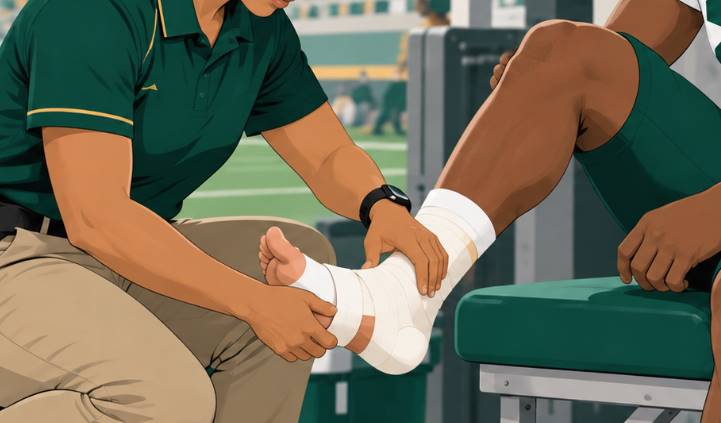
On a sideline, an athletic trainer may be the person evaluating an athlete seconds after an injury. On a normal Tuesday, the same professional might be documenting treatment, taping an ankle, running rehabilitation, reviewing an emergency plan or coordinating with a physician. That range is why the job is often misunderstood.
In the United States, an athletic trainer is a health professional, not another name for a personal trainer. Entry into the profession typically requires a master’s degree, certification and state licensure or other regulation. The work also extends beyond teams into clinics, hospitals, performing arts, public safety and other physically demanding environments.
This guide uses the latest U.S. Bureau of Labor Statistics data available as of September 26, 2026, and separates the U.S. occupation from the related Canadian title of athletic therapist.
What does an athletic trainer do?
Athletic trainers can be involved before, during and after an injury. Their exact responsibilities depend on the employer and scope of practice, but common areas include:
- injury and illness prevention programs;
- recognizing and assessing injuries;
- emergency care and first response;
- developing or supporting rehabilitation plans;
- taping, bracing and protective-equipment decisions;
- communicating with physicians and other health professionals;
- documenting injuries, treatment and return-to-activity progress;
- educating athletes, coaches and staff about health and safety;
- helping implement concussion, heat illness and emergency-action procedures.
At a sporting event, the athletic trainer may be one of the first health professionals to evaluate an injured athlete. Away from competition, much of the work can involve prevention, rehabilitation, documentation and coordination with a broader medical team.
Athletic trainer vs. personal trainer
The similar names cause persistent confusion.
| Athletic trainer | Personal trainer |
|---|---|
| Health-care profession in the U.S. | Fitness and exercise profession |
| Typically requires a master’s degree for entry | Education requirements vary |
| Works with injury prevention, assessment and care | Builds exercise and fitness programs |
| Certification and state regulation commonly apply | Certification depends on employer and market |
| May work under or alongside physicians and other clinicians | Generally does not diagnose or treat medical injuries |
A strength coach, physiotherapist, physical therapist, team physician and athletic trainer can all contribute to athlete performance or health, but their training and scope are different.
Where do athletic trainers work?
Professional teams are the most visible employers, but they represent only part of the field. Athletic trainers work in:
- high schools and colleges;
- professional and developmental sports;
- sports medicine clinics;
- hospitals and physician offices;
- rehabilitation facilities;
- military and public-safety settings;
- industrial and occupational health programs;
- dance, theatre and performing arts;
- youth and community sports organizations.
The setting changes the job. A college athletic trainer may cover practices, travel and competitions. An industrial athletic trainer may focus on injury prevention and ergonomics for workers. A clinic-based role can involve a more predictable medical schedule.
How much does an athletic trainer make?
According to the U.S. Bureau of Labor Statistics, the median annual wage for athletic trainers was $62,520 in May 2025. The lowest 10 percent earned less than $48,180, while the highest 10 percent earned more than $88,760.
Pay varies substantially by setting. BLS reported 2025 median wages of $71,810 in arts, entertainment and recreation, $64,340 in educational services, $62,690 in hospitals, $61,820 in physician offices and $61,060 in offices of physical, occupational and speech therapists and audiologists.
Those figures are occupational medians, not guarantees. Professional-team jobs can be unusually competitive, and titles can hide major differences in travel, schedule, responsibility and experience.
Athletic trainer salary at a glance
| U.S. measure | May 2025 wage |
|---|---|
| Median annual wage | $62,520 |
| Lowest 10% | Below $48,180 |
| Highest 10% | Above $88,760 |
| Arts, entertainment & recreation median | $71,810 |
| Educational services median | $64,340 |
| Hospitals median | $62,690 |
Source: U.S. Bureau of Labor Statistics Occupational Outlook Handbook, updated with May 2025 wage data.
What education does an athletic trainer need in the United States?
BLS states that athletic trainers typically need a master’s degree to enter the occupation. Entry-level professional education is completed through an accredited athletic training program, followed by the relevant certification and state requirements.
The Commission on Accreditation of Athletic Training Education accredits professional programs, while the Board of Certification administers the national certification examination. Nearly all states require athletic trainers to hold a license or certification, although the exact legal structure varies.
Anyone considering the field should verify current requirements in the state where they intend to practise rather than relying on an older article or degree description.
What do students study?
Athletic training education combines health science with applied clinical experience. Coursework can include anatomy, physiology, biomechanics, emergency care, therapeutic interventions, injury evaluation, evidence-based practice and health-care administration.
Clinical placements are important because the job requires decision-making around real athletes and patients. Students need to learn not only what an injury is, but how to communicate, document, refer and act when the situation is urgent.
Is athletic training a growing profession?
BLS projects employment of athletic trainers to grow 13 percent from 2025 to 2035, much faster than the average for all occupations. It projects about 2,400 openings per year on average over that period.
Growth can be influenced by greater attention to injury prevention, concussion management and athlete safety, as well as expansion of athletic training into settings outside traditional team sports.
What is the Canadian equivalent?
Canadian terminology is different, so U.S. and Canadian salary figures should not be treated as the same occupation automatically. In Canada, the closely related title is commonly athletic therapist. Education, certification and regulatory structures differ from the U.S. athletic trainer pathway.
Canada’s Job Bank reports wage information for the occupation “athletic therapist.” Its national data, updated November 19, 2025, shows an hourly low of C$22.00, median of C$32.00 and high of C$49.73, based on the referenced labour-market data. Ontario’s reported median is C$30.10 per hour.
Those numbers are useful for Canadian context, but they should not be converted directly into a U.S. athletic-trainer comparison without considering differences in classification, credentials, employment structure and currency.
What makes the job challenging?
The work can be physically and emotionally demanding. In team settings, athletic trainers may work evenings, weekends and long competition days. Travel can be significant. Emergencies require calm decisions under pressure.
There can also be competing incentives. Athletes want to play. Coaches want available rosters. Teams want performance. The health professional’s responsibility is to operate within clinical standards even when the competitive environment creates pressure.
What makes a good athletic trainer?
Technical knowledge is essential, but the role also depends heavily on communication. Strong athletic trainers can explain an injury to an athlete, communicate restrictions to a coach, document treatment for a medical record and coordinate with physicians or therapists.
Other valuable qualities include attention to detail, emergency readiness, empathy, professional boundaries, organization and the ability to make decisions when information is incomplete.
Frequently asked questions about athletic trainers
Is an athletic trainer a doctor?
No. Athletic trainers are health professionals, but they are not physicians. They commonly work within a broader health-care team and refer patients when physician or specialist care is required.
Is an athletic trainer the same as a physiotherapist or physical therapist?
No. The professions overlap in some rehabilitation settings, but education, licensing and scope of practice differ.
How much do athletic trainers make in the United States?
The U.S. median annual wage was $62,520 in May 2025, according to the Bureau of Labor Statistics.
Do athletic trainers need a master’s degree?
For entry into the U.S. profession, athletic trainers typically need a master’s degree. Prospective students should verify current accredited-program and state requirements.
What is an athletic trainer called in Canada?
The related Canadian profession is commonly called athletic therapy, and practitioners may use the title athletic therapist. Canadian credentials and regulation are not identical to the U.S. athletic training system.
Current data: U.S. Bureau of Labor Statistics and Government of Canada Job Bank.
This article is educational and does not provide medical, licensing or career-placement advice. Requirements change, so verify them with the relevant professional and regulatory bodies.
The people learning about sport careers here could be your next applicants.
Turn your next opening into a professional Sports Hired listing and give candidates a clear path from career research to your opportunity.
Have experience with this topic?
Help make this SPMA resource better with a first-hand perspective, practical addition, or question. Use your SPMA account or contribute as a guest.