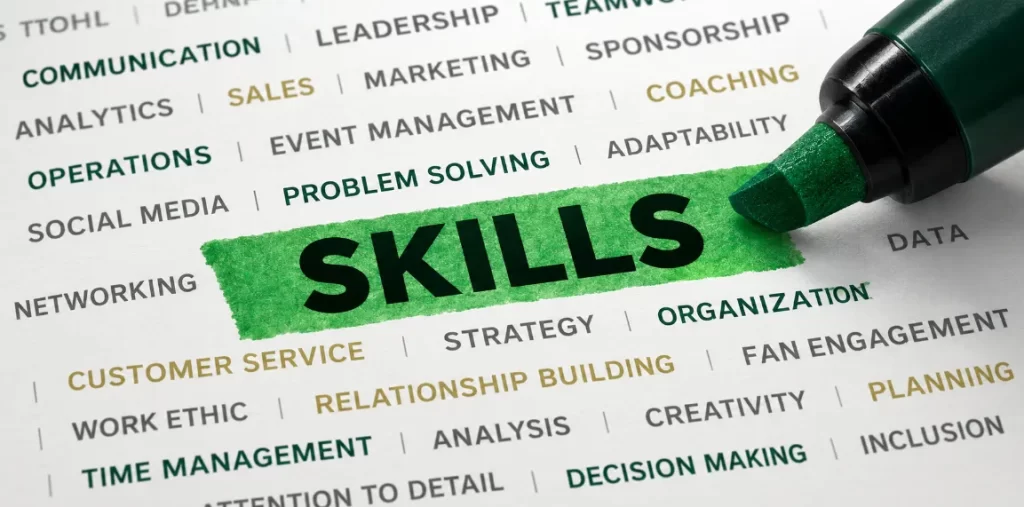
Sports employers do not hire a vague quality called “passion.” They hire people who can sell, analyze, organize, communicate, build relationships, solve problems and make the fan or athlete experience better. Passion can help a candidate understand the product and speak the language of the industry, but the job offer usually depends on whether that person can do useful work.
That distinction matters because the sports business has become more sophisticated. Teams and leagues are building year-round content operations, first-party data programs, membership and ticketing systems, partnership portfolios, community programs and technology workflows. Deloitte’s 2026 sports industry outlook describes artificial intelligence as an increasingly important operating layer inside sports organizations, not simply a consumer-facing novelty. That creates demand for people who can combine judgment with technology instead of treating the two as separate worlds.
What skills do sports employers look for most?
The answer depends on the department, but several abilities travel well across sports organizations. Communication sits near the top because almost every role serves a customer, colleague, athlete, sponsor, media partner or community stakeholder. Relationship management matters for the same reason. Sports is a networked business. Revenue teams manage accounts, operations teams coordinate vendors, communications teams work with journalists and creators, and event staff have to solve problems in real time with many people watching.
Project management is another quietly valuable skill. A season is a sequence of deadlines: ticket campaigns, sponsor assets, game presentation, community events, roster announcements, travel, content shoots and reporting cycles. Candidates who can turn a goal into tasks, owners and timelines are useful in almost any department.
Business skills are still the foundation
Many sports jobs sound unique because the setting is unique, but the underlying work often looks familiar. A partnership sales representative is still doing consultative selling. A ticketing manager is still working with segmentation, pricing, service and retention. A team marketer is still trying to understand an audience and create demand. A finance department still needs budgeting, forecasting and controls.
- Sales and persuasion: useful in partnerships, ticketing, premium seating, fundraising and business development.
- Customer service: essential in membership, hospitality, fan experience and community-facing roles.
- Writing and presentation: important for communications, social media, sponsorship decks, proposals and internal reporting.
- Budget awareness: useful even when finance is not in the job title. Sports organizations operate under real cost constraints.
- Negotiation: valuable when working with vendors, talent, partners, venues or rights holders.
A candidate does not have to master all of these at once. The better approach is to understand which two or three business skills define the role you want and develop evidence around those.
Digital fluency now reaches almost every department
“Digital” is no longer a department tucked beside marketing. Ticketing systems, CRM platforms, social analytics, sponsorship measurement, email marketing, ecommerce, digital signage and internal workflow software touch large parts of a modern organization. Even if you never write code, you should be comfortable learning tools, exporting data, checking results and explaining what the numbers mean.
For marketing and communications candidates, that may mean content management systems, social publishing, email platforms, paid media dashboards and basic creative tools. For revenue roles, it may mean CRM hygiene, pipeline reporting and account notes. For analysts, it may mean SQL, Python, spreadsheets, visualization tools and a strong understanding of data quality.

The important skill is not memorizing every platform. Software changes. Employers benefit from people who can learn systems quickly and understand the business process underneath them.
Data literacy is becoming a career multiplier
You do not need to become a data scientist to benefit from analytical thinking. Data literacy can be as simple as knowing how to structure a spreadsheet, calculate a conversion rate, compare a campaign against a baseline and notice when a conclusion is not supported by the sample.
For candidates who do want a technical path, the broader labor market shows why the skill set has value. The U.S. Bureau of Labor Statistics reported a May 2025 median annual wage of $120,230 for data scientists and projected 35% employment growth from 2025 to 2035. Sports-specific analyst compensation can differ significantly by employer and level, but the benchmark shows the demand surrounding advanced analytical capability.
In sport, analytics can support player evaluation, pricing, sponsorship measurement, fan segmentation, content strategy, venue operations and forecasting. The strongest analysts also know how to explain a result to someone who does not live in a dashboard.
What soft skills actually matter in sports?
“Soft skills” can sound like filler, so translate them into observable behavior. Communication means sending the right information before a deadline. Adaptability means changing a run-of-show when weather, travel or technology changes. Leadership means creating clarity when a group is unsure what to do next. Attention to detail means the sponsor logo is correct, the credential list is accurate and the ticket offer points to the right event.
Sports can be intense because the product is live. That makes composure and judgment valuable. Hiring managers often remember candidates who can describe a difficult situation, explain the decision they made and show what happened afterward.
How can you prove these skills without years of sports experience?
Build evidence before you have the title. Run social content for a campus organization. Create a mock sponsorship proposal for a local club. Analyze publicly available attendance data. Volunteer in event operations. Sell memberships for a student organization. Build a small portfolio that shows the quality of your thinking and execution.
A useful portfolio does not need to be flashy. One page that explains the problem, your role, what you did and the result is often more persuasive than a list of adjectives on a resume. Whenever possible, include numbers: revenue influenced, registrations generated, open rate improved, response time reduced, people served or projects delivered.
How should you read a sports job posting?
Ignore the title for a moment and look at the verbs. If a posting repeatedly says “sell,” “renew,” “prospect” and “activate,” it is a revenue role even if the title sounds broad. If it says “analyze,” “report,” “forecast” and “visualize,” the employer is telling you where the value sits. If it says “coordinate,” “execute,” “schedule” and “support,” operational reliability may matter more than strategic theory.
Then look for repeated tools, stakeholders and outcomes. Those three categories tell you what to feature in your resume and interview stories. Matching a resume is not about copying keywords. It is about showing relevant evidence in the employer’s language.
Live Sports Hired skills snapshot
[spma_evergreen_jobs_snapshot mode=”skills”]
Frequently asked questions
Do I need to play sports to work in sports?
No. Playing experience can help in certain performance, coaching or scouting roles, but most business-side positions depend on the same professional skills used in other industries. Teams need accountants, sellers, marketers, analysts, designers, technologists, event operators and communications professionals.
What is the best skill to learn first?
Choose the skill closest to the job you want. For partnerships, practice sales and account management. For marketing, learn audience strategy, content and measurement. For analytics, strengthen spreadsheets, SQL and data storytelling. A targeted skill with proof is more useful than collecting unrelated certificates.
Does networking matter more than skills?
Networking can help you become visible, but skills determine whether a conversation becomes an opportunity. The most durable approach is to build both at the same time: do good work, document it, meet people and make it easy for them to understand what you can contribute.
Have experience with this topic?
Help make this SPMA resource better with a first-hand perspective, practical addition, or question. Use your SPMA account or contribute as a guest.