


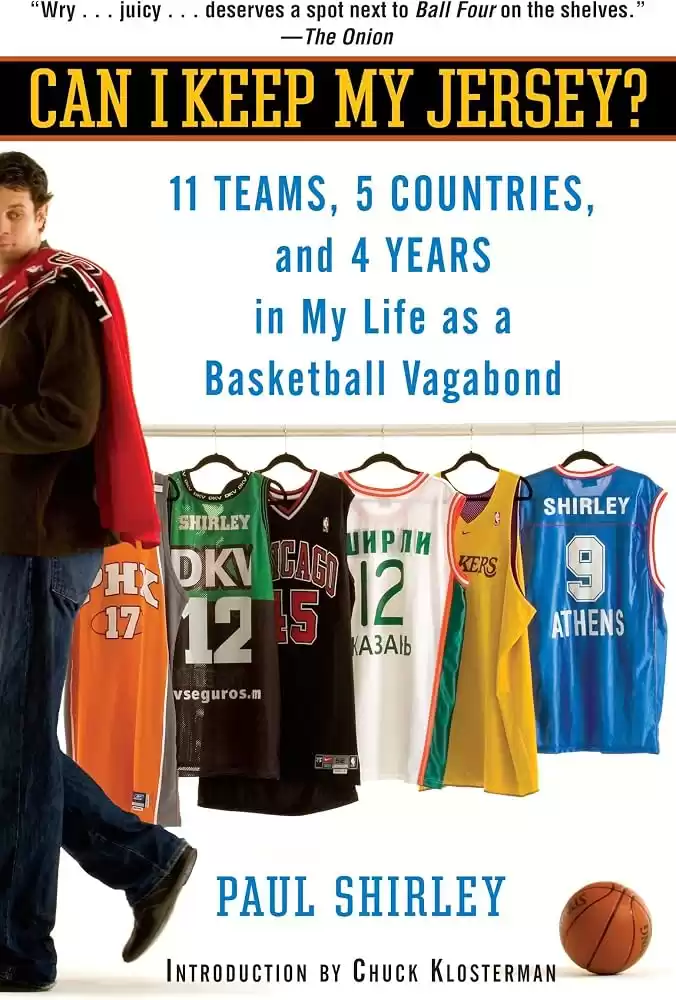
Most NBA books begin when an athlete has already become indispensable. Paul Shirley begins closer to the exit door. Published in 2007, his memoir, whose full subtitle is 11 Teams, 5 Countries, and 4 Years in My Life as a Basketball Vagabond, recounts an itinerant career through NBA opportunities, minor leagues, and overseas assignments. Shirley played at Iowa State before trying to establish himself professionally, but the organizing fact of this narrative is uncertainty. Each new destination means unfamiliar coaches, new teammates, and the possibility that a promising opportunity may last only a few games. The book's sharp humour is not an alternative to the economics of that arrangement; it helps expose them.
The Shelf · Books
Can I Keep My Jersey?
By Paul ShirleyReleased 2007Curated by SPMA Hub because sport culture lives beyond the field.
Paul Shirley's Can I Keep My Jersey? finds a sports-business story in the transaction every fan forgets: the player who never knows whether he will still have a job next week.
The Shelf
The Gist
Why it caught our attention
At A Glance
Paul Shirley's Can I Keep My Jersey? finds a sports-business story in the transaction every fan forgets: the player who never knows whether he will still have a job next week.
About This Shelf Item
About Can I Keep My Jersey?
Shirley's experience makes visible the enormous population of professional players who have neither a secure roster place nor a guaranteed future. A player without a franchise's investment behind him may have to prove his usefulness in a handful of practices while learning a system built for people who already belong. Overseas moves introduce another set of challenges: adjusting to a different league's expectations, training habits, language, and everyday life. The memoir also presents the disparities between the comforts available on an NBA road trip and the comparatively improvised arrangements elsewhere. Shirley can be irreverent about the culture surrounding basketball, but the useful distinction is between jokes about an absurd situation and a first-hand record of how precarious this occupation can be.
Why It Belongs
The Sport Connection
For sports management, the book raises questions about what organizations owe athletes who sit at the edge of their plans. Teams speak about depth and flexibility as competitive advantages. From the individual's perspective, that flexibility can mean sudden travel, interrupted housing, and little time to establish a support network. Contract structure, roster rules, immigration paperwork, health coverage, and communications from staff are not background administration for the player concerned. They determine whether the next assignment is workable. Shirley's account also shows why scouts cannot assess a marginal player solely by the minutes that appear in an NBA box score. Performance depends on clear role expectations and the circumstances in which an athlete is asked to contribute.
Our Recommendation
Why Read Can I Keep My Jersey?
The most interesting discussion may be about the evaluation process. An organization may believe that bringing in another player for a short audition is low risk; for that player, the decision involves moving across the country for a chance that may disappear quickly. Where does responsibility begin and end? How should front offices communicate an honest assessment without closing off future relationships? How can player-development staffs maintain continuity when the roster is intentionally fluid? Those questions apply well beyond basketball. Minor-league hockey, lower-division football, and international talent pipelines all depend on people whose work is essential but whose contracts are temporary. The memoir is a reminder that efficiency measures can have a substantial human dimension.
One less visible issue is information asymmetry. A team can evaluate many candidates simultaneously; an individual player may learn only after arriving whether there is a realistic vacancy. Clear communication will not remove every uncertainty in professional recruitment, but it may reduce needless disruption. Shirley's account also invites comparisons between NBA and international structures. Working abroad is not automatically a fallback of lower professional value. It can provide a different competitive environment, a more stable role, or practical demands that make a later transition easier. A responsible career adviser should help an athlete compare those trade-offs instead of judging success solely by proximity to an NBA bench.
Final Thoughts
Arash's Final Thoughts
Can I Keep My Jersey? earns a Shelf place precisely because Shirley is not telling the story of a dynasty. The book describes professional sport from a position where every contract and call-up matters more than any endorsement. Its value is not a formula for building a winning team. It is an unusually candid perspective on the labour market that makes a team possible, and on the dignity, patience, and institutional care required for people competing for its final roster spot. Readers interested in scouting, player services, or league operations will find plenty to question after the jokes have landed.
Keep Exploring
More On The Shelf




Copied
