The Charlotte Hornets fill their breaks with a mix of music, comedy and local tie-ins. A fan game puts a joke behind a shot. A Thanksgiving menu game brings the holiday into the building. A segment brings Roy Williams and North Carolina into the arena. The Honeybees and a halftime act take the floor. Those choices make this Charlotte Hornets game day presentation worth studying.
This case study follows the in-arena show at the Hornets’ game against the Chicago Bulls at Spectrum Center in Charlotte on November 25, 2026, from the national anthem and starting lineup intros through the first-half breaks and the halftime entertainment. Eight clips show the moments, and the list below lets you jump to each one.
This analysis is for educational purposes.
The anthem opens the night at Spectrum Center
The national anthem opens the Charlotte Hornets game day presentation. The video board runs a waving American flag, then the camera finds the vocalist, who sings the anthem with a Hornets-branded microphone on the floor of Spectrum Center. The clip is short, about 30 seconds, and it keeps the focus on the singer and the flag.
Starting with a quiet, shared moment gives the production a clean reset before the noise begins. It is also the one part of the night every team runs, which makes it a useful baseline when comparing how different arenas handle the same ceremony.
Starting lineup intros turn names into an event
Starting lineup introductions are where the Hornets move from ceremony to show. The arena goes dark, the lights and the ring of video boards take over, and the players come through a line of teammates before the group gathers in a huddle on the floor.
This is the point where a crew can show its brand. The intros are short, but the darkness, the light show and the players’ entrance tell fans the game is about to start and give the arena its first big burst of energy.
A Thanksgiving menu game brings the holiday into the arena
With Thanksgiving the next day, the Hornets build a bit around the holiday meal. The video board shows a Thanksgiving menu with a $15 budget, where meats and sides are priced at $5, $3 and $2, such as prime rib, mac ’n’ cheese, turkey and stuffing, while a running “spent” total counts up. Players appear on the board reacting to their choices, and courtside the hosts keep the bit going while the Hornets mascot and a person in an inflatable turkey costume join them on the floor.
Timely bits are a low-cost way to make a regular-season game feel specific. A holiday menu is easy for any fan to understand in a few seconds, and it gives the board, the hosts and the mascot something to play with together.
Shoot for the Punchline turns a stoppage into a fan game
Shoot for the Punchline puts a fan in the spotlight at center court. A host with a Hornets-branded microphone talks to a fan in a Hornets jersey holding a basketball while the arena watches, and a “Shoot for the Punchline” graphic runs on the video board. The same clip includes a Black Friday “No Fees” promotion on the board, which shows how the show makes room for sponsor and ticket messages between bits.
Games like this give the crowd a person to root for and a result they can follow in real time, which is why contests are a staple of NBA game day entertainment. The joke format also gives the host material to work with, so the energy stays up whether the shot goes in or not.
Crowdsourcing brings Roy Williams and UNC into the show
In the crowdsourcing segment, a host in a gold jacket takes the microphone into the stands and talks to fans, from a young fan in a teal Hornets cap to a dad with a baby. The segment also brings Roy Williams and North Carolina into the arena, a nod to a state where college hoops loyalty runs deep.
Taking the mic into the seats puts the crowd at the center of the show. Local connections like this help a team feel rooted in its market, and a familiar face lets the arena celebrate more than one team’s fans in the same building.
The Honeybees get a full break to themselves
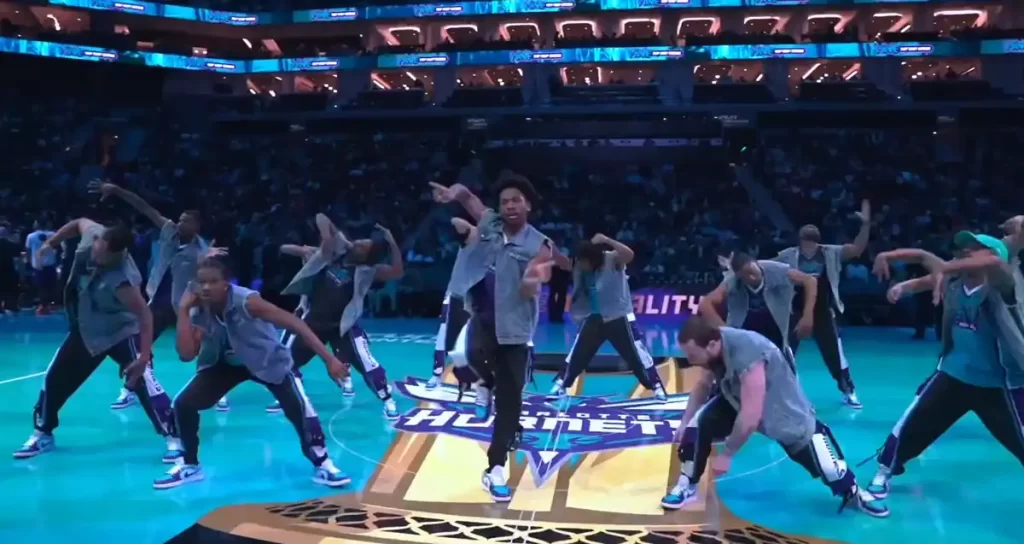
The Honeybees, the Hornets’ dance team, take over a break with a routine in teal uniforms on the floor, with the ring of video boards lit above them. The clip ends with the camera finding fans in the seats reacting to the show.
A dance team carries team branding on the floor, from the uniforms to the choreography. It gives the in-arena show a recurring act fans come to expect and look forward to.
The T-shirt toss keeps a classic break moving
The T-shirt toss is one of the oldest crowd moments in sports, and the Hornets keep it in the rotation. A host at courtside sets it up, a neon “T-SHIRT TOSS” graphic fills the video board, and kids and adults in the seats stand and reach for shirts as the camera finds their reactions.
It is easy to run, easy to understand and gives sponsors a visible, physical item to attach their name to. Its simplicity is what lets it fill a stoppage without needing any explanation.
Halftime hands the floor to Rialcris
The longest clip in this case study is the halftime entertainment, where Rialcris takes the floor. The act is a three-person acrobatic team that performs balances and lifts on the center-court Hornets logo, with “Hive Mentality” lettering glowing across the video boards behind them and a camera that moves in close on the holds and out wide for the full-arena view. Halftime is the biggest open window of the night, and teams usually give it to an act that can hold a full arena’s attention.
Booking an outside performer gives fans something different from the rest of the in-arena show. It also gives the performer an audience, which is part of why halftime slots are sought after.
A Thanksgiving-eve night in Buzz City
The game in these clips was played on November 25, 2026, the night before Thanksgiving. That timing explains the holiday theme: the Thanksgiving menu game and the Black Friday promo inside the Shoot for the Punchline segment were built for this specific week, not for a generic home date.
The building is part of the story. Spectrum Center opened in 2005 and seats 19,077 for basketball, so a full crowd leaves very little empty space for the production to work around. The Hornets also set a franchise record for sellouts at Spectrum Center during the 2025–26 season, Axios Charlotte reported. A team with a busy building and a “Buzz City” identity can lean on the room, which shows up in how many of these bits put fans, not the team, in front of the camera.
Several of the pieces have deep local roots too. The Honey Bees dance team goes back to 1988, the franchise’s first season, and has carried different names since then, including the Lady Cats from 2002 to 2014. The teal-and-purple look, the hornet logo on the center court and the Buzz City branding on the singer’s microphone all tie each moment back to the same identity.
What the Charlotte Hornets game day presentation teaches about pacing a night
Match each break to its length. The anthem and lineup intros open the night, short bits like the T-shirt toss and the fan game fill the quick timeouts, the Honeybees and the local tie-ins give the first half its identity, and the halftime act takes the biggest window. Each piece is a different size, so no break feels like a repeat of the last one.
This is part of SPMA’s NBA Game Day Presentation series, which is following the in-arena show across all 30 teams. Read the Sacramento Kings game day presentation case study or the Utah Jazz game day presentation case study for more looks at how an NBA crew uses the floor, the board and the stands, or see all 30 teams in the series.
Related organizations

Have experience with this topic?
Help make this SPMA resource better with a first-hand perspective, practical addition, or question. Use your SPMA account or contribute as a guest.