The New York Knicks fill their breaks with moments only the Garden can offer. A seat upgrade sends a fan toward Celebrity Row, where actor Sarah Pidgeon gets her moment on the video board. A lyric game gets the whole arena singing. The Air Elite Dunkers take over the longest break. Those choices make this New York Knicks game day presentation worth studying, because it comes from the reigning NBA champions in one of the most famous arenas in the world, a team that does not have to lean on game day entertainment the way most teams do.
This case study follows the in-arena show at the Knicks’ game against the Cleveland Cavaliers at Madison Square Garden in New York on November 25, 2026, from the national anthem through the first-half breaks and the dunk show. Six clips show the moments, and the list below lets you jump to each one.
This analysis is for educational purposes.
The reigning champions do not need a nonstop show
The Knicks came into this night as the reigning NBA champions. They beat the San Antonio Spurs 4–1 in the 2026 NBA Finals and clinched on June 13, 2026 with a 94–90 win in Game 5, the franchise’s first title since 1973. A team with that story has a different job on game day. The fans in the building already know why they came.
The building does a lot of the work too. Madison Square Garden has been the Knicks’ home since 1968, which makes it the oldest arena still in use in the NBA, and it is the only NBA arena that is not named after a corporate sponsor. The history, the name and the crowd noise are all part of the show before a single graphic hits the video board.
That helps explain what the clips show. The Knicks do not need to fill every stoppage with entertainment the way many teams do. The breaks in this case study are short, well placed and built around the Garden itself: a seat upgrade, a sing-along, a sponsor-presented T-shirt toss and one longer dunk show. Everything else is left to the atmosphere.
The Knicks are also one of the few NBA teams that run the night without an in-arena host. No one stands at center court to lead the crowd from one break to the next. The video board, the lower-thirds, the music and the fans do that job instead, and the show keeps its pace without a voice on the floor. Many teams build their game day around a host, so this is a clear choice to study.
The anthem opens the night at Madison Square Garden
The national anthem opens the New York Knicks game day presentation. The Garden quiets, attention moves to center court and the show holds until the last note is done.
Starting with a shared, quiet moment gives the production a clean reset before the energy builds. It is also the one ceremony every team runs, which makes it a useful baseline when comparing how different arenas handle the night.
A seat upgrade puts a fan in Celebrity Row
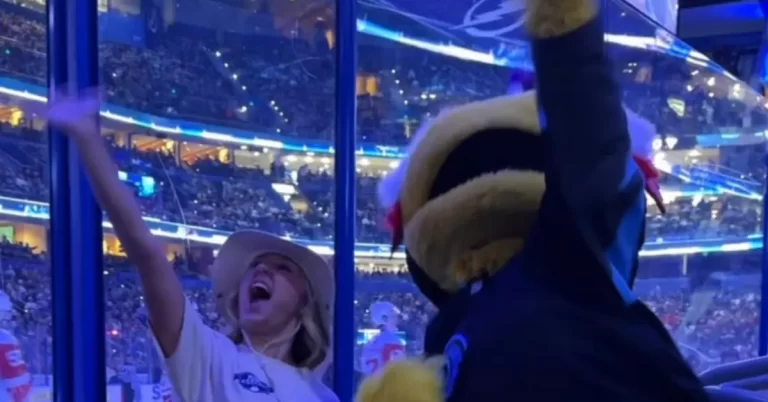
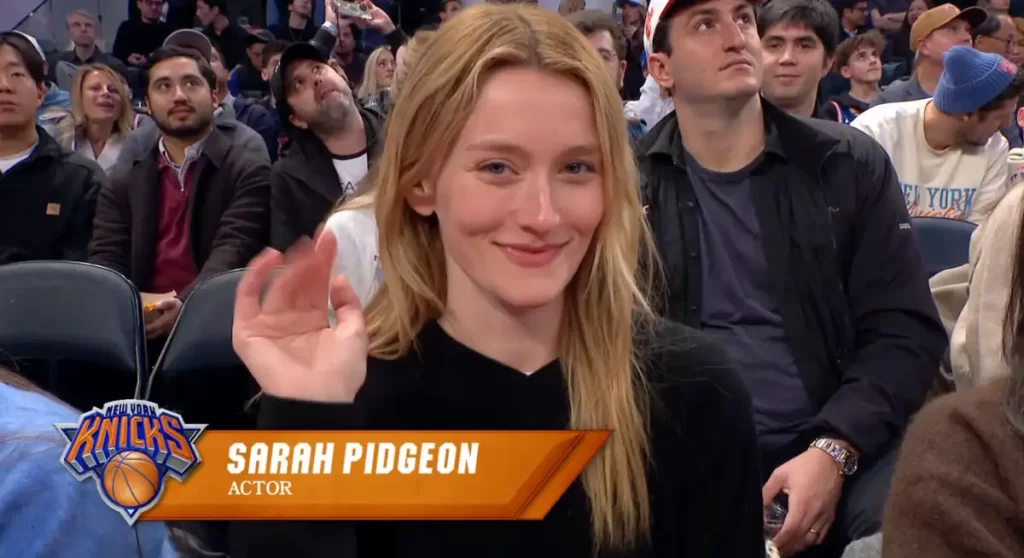
The Knicks run a seat upgrade moment during the break: a “Congratulations, seat upgrade” sign goes up on the video board, a seat-map graphic shows where the fan is moving, and the cameras catch the reaction. Celebrity Row is part of the same stretch of the show.
The Celebrity Row segment is also a sponsor and promotion showcase. The video board runs an MSG Snow Village promo for the model-train display at Chase Square, which opens at 10:00 a.m. daily, then plays scenes from the Kennedy-family series that Sarah Pidgeon stars in. A razr-branded Celebrity Row graphic with the Knicks logo follows. Pidgeon herself appears on the arena feed with a lower-third that gives her name and the word “Actor,” and she waves to the camera while the board shows her to the building.
The promo and the guest cam work as a pair. Fans see the show first and meet the person from it a few seconds later, which turns a guest appearance into a reason for the whole arena to look up. The same moment gives a sponsor a title graphic and gives the Knicks a way to treat a celebrity in the stands like a featured guest instead of a name on a list.
The idea works because the prize is the venue itself. Seats near the court are part of the New York Knicks brand, and giving one away connects a single fan to the thing everyone in the arena is looking at.
The T-shirt toss keeps a classic break moving
The T-shirt toss is presented by Champion, and the Knicks open it with a full video-board intro graphic before the dancers take the floor. The same clip includes a Season Ticket Member of the Game feature that puts a loyal fan’s name and favorite memory on screen.
The sponsor name sits on the graphic and in the corner of the screen for the whole bit, so it earns its place without interrupting the fun. Pairing the toss with a season ticket holder feature gives the crew a second reason for fans to look up.
Finish the Lyric gets the Garden singing with the Baha Men
Finish the Lyric turns the crowd into the performers. A contestant has to complete song lyrics for a prize that rises from $250 to $750 as songs are added, and the Baha Men appear in the crowd for the final lyric. The contestant, named on screen as Krystal R. on a Finish the Lyric Contestant lower-third, works the stands with a Knicks-branded microphone while fans in Knicks jerseys sing along. A prize counter in the corner of the screen climbs as songs are added, reading $500 for two songs and $750 for three. The final lyric is the Baha Men’s “Who Let the Dogs Out,” and the Garden answers the line. A sing-along gives fans something to do with their voices and a reason to look up at the video board.
Music games like this work because everyone already knows the material. The crew only has to start the line, and the arena fills in the rest.
Putting the contestant in the stands instead of on the floor keeps the energy in the crowd, and the rising prize counter gives viewers a clear reason to stay for the next song. Bringing in the Baha Men for the finish gives the bit a payoff that the arena can share.
The Running Man gives a stoppage a signature move
The Running Man Cam puts a neon video-board graphic on screen and then finds fans in the stands doing the dance. Later in the same clip, the board shows a Thank You, NYPD message during a timeout.
Dance challenges travel well on video, which matters for teams that share their game day moments online. A short, repeatable move is easy for both the arena and a social clip.
The Air Elite Dunkers fill the longest break
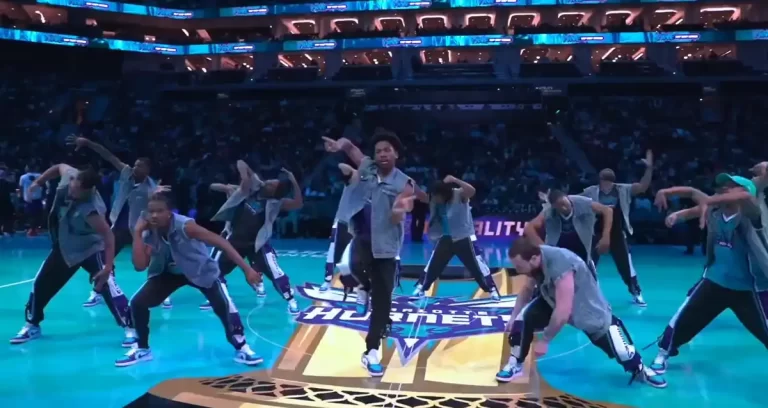
The Air Elite Dunkers get the longest clip in this case study, running just over six minutes. A video-board graphic introduces the halftime entertainment, then the dunk show takes the floor with the group’s logo in the corner of the screen.
Athletic acts like this give the building a spectacle that does not depend on the score. It is a natural fit for a break long enough to need more than a single quick bit.
What the New York Knicks game day presentation teaches about pacing a night
Let the brand carry the night. A champion in the most famous arena in the league can run a lighter show and still hold the crowd. Teams without that built-in pull can still copy the idea: pick a few signature moments instead of filling every break, and let the venue do the rest.
Use the building you have. Celebrity Row, the video board, the crowd’s voice and the hoop all show up in different clips. The show is built from what makes the Garden different, so each break feels like it belongs to this arena and not to any other.
This is part of SPMA’s NBA Game Day Presentation series, which is following the in-arena show across all 30 teams. Read the Sacramento Kings game day presentation case study or the Utah Jazz game day presentation case study for more looks at how an NBA crew uses the floor, the board and the stands, or see all 30 teams in the series.
Related organizations
 New York KnicksNew York, NY, United StatesView company
 National Basketball Association (NBA)New York, NY, United StatesView company
 Madison Square GardenNew York, NY, United StatesView company
 Cleveland CavaliersCleveland, OH, United StatesView company
 MSG NetworksNew York, NY, United StatesView company
 San Antonio SpursSan Antonio, TX, United StatesView company
Have experience with this topic?
Help make this SPMA resource better with a first-hand perspective, practical addition, or question. Use your SPMA account or contribute as a guest.