
The Shelf · Movies

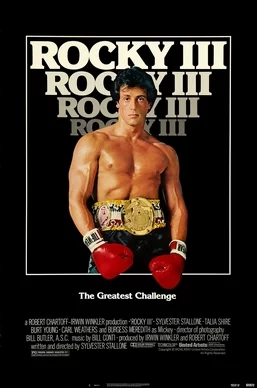
Rocky III

Released 1982Curated by SPMA Hub because sport culture lives beyond the field.

Rocky III turns success into a problem of perception. Rocky Balboa has learned how to live as a champion, but the comforts surrounding him have made it harder to judge his readiness for someone who has built an entire ambition around taking that status away.

Alex Bennett
Covered by Alex Bennett
The Shelf
Rocky III
Rocky III
The Gist Of Rocky III

The Gist

Why it caught our attention

Sylvester Stallone's 1982 sequel introduces Mr. T as Clubber Lang, a forceful challenger to Rocky's heavyweight title. Carl Weathers returns as Apollo Creed, whose role changes from rival to mentor. Talia Shire and Burgess Meredith remain central to the personal relationships around Rocky's career.

The film begins with the champion enjoying the rewards of his position. Public appearances and commercial attention have become part of the job. Lang's challenge exposes the distance between being recognised as the best and continuing to prepare for the hardest available opposition.
At A Glance

Rocky III turns success into a problem of perception. Rocky Balboa has learned how to live as a champion, but the comforts surrounding him have made it harder to judge his readiness for someone who has built an entire ambition around taking that status away.

About This Shelf Item

About Rocky III

Rocky's relationship with Mickey becomes more complicated when protection and honest assessment no longer appear identical. A trainer may believe he is looking after an athlete while filtering the challenges that athlete faces. The discovery unsettles Rocky because it changes his understanding of what his recent success has actually demonstrated.

Lang's aggression makes the threat immediate, but the deeper problem is Rocky's loss of confidence in his own competitive foundation. He must face more than a powerful opponent. He has to reconsider the story he has been telling himself about the champion he has become.

Apollo's offer of help changes the emotional structure of the series. The former opponent understands both the skills Rocky lacks and the burden of a damaged public image. Their cooperation depends on accepting that a rival can possess knowledge unavailable within the familiar circle of support.

Adrian's role remains essential because the obstacle is not purely physical. Rocky's reluctance to admit fear interferes with his ability to respond to it. The film gives their conversation a significance that training alone cannot replace, making emotional honesty part of the preparation rather than an interruption of it.

Why It Belongs

The Sport Connection

Rocky III offers a clear discussion of the difference between confidence and accurate feedback. Repeated success can strengthen an athlete while also protecting him from information he needs. A support team that values reassurance above candour may leave a champion less prepared for the next serious test.

The shift to Apollo's training approach also makes adaptation visible. Rocky cannot solve the new problem simply by repeating the preparation that once worked. He must accept unfamiliar methods and a different understanding of how to use his body, while resisting the temptation to interpret learning as proof that his earlier success was false.

The former rivalry adds another useful point. Competitive relationships can contain respect and detailed knowledge even when the public sees only opposition. Apollo's contribution comes partly from having studied Rocky as someone he needed to beat. That experience becomes valuable when the purpose of the relationship changes.

Our Recommendation

Why Watch Rocky III

Watch Rocky III for the way it tests a familiar hero after he has obtained the rewards he once wanted. The film's fast pace and emphatic music make the comeback highly accessible, but the underlying question is more precise than a general instruction to work harder: what has success made Rocky unwilling to see?

Lang is presented in broad, intimidating strokes, so the richest character work lies around Rocky rather than in a balanced account of both fighters. Keeping that dramatic choice in view helps distinguish the film's emotional logic from a complete understanding of the challenger as a person.

Final Thoughts

Alex's Final Thoughts

Rocky III makes renewal depend on admitting vulnerability. The champion's next step becomes possible only when he stops defending an image of invulnerability and accepts help from an unexpected source. Its lasting sporting idea is that staying capable may require learning from the person who once understood your weaknesses better than anyone else.
