
The Shelf · Movies

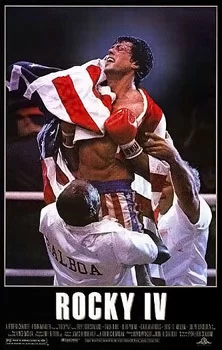
Rocky IV

Released 1985Curated by SPMA Hub because sport culture lives beyond the field.

Rocky IV makes a boxing match carry the weight of a geopolitical fantasy. Rocky Balboa confronts Ivan Drago in a story where training methods, bodies, entrances and even the crowd are organised into an argument about national identity as much as athletic ability.

Alex Bennett
Covered by Alex Bennett
The Shelf
Rocky IV
Rocky IV
The Gist Of Rocky IV

The Gist

Why it caught our attention

Sylvester Stallone's 1985 film introduces Dolph Lundgren as Drago, a Soviet boxer presented as a formidable product of an elaborate performance system. Carl Weathers returns as Apollo Creed, whose exhibition encounter with Drago turns the story from public spectacle into personal tragedy. Rocky's response drives the remainder of the film.

The review here concerns the original theatrical version, whose tone and structure are strongly associated with its 1980s setting. The later recut makes different editorial choices. In the original, music, montage and sharply drawn national contrasts often communicate as much as extended dialogue.
At A Glance

Rocky IV makes a boxing match carry the weight of a geopolitical fantasy. Rocky Balboa confronts Ivan Drago in a story where training methods, bodies, entrances and even the crowd are organised into an argument about national identity as much as athletic ability.

About This Shelf Item

About Rocky IV

Apollo's involvement establishes the danger of treating reputation as protection. His confidence in his public identity and his ability to command an event meets an opponent who does not participate in the occasion on the same terms. The exhibition's pageantry cannot control what happens when the fight becomes physically serious.

Rocky's decision to face Drago is therefore shaped by grief and responsibility rather than a conventional climb toward a title. Adrian's opposition makes the risk personal. She can see that his need to act may be inseparable from emotions that do not provide a reliable assessment of what another fight will cost.

The contrasting training sequences give the film its clearest visual argument. Drago works amid technicians and machines, while Rocky prepares in an austere rural environment. The opposition is deliberately symbolic, connecting Rocky with self-reliance and Drago with institutional control rather than offering a balanced account of training science.

The final contest pushes that symbolism into the arena. Rocky and Drago are expected to represent whole nations, but the film also allows the strain of that expectation to become visible. The athletes' bodies are asked to settle an argument that neither has created alone.

Why It Belongs

The Sport Connection

Rocky IV is a particularly useful example of sport as a vehicle for political storytelling. National rivalry is made legible through a contest with a clear opponent and a finite result. The simplicity is emotionally powerful precisely because international relations do not operate with the same rules or offer the same clean conclusion.

Its training imagery also invites scrutiny. Technology is associated with cold control, while improvised physical labour is associated with authenticity. That contrast tells viewers how to feel about the characters, but it should not be mistaken for evidence that scientific support and human determination are opposing approaches to performance.

Apollo's fate raises a separate question about the obligations surrounding an exhibition. Promoters, corners and participants cannot treat entertainment value as a guarantee of safety. The film makes the failure to control the event central to Rocky's guilt, giving the subsequent spectacle an uncomfortable foundation beneath its excitement.

Our Recommendation

Why Watch Rocky IV

Watch Rocky IV with attention to how confidently it turns style into ideology. The music, editing and physical contrast between the fighters make its message immediately understandable. That directness explains much of its appeal and also makes it a revealing object for critical discussion about Cold War popular culture.

The film is less interested in a complex portrait of Soviet life than in constructing a formidable symbolic opponent. Drago's intimidating presence works within that design, while any serious account of the period would require a much broader perspective than the boxing story supplies.

Final Thoughts

Alex's Final Thoughts

Rocky IV remains striking because it makes the ring appear capable of resolving grief, rivalry and political hostility at once. Its power lies in that compression, and so do its limitations. The most rewarding viewing recognises both the emotional pull of the contest and the enormous claims placed upon its result.
