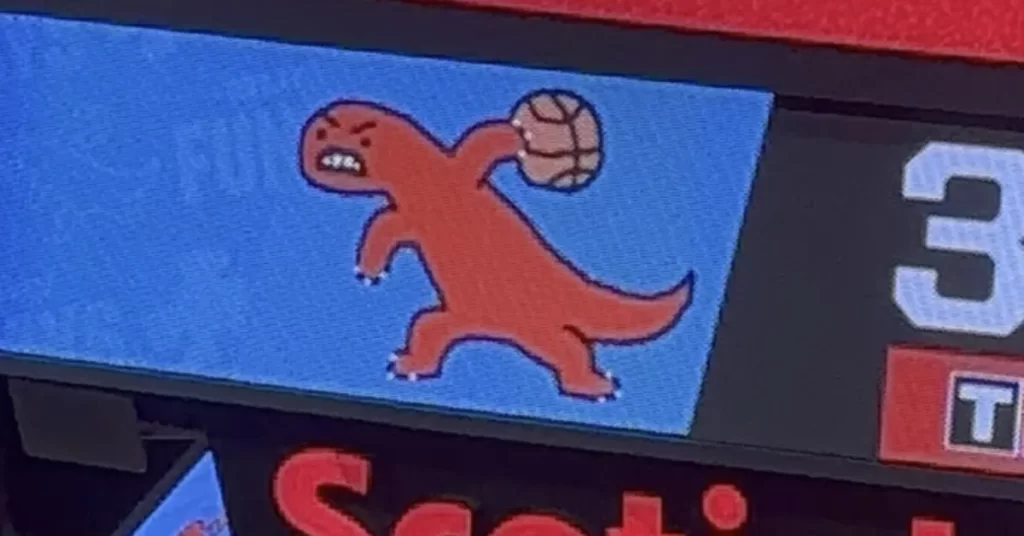
The Raptors’ NBA Paint logo has fans talking again. With its uneven outline, awkward stance and basketball raised in one hand, the dinosaur looks closer to something made during a computer class than a conventional professional sports logo. That is exactly what makes it worth a second look.
The drawing appeared on Scotiabank Arena’s big screen during the Toronto Raptors’ November 15 game against the New York Knicks. Its appearance brought fresh attention to a creative relationship that already spans social media, merchandise and game presentation.
For people working in sport marketing, content and game presentation, there is a story here about recognising an idea fans already enjoy and giving it room to grow.
Where the Raptors’ NBA Paint logo came from
The drawing’s history goes back to July 2025. NBA Paint, the creator behind the basketball art account @nba_paint, posted a Raptors logo redesign on July 8. The following day, Toronto adopted the image as its profile picture on X.
The appeal was easy to understand. The dinosaur was recognisable, funny and deliberately rough around the edges. Its expression and proportions gave supporters something to react to immediately. Fans did not need a campaign explanation to understand the joke, although knowing the creator added another layer.
The team’s involvement also gave the artwork a different status. A creator’s interpretation had become something the organization was willing to display through its own channels. That public embrace helped connect the humour circulating among basketball fans with the team they followed.
Merchandise, Paint Merch and the creator’s business
The idea soon reached merchandise. By July 2025, shirts and hats featuring the design were available through Real Sports. The retailer continues to list a Raptors Dino Paint collection, including logo and wordmark tees.
Paint Merch gives the creator a direct route to fans. NBA Paint promotes the shop, which lists a Raptor Hat and Raptor Shirt alongside other basketball designs. Its contact page also invites enquiries about partnerships and commissioned artwork. The site therefore brings merchandise sales and potential creative projects into the same business.
The Raptor Hat listing describes production after an order is placed. That model can reduce the need to commit to large batches of stock before demand is known. Alongside the Raptors’ retail activity, it illustrates how a recognisable drawing can support both a creator’s own products and team collaborations.
That commercial potential should be measured carefully. Product availability and online attention do not establish sales performance; assessing results would require sales, margins and repeat demand.
Toronto also worked with NBA Paint on its August 2025 schedule release, giving the creative relationship another application beyond a profile image.
Why fans are seeing it in the arena
That history helps explain why some supporters immediately recognised the dinosaur in the recent arena photo. Others were encountering it for the first time. Both reactions matter when a team takes an online reference into a building filled with people whose familiarity with its social accounts varies considerably.
The November 15 game was part of the Raptors’ Sunday Funday programming, which features family activities.
From a game presentation perspective, a loose, cartoonish dinosaur can suit a playful atmosphere. The specific decision behind the scoreboard graphic remains unconfirmed, but the artwork’s presence shows how a social media idea can reach people who may never have encountered the original post.
Are other teams doing this too?
Yes. Toronto is one of several teams to embrace NBA Paint collaborations, with the concept reaching the NBA and its development league.
- Minnesota Timberwolves promoted NBA Paint Night in February 2025 with exclusive merchandise available at the Target Center team store.
- Cleveland Charge announced NBA Paint Crossover Night for January 13, 2023. The collaboration included custom jerseys and shorts, with the uniforms set to be auctioned to support the Cavaliers Community Foundation. A separate ticket package offered fans an exclusive NBA Paint hat, giving the artwork a role in both game presentation and ticket sales.
- Salt Lake City Stars followed with a uniform collaboration for their January 19, 2024 game. Their promotion included NBA Paint hats for the first 300 fans and an auction of the player uniforms after the game.
These examples show how teams can develop the same creative relationship in different ways, through merchandise, ticket packages, giveaways and uniforms. They establish a wider pattern of collaborations, while each team’s use of arena graphics remains a separate decision.
What sport organizations can learn
Leave room for personality. A team needs recognisable colours, symbols and a clear identity. It can also create spaces where those familiar elements behave differently. A humorous dinosaur still gives fans an obvious connection to Toronto while offering a fresh way to express their attachment.
The context determines whether that flexibility works. A playful treatment can feel appropriate during an entertainment segment, a themed game or a limited merchandise release. Using it everywhere could reduce the novelty or make the identity harder to follow. Creative judgement involves choosing where the joke belongs and when to let the familiar branding carry the message.
Give fans a way into the reference. Supporters who recognise the drawing may enjoy seeing it immediately. Everyone else needs an accessible way into the reference. A short creator credit, a brief video introduction or a related social post could provide that context without slowing down the entertainment.
That coordination would involve several roles. Content staff can explain the origin. Designers can prepare artwork for different screen dimensions. Game presentation staff can choose the moment and duration. Retail staff can help ensure that any merchandise connection is clear. The casual appearance of the drawing does not remove the work needed to present it well, from production planning through the final cue.
Start with your own community
For smaller sport organizations, the relevant starting point is observation. Which illustrations, supporter traditions or recurring jokes already mean something to the community? A local artist or fan may have developed an idea that deserves attention. Building a relationship with that person, crediting their contribution and agreeing on its use gives the organization something specific to its own audience.
The next step is to test the response in a manageable setting. A single social feature, a themed fixture or a small merchandise run can reveal whether the idea travels beyond its original followers. Teams should then examine what happened: whether people understood it, shared it, bought it or wanted to see it again.
The Raptors’ dinosaur shows how a small creative idea can move from a social feed to merchandise and arena presentation. For sport organizations, the opportunity starts with noticing what supporters enjoy, building a fair working relationship with the creator and giving the idea a clear place in the fan experience.
Related organizations
 National Basketball Association (NBA)New York, NY, United StatesView company
 Toronto RaptorsToronto, ON, CanadaView company
 Cleveland ChargeCleveland, OH, United StatesView company
 Maple Leaf Sports & Entertainment (MLSE)Toronto, ON, CanadaView company
 Minnesota TimberwolvesMinneapolis, MN, United StatesView company
 New York KnicksNew York, NY, United StatesView company
 Salt Lake City StarsWest Valley City, UT, United StatesView company
 Target CenterMinneapolis, MN, United StatesView company
 NBA G LeagueNew York, NY, United StatesView company
Have experience with this topic?
Help make this SPMA resource better with a first-hand perspective, practical addition, or question. Use your SPMA account or contribute as a guest.