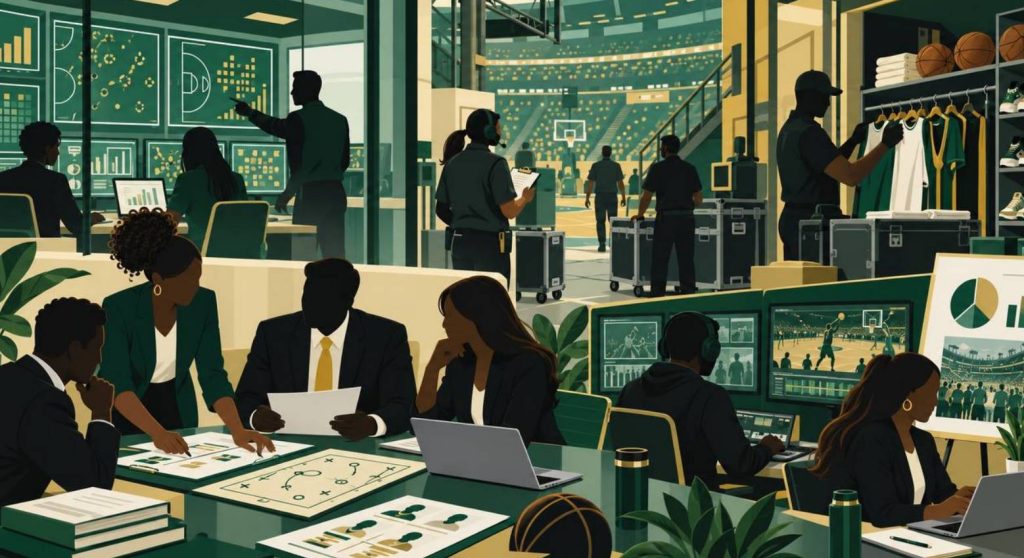
An NBA front office is easy to oversimplify. Fans see the general manager, head coach and players, but a modern franchise also needs people who can interpret a dense collective bargaining agreement, turn game film into usable teaching material, manage player-development workflows, move equipment across a national travel schedule and produce a live show for 18,000 people.
These unique NBA roles are not necessarily unique job titles. Teams organize departments differently. What is NBA-specific is the combination of roster rules, guaranteed contracts, a development league, constant travel and an arena product in which basketball and entertainment happen in the same building.
The examples below are based on current team and league structures, with 2026-27 salary-cap figures included where they matter.
1. Salary cap and basketball strategy specialists
The NBA is not built around a simple payroll ceiling. Front offices operate under a collective bargaining agreement with salary-cap rules, exceptions, trade restrictions, tax thresholds, draft-pick rules and contract structures that can make one transaction affect several future seasons.
For 2026-27, the NBA set the salary cap at $164.961 million and the luxury-tax line at $200.428 million. The first apron is $209.015 million and the second apron is $221.686 million. Those thresholds are not trivia for a cap group. They can change which exceptions, trades and roster-building tools are available to a team.
That creates a need for specialists who can model the financial and roster consequences of decisions before they happen.
A cap or strategy group may analyze questions such as:
- Can a proposed trade legally be completed under current salary rules?
- What will the roster cost next season if a player receives a new contract?
- How does a particular exception affect future flexibility?
- What happens to tax exposure if a team adds another player?
- Which draft assets can legally be traded?
- How do contract guarantees and option dates affect decision timing?
This is one of the clearest examples of basketball becoming a multidisciplinary business. The work sits between finance, law, analytics and roster strategy. A person may need to understand the collective bargaining agreement as carefully as another analyst studies shot quality.
Why this role is especially NBA-specific
Many professional leagues have salary systems, but the NBA’s combination of guaranteed contracts, exceptions, luxury-tax rules and a relatively small roster makes cap decisions unusually visible. One contract can shape the team’s flexibility for years.
Fans often experience the result as a trade rumor. Behind the rumor may be spreadsheets, legal interpretations, scenario models and dozens of roster constructions that never become public.
2. Video coordinators and basketball video operations
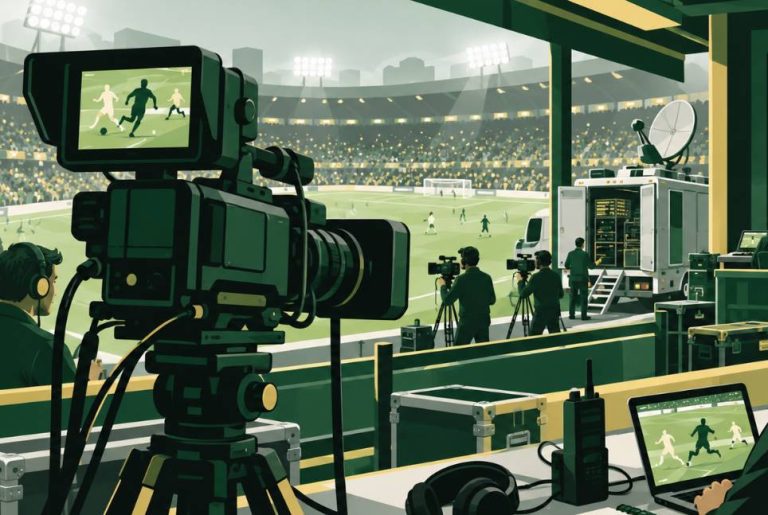
Basketball teams generate enormous amounts of film. Every offensive possession, defensive coverage, lineup and individual action can be tagged, clipped and reviewed.
Video coordinators help turn that raw footage into useful information. On a game day, that can mean preparing opponent clips, organizing play-type examples, supporting coaches with teaching edits and making sure film is immediately available for review.
The title sounds technical, but the role is deeply connected to basketball understanding. A useful clip package is not simply a collection of plays. Someone has to understand what the coaching staff is trying to show.
From physical tape to instant digital workflows
Video work in basketball once literally involved tape. Modern NBA operations use digital systems that allow staff to sort and retrieve possessions quickly. Coaches can review specific pick-and-roll coverages, a player’s shot attempts or an opponent’s baseline out-of-bounds plays without watching an entire game from beginning to end.
That speed changes preparation. Information can move from game footage to a coaching conversation almost immediately.
Why video roles have produced coaches
Video work can expose staff to detailed film study, coaches’ meetings and the language of schemes. Historically, some basketball coaches have risen from video-room positions because the job creates a demanding basketball education. That does not make it a guaranteed coaching path, but it explains why the function is more strategic than the title might suggest.
3. Player development staff
NBA players are already among the best basketball players in the world, but their development does not stop when they reach the league. Players continue refining shooting, finishing, footwork, reads, strength, movement and decision-making throughout their careers.
Player development staff help turn broad goals into daily work. For a young guard, that might mean improving pace in pick-and-roll situations. For a wing, it could be corner shooting or attacking closeouts. A veteran may work on movement patterns that help preserve efficiency as athletic tools change.
The role overlaps with coaching but has its own rhythm. Development often happens in small groups or one-on-one sessions before practices, after team work and during offseason periods.
Development is individual, not generic
An NBA roster contains players with different body types, ages, roles and contract situations. A drill that makes sense for one player may have little value for another.
The best development plans connect skill work to the player’s actual game role. Making 100 difficult shots in an empty gym is less useful if none resemble the decisions the player will face during competition.
The G League adds another development layer
NBA organizations can also use their G League affiliates to create game repetitions for developing players. That makes player development an organizational system rather than only an individual coach-and-player relationship.
4. Equipment managers and locker-room operations
Equipment work is easy to notice only when something goes wrong. An NBA team travels with uniforms, practice gear, shoes, medical and performance supplies, warmups and countless small items that have to be available at the right time.
Equipment managers and operations staff coordinate that physical infrastructure. They may work with players on gear preferences, prepare uniforms, manage inventory, pack road trips and coordinate with arenas and team staff.
At the NBA level, small preferences can matter. Players may have specific shoe models, sizes, taping supplies or practice routines. The equipment operation has to support those individual needs without losing control of a large, fast-moving inventory.
Why travel makes the role more complex
An 82-game regular season includes frequent travel and back-to-back games. Equipment has to move ahead of the team, arrive in the correct building and be ready on schedule.
That means the role is partly logistics. A locker room may look effortless to a player walking in before a game precisely because someone has spent hours making sure it is ready.
5. Game presentation and in-arena entertainment
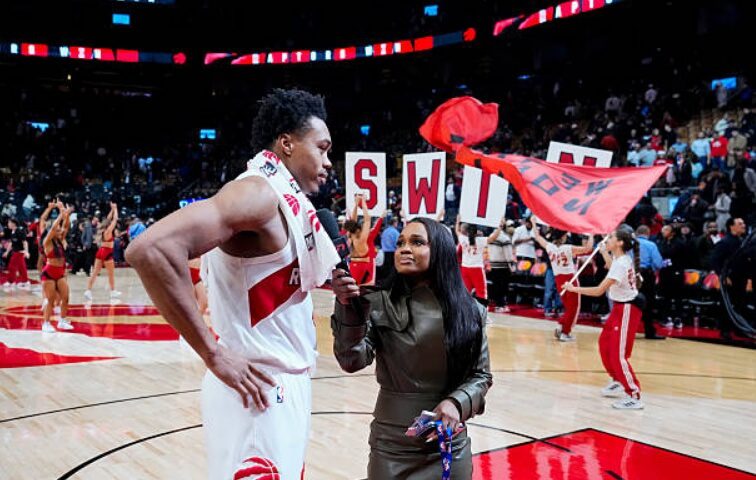
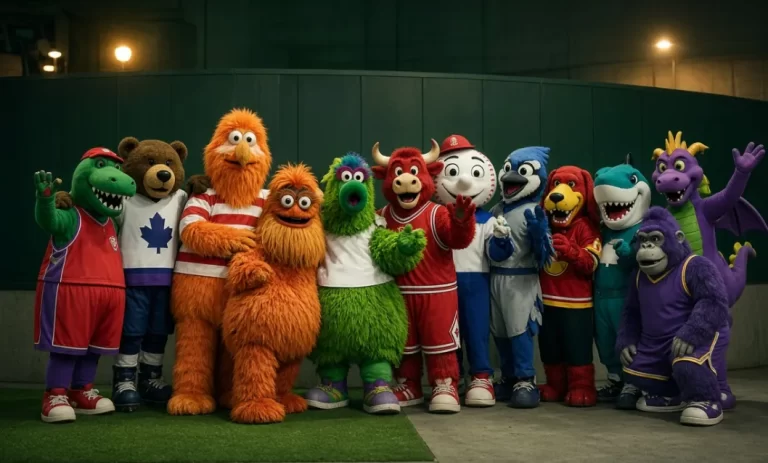
An NBA game is a basketball competition and a live entertainment production happening at the same time. During timeouts and stoppages, teams may run music, sponsor activations, contests, videos, mascot appearances, lighting effects and crowd prompts.
Game presentation teams coordinate those elements so they fit into the unpredictable timing of live basketball.
Unlike a concert, a game does not follow a fully fixed script. A timeout can occur at different moments. A replay review can extend a break. An emotional fourth quarter may call for a different tone than a blowout. The production team has to react while still delivering sponsor obligations and arena entertainment.
What game presentation may coordinate
- music and DJ cues;
- scoreboard and ribbon-board content;
- mascot and dance-team appearances;
- fan contests;
- lighting and special effects;
- public-address cues;
- sponsor activations;
- halftime performances;
- special ceremonies and theme nights.
The best presentation supports the basketball rather than competing with it. A dramatic late-game moment needs space for the crowd to react naturally.
Other specialized NBA functions fans may not see
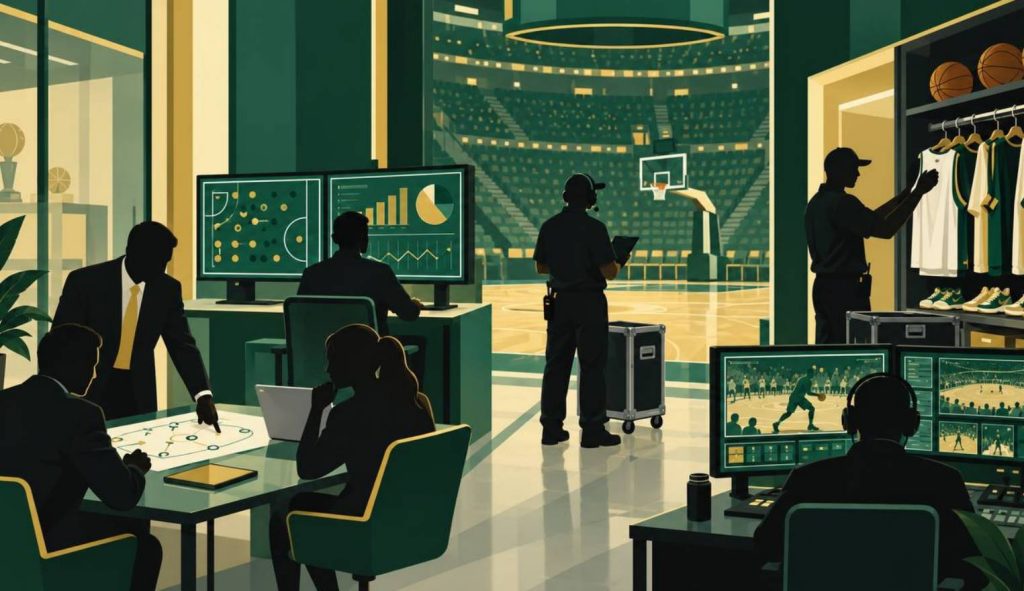
The five roles above are only a sample. NBA organizations can also employ specialists in analytics, scouting, performance science, medical services, mental performance, security, travel, communications, community impact, partnerships, ticketing, content production, data engineering and legal affairs.
A franchise therefore resembles a medium-sized entertainment and technology business wrapped around a basketball operation.
Why specialization has grown in the NBA
NBA teams make high-value decisions with small margins for error. Player contracts can be worth hundreds of millions of dollars. One playoff series can materially change revenue. A minor competitive edge can matter over 82 games.
As more data, money and technology entered the sport, organizations created more specialized functions. The same pattern exists across other industries: when decisions become more complex, expertise becomes more specific.
There is also a performance reason. Coaches and senior executives have limited time. Specialists can prepare the analysis, film, logistics or production systems that allow decision-makers to focus on the part only they can do.
Basketball operations and business operations are connected
Fans often imagine a hard line between the “basketball side” and “business side.” In practice, the two interact constantly.
A new star player affects ticket demand and sponsorship. A deep playoff run changes arena scheduling and content production. Salary-cap choices affect roster quality, which affects the product being sold. Game presentation shapes the environment in which the basketball product is experienced.
Understanding those connections is one of the reasons behind-the-scenes roles are useful for anyone studying sport management.
What these roles tell you about NBA work
The common feature is specialization. NBA teams are making expensive decisions on short timelines, so they build departments around knowledge that cannot be improvised in the moment. Cap specialists reduce transaction risk. Video staff make information usable for coaches. Development staff individualize improvement. Equipment operations keep the team functioning on the road. Game-presentation teams manage the live entertainment product around the game.
If you are exploring NBA work, do not search only for glamorous job titles. Read team staff directories and media guides closely. Current organizations list roles across cap strategy, basketball systems, software, data science, coaching operations, player development, medical performance, content and business operations that most fans never see.
The NBA’s official 2026-27 salary-cap release is a useful example of the financial rules these departments work around. For broader career functions, see NBA Careers.
The people learning about sport careers here could be your next applicants.
Turn your next opening into a professional Sports Hired listing and give candidates a clear path from career research to your opportunity.
Have experience with this topic?
Help make this SPMA resource better with a first-hand perspective, practical addition, or question. Use your SPMA account or contribute as a guest.