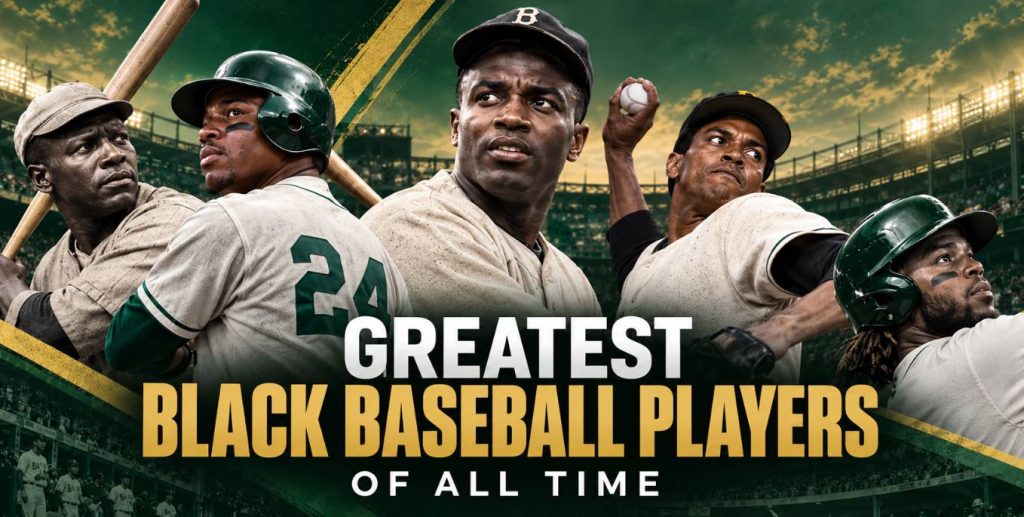
Baseball’s record book changed in 2024, and any serious discussion of the greatest Black baseball players has to reflect that change. Major League Baseball incorporated available Negro Leagues statistics into its official major-league record, moving Josh Gibson to the top of several career rate-stat categories and bringing more of the Negro Leagues into the same statistical history as the American and National Leagues.
That does not make cross-era comparisons simple. Segregation denied generations of Black players access to the American and National Leagues, Negro Leagues records are incomplete in places, schedules differed, and every era produced different competitive conditions. A neat one-through-15 ranking would pretend those problems do not exist.
So this is an editorial list, not a mathematical verdict. The 15 players below belong in the conversation because of what they accomplished, what they changed and how their careers fit into the larger history of baseball.
1. Willie Mays
Willie Mays combined power, speed, defense and durability at a level that made him one of baseball’s most complete players. He won two National League MVP awards, earned 24 All-Star selections and won 12 Gold Gloves.
Mays is remembered for iconic moments such as “The Catch” in the 1954 World Series, but his greatness was sustained over decades. He hit for power, stole bases, played elite centre field and remained a central figure in baseball as the Giants moved from New York to San Francisco.
2. Hank Aaron
Hank Aaron’s career home-run record of 755 stood for more than three decades, but focusing only on home runs undersells his offensive consistency. Aaron accumulated more total bases than any player in MLB history and produced at an elite level across a 23-season career.
His pursuit of Babe Ruth’s home-run record also exposed him to extraordinary racist abuse. Aaron reached 715 home runs in 1974 despite that pressure, turning the moment into both a baseball milestone and a significant chapter in American sports history.
3. Josh Gibson
Josh Gibson’s reputation as one of the greatest power hitters in baseball long predated the official statistical recognition he received from MLB. He starred for the Homestead Grays and Pittsburgh Crawfords and became a legendary figure of the Negro Leagues.
When MLB incorporated Negro Leagues statistics into its official record in 2024, Gibson became the career leader in batting average, slugging percentage and OPS based on the available recognized data. MLB also lists him as the all-time single-season leader in those categories.
That change did not make Gibson great. It made the official record better reflect greatness that had always existed.
4. Jackie Robinson
Jackie Robinson’s historical importance is inseparable from his performance. When he debuted for the Brooklyn Dodgers in 1947, he broke Major League Baseball’s modern colour barrier. He also immediately proved he belonged, winning Rookie of the Year and later the 1949 National League MVP.
Robinson’s speed, baserunning, plate discipline and defensive versatility made him a star. His ability to perform while facing relentless racist hostility made his career one of the most consequential in sports history.
5. Satchel Paige
Satchel Paige became one of the most famous pitchers in Negro Leagues history through a combination of elite ability, longevity and showmanship. He pitched for major Negro League clubs and barnstorming teams before finally receiving a chance in the American League after integration began.
Paige debuted in MLB with Cleveland in 1948 at an age when most pitchers are nearing the end of their careers. He became the first Black pitcher to appear in a World Series and later became the first Negro Leagues star inducted into the National Baseball Hall of Fame through the special committee created to recognize those players.
6. Oscar Charleston
Oscar Charleston is one of the most important names casual baseball fans may not know well enough. A dominant centre fielder and hitter in the Negro Leagues, Charleston combined power, average, speed and defense.
Historians have repeatedly placed him among the best all-around players of the early 20th century. The limited surviving statistical record makes exact comparisons difficult, but his reputation among peers and historians is enormous.
7. Barry Bonds
Barry Bonds owns MLB’s career home-run record and single-season home-run record and won seven MVP awards, more than any other player. At his peak, pitchers often chose not to challenge him at all.
His career is also inseparable from the performance-enhancing-drug era and the controversies surrounding it. Any evaluation of Bonds has to acknowledge that history. It also has to acknowledge the extraordinary production, plate discipline and all-around ability he displayed, including earlier years when he was already an elite power-speed player.
8. Ken Griffey Jr.
Ken Griffey Jr. became one of the defining stars of the 1990s. His left-handed swing, centre-field defense and charismatic style made him an international sports icon.
Griffey finished with 630 home runs and 10 Gold Gloves. Injuries reduced his availability later in his career, but his peak with the Seattle Mariners combined highlight-level defense with elite power and helped make baseball feel younger and more culturally connected.
9. Frank Robinson
Frank Robinson remains the only player to win MVP awards in both the National League and American League. He was a feared power hitter, an intense competitor and later a history-making manager.
In 1975, Robinson became the first Black manager in MLB history when he served as player-manager of Cleveland. His influence therefore stretches from his Hall of Fame playing career into leadership and management.
10. Rickey Henderson
Rickey Henderson changed games before the ball was even put in play. Baseball’s career stolen-base leader combined unmatched baserunning pressure with power and an exceptional ability to reach base.
He also holds the MLB career record for runs scored. Henderson’s style showed that a leadoff hitter could be both a table-setter and a major offensive weapon.
11. Bob Gibson
Bob Gibson’s 1968 season remains one of the most famous pitching performances in baseball history. His 1.12 ERA helped define the “Year of the Pitcher” and contributed to changes in the height of the pitching mound the following season.
Gibson won two Cy Young Awards, two World Series MVP awards and a regular-season MVP. His combination of power pitching, durability and competitiveness made him one of the most intimidating pitchers of his era.
12. Roy Campanella
Roy Campanella was one of the National League’s premier catchers in the 1950s, winning three MVP awards with the Brooklyn Dodgers. Before joining the Dodgers organization, he also played in the Negro Leagues.
His playing career ended after a 1958 automobile accident left him paralyzed. Even with that abrupt ending, his peak established him as one of baseball’s greatest catchers.
13. Cool Papa Bell
James “Cool Papa” Bell became legendary for his speed. Stories about how fast he was grew into folklore, but his actual baseball value went far beyond anecdotes. He was an outstanding centre fielder, baserunner and contact hitter across a long Negro Leagues career.
Bell’s career is also a reminder of how segregation shaped historical statistics. Much of his prime occurred outside the leagues whose records were traditionally treated as the default definition of major-league history.
14. Reggie Jackson
Reggie Jackson earned the nickname “Mr. October” because of his postseason performances, most famously his three-home-run game in the 1977 World Series for the New York Yankees.
He hit 563 career home runs and became one of baseball’s first modern superstar personalities. Jackson’s ability to perform in major media markets and postseason moments made him central to baseball culture in the 1970s and early 1980s.
15. Buck Leonard
Buck Leonard was a cornerstone of the Homestead Grays, forming a devastating middle of the lineup alongside Josh Gibson. A first baseman with power and consistency, Leonard was one of the Negro National League’s defining stars.
He was inducted into the Hall of Fame in 1972 and remains essential to understanding how much elite talent was excluded from MLB before integration.
Other Black baseball legends who belong in the conversation
A list of 15 necessarily leaves out extraordinary players. Larry Doby, the first Black player in the American League, deserves major recognition. Minnie Miñoso, Monte Irvin, Willie Stargell, Eddie Murray, Ozzie Smith, Dave Winfield, Joe Morgan, Tony Gwynn, Dave Parker and many others have compelling cases for inclusion depending on the criteria used.
The point is not to create one permanent ranking. It is to understand the depth of Black baseball history and how much of that history was once separated from the official record.
Why the Negro Leagues statistical update matters
MLB’s 2024 incorporation of Negro Leagues statistics changed the presentation of baseball’s official record books. The available data from seven Negro Leagues recognized as major leagues for the 1920-48 period now appears alongside other major-league statistics.
The record remains incomplete because not every box score survived. That uncertainty should be acknowledged rather than treated as a flaw in the players. Segregation created the separate system, and incomplete preservation followed from unequal resources and coverage.
The modern statistical update gives fans a better framework for seeing players such as Gibson, Paige, Charleston, Bell and Leonard not as a separate footnote, but as part of major-league history.
How to read a list like this
There is no responsible way to flatten Willie Mays, Josh Gibson, Satchel Paige, Hank Aaron, Jackie Robinson and players from several other eras into one perfect statistical order. The better approach is to understand what each player dominated, what opportunities were available to him and what barriers shaped the record that survived.
MLB’s 2024 statistical integration was important because it changed the official record rather than treating Negro Leagues performance as a separate appendix. MLB has also acknowledged that historical research continues as additional box scores and records are located, so some totals may continue to evolve.
For the statistical background, see MLB’s Negro Leagues record integration announcement. Biographical research is also available through the National Baseball Hall of Fame.
Have experience with this topic?
Help make this SPMA resource better with a first-hand perspective, practical addition, or question. Use your SPMA account or contribute as a guest.