Elite sport has always demanded resilience. What has changed is the assumption that resilience means staying silent. Athletes and mental health are now discussed together because teams, schools and athletes themselves have become more willing to treat psychological health as part of performance and overall health, not as a private weakness.
That shift is still incomplete. The NCAA’s current Mental Health Best Practices require member schools to make mental-health services and resources available to student-athletes consistent with the national framework. At the same time, newer pressures are becoming harder to ignore. In the NCAA’s 2025 GOALS study, published in February 2026, 51% of Division I men’s basketball players said they had received performance-related social-media abuse, and 46% reported negative or threatening messages from someone who had bet on their game.
Those numbers make this more than a culture-war conversation about whether athletes should “tough it out.” It is an organizational issue involving access to qualified care, coach behaviour, injury, online harassment, gambling-related abuse and the transition into and out of sport.
Why athletes and mental health became a bigger sports issue
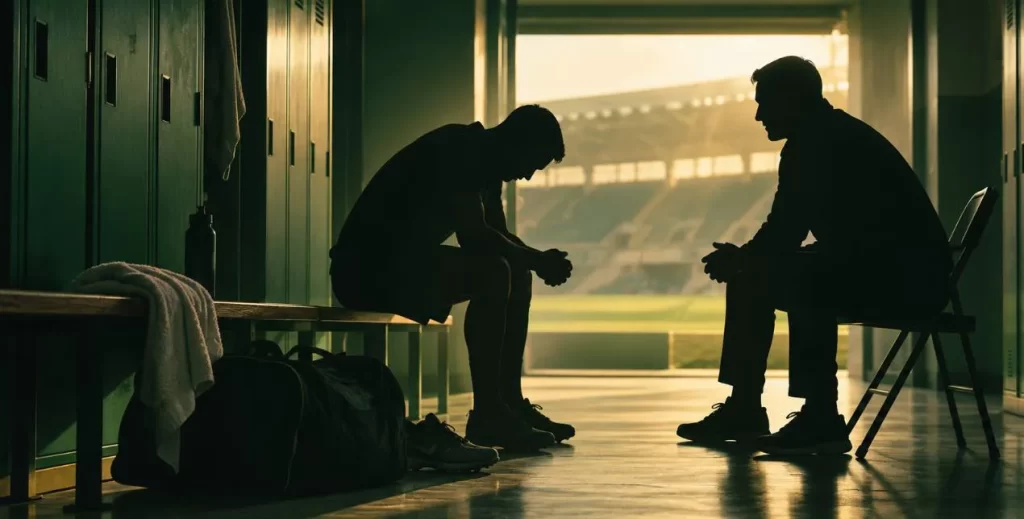
Sport has traditionally rewarded traits such as toughness, discipline, persistence and the ability to perform under pressure. Those qualities can be positive, but they can become harmful when toughness is interpreted as never asking for help. An athlete who would immediately seek treatment for a torn ligament may still hesitate to tell a coach that panic, grief, depression or exhaustion is affecting daily life.
Several forces have pushed the issue into the open. Athletes now have direct communication channels through social media and player-led media. Mental-health research has become more visible. Universities, leagues and governing bodies face greater expectations around athlete welfare. Younger athletes are also entering elite sport with a vocabulary for mental health that previous generations were often not given.
The result is not that stigma has disappeared. It has not. The important change is that silence is no longer the only accepted response.
The pressures athletes can face
Athletes can experience the same mental-health conditions as anyone else, while also dealing with pressures that are specific to competitive sport. Those pressures can overlap and intensify one another.
- Performance evaluation: an athlete’s work is measured publicly through statistics, selection decisions, playing time and results.
- Injury and rehabilitation: an injury can remove an athlete from the routine, identity and social network that sport provides.
- Uncertainty: roster spots, scholarships, contracts and careers can change quickly.
- Public criticism: professional and high-profile amateur athletes may receive criticism from fans, media and strangers online.
- Time pressure: travel, training, school, work, recovery and family responsibilities can compete for the same limited hours.
- Identity: when a person is known primarily as an athlete, poor performance or retirement can feel larger than a bad day at work.
These pressures do not mean competitive sport is inherently unhealthy. Sport can also provide purpose, friendship, confidence, structure and belonging. The point is that a serious athlete-health system has to account for both sides of the experience.
College sports helped move mental health into policy
The NCAA’s current Mental Health Best Practices are a useful example of the broader shift. The guidance treats mental health as part of overall health and requires member schools to make services and resources available to student-athletes consistent with those best practices. The updated framework became effective August 1, 2024.
The NCAA approach emphasizes healthy environments, education, screening and access to qualified care. It also recognizes that coaches and other people around athletes help shape whether seeking help feels normal or risky. That is an important distinction. A brochure about mental health has limited value if the day-to-day culture punishes vulnerability.
For sport organizations, the lesson is clear: mental-health support cannot sit outside the performance environment. It has to be integrated into how athletes are coached, referred, monitored and supported.
Athletes speaking publicly can change what fans see
When athletes discuss mental health publicly, they can challenge one of sport’s most persistent myths: that elite performance and psychological struggle are opposites. They are not. Someone can be successful, physically gifted and highly disciplined while still needing mental-health care.
Public disclosure also changes the visual language of mental health. Fans are used to seeing an athlete receive treatment for an ankle, shoulder or concussion. When athletes talk about therapy, anxiety, grief, burnout or depression, they make another form of health care visible.
That visibility can be particularly meaningful for young athletes who may assume that successful people never struggle. It can also influence parents, coaches and administrators by showing that asking for help is compatible with ambition.
Mental health is bigger than a motivational quote
One risk of increased awareness is that mental health becomes a branding theme rather than a health issue. Telling athletes to “be resilient” or posting supportive messages is not a substitute for qualified care.
Good systems separate normal performance coaching from clinical treatment. Coaches can create supportive environments, listen and connect athletes to resources, but they are not substitutes for licensed mental-health professionals. Likewise, teammates can be supportive without being responsible for diagnosing or treating one another.
Organizations should have clear pathways for urgent concerns, confidential care, routine screening where appropriate and education about how to access help. Policies should also explain how privacy is handled and who needs to know what.
Social media changed both the problem and the conversation
The latest NCAA data gives that pressure a measurable dimension. The 2025 GOALS study included more than 20,000 student-athletes across all three divisions. Among Division I men’s basketball players, 51% reported performance-related social-media abuse and 46% reported negative or threatening messages from a bettor. Those figures do not describe every sport or every athlete, but they show how public performance, social media and legalized sports betting can collide.
Social media gives athletes unprecedented control over their own stories. That can help normalize mental-health conversations because athletes do not have to wait for a traditional interview to speak. At the same time, those platforms can add a new layer of pressure.
Athletes may encounter direct harassment, gambling-related abuse, racial or gendered attacks, constant performance comparisons and the expectation that they remain publicly available after difficult games. For younger athletes, online identity can blend with athletic identity at exactly the stage when both are still developing.
Healthy sport environments increasingly need a digital component: education about online boundaries, support after harassment, and realistic expectations about public engagement.
Injury can affect more than the injured body part
Injury is one of the clearest examples of why physical and mental health should not be separated. A serious injury can mean pain, uncertainty, loss of playing time, isolation from teammates and fear about whether the athlete will return at the same level.
Rehabilitation plans often focus on physical milestones because they are easier to measure. A more complete approach also pays attention to mood, confidence, sleep, social connection and fear of reinjury. Those factors can affect the rehabilitation experience even when the physical treatment is progressing normally.
What a healthier sport culture looks like
A healthier culture does not mean removing pressure from competitive sport. Pressure is part of competition. It means creating systems where athletes can respond to pressure without being forced to hide health concerns.
- Leaders talk about mental and physical health in the same matter-of-fact way.
- Athletes know where confidential support is available before a crisis occurs.
- Coaches receive education on recognizing concerns and making referrals.
- Organizations avoid language that equates help-seeking with weakness.
- Return-to-play and injury processes consider the whole athlete.
- Teams plan for transition points such as retirement, deselection and graduation.
- Policies are designed for different athlete populations rather than assuming every athlete has the same experience.
The conversation still has gaps
Progress is uneven. Access to qualified care can vary by level of sport, geography and financial resources. Some athletes may worry that disclosure will affect selection or contract opportunities. Others may face cultural, language or identity-based barriers to care.
There is also a difference between celebrating a famous athlete for speaking openly and creating a safe environment for a less powerful athlete to do the same. The real test of culture is what happens when disclosure is inconvenient, when an athlete needs time, or when support requires resources.
What fans, coaches and sport organizations can take from the shift
The most important change in the portrayal of athlete mental health is not that athletes are suddenly talking about weakness. It is that sport is developing a more accurate definition of strength.
Preparation includes recovery. Performance includes health. Resilience can include knowing when to ask for professional support. Those ideas do not diminish competition. They make athlete care more realistic.
As more athletes speak, and as organizations turn awareness into concrete systems, the conversation can move beyond isolated stories. Mental health can become what it should have been all along: one part of the complete picture of athlete health and performance.
Where the conversation has to go next
The next step is less about producing another awareness slogan and more about ordinary systems that work: clear referral pathways, licensed providers, rehearsed emergency plans, annual screening where appropriate, trained coaches and a culture in which asking for help does not threaten an athlete’s standing on the team.
The NCAA’s Mental Health Best Practices are effective from August 1, 2024 and remain the current framework in 2026. The NCAA also publishes current mental-health education and resources, including material on social media and mental health.
This article was fact-checked for September 26, 2026. It is educational and is not medical advice. Anyone facing an immediate mental-health emergency should contact local emergency services or an appropriate crisis service.
Have experience with this topic?
Help make this SPMA resource better with a first-hand perspective, practical addition, or question. Use your SPMA account or contribute as a guest.