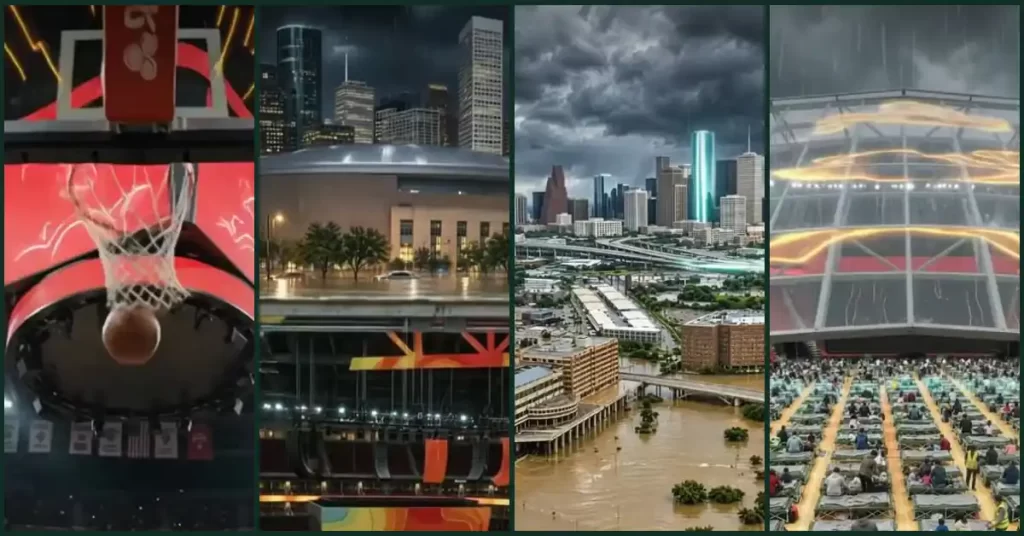
Hundreds of Rockets fans waited out a flood inside Toyota Center. The arena’s sunken court is real, too. The reel’s underground cutaway is where the story goes wrong.
Featured image from the AI-labeled Instagram reel by @its.layers.
The Toyota Center flood story began on May 25, 2015, after the Houston Rockets beat the Golden State Warriors 128–115 in Game 4 of the Western Conference Finals. Before fans headed for the doors, the arena put a message on the scoreboard urging them to stay inside. Houston’s roads were flooding. Most spectators left, but hundreds stayed, and some were still there the next morning.
Years later, the Instagram account @its.layers told the story with a cutaway of flooded streets and a basketball arena underneath them. The creator added an AI disclosure to the post. The reel is persuasive because its opening facts are surprising and true. The picture it builds from those facts is where a closer look pays off.
What the reel gets right and wrong
The court is almost 32 feet down
Toyota Center lists the playing surface at 31 feet 8 inches below street level and 315,000 cubic yards of excavated soil. Both figures match the reel.
Hundreds sleeping together in the bowl
Hundreds stayed inside. One fan spent the night in the lower stands. Witnesses described people resting in different parts of the building.
An arena buried under the street
The court sits below the street. The high point of the arena’s main roof truss sits 120 feet above it.
Pumps kept the bowl dry
The contractor describes how the site was excavated. The available records leave open what permanent equipment the arena uses and what was running that night.
Why the Toyota Center court sits below street level
The court’s depth was a choice about how people enter the building. In 2001, Rockets and Houston Comets executive George Postolos told the Houston Chronicle that sinking the seating bowl would allow fans to enter at street level and walk down to their seats. The plans placed 62 percent of the seats in the lower bowl. Toyota Center’s own dimensions put the high point of its main roof truss 151 feet 8 inches above the court. Subtract the court’s depth and you get 120 feet above the street. The reel’s cutaway places the roof structure and scoreboard beneath the flooded roadway, making the building look far more buried than it is.
That matters because the illustration also suggests an explanation for how the building handled the flood. The excavation contractor lists a fabric and filter system and a sand wick system. Those are details from the construction project. The public records reviewed for this story leave the arena’s permanent groundwater equipment and the water level at its doors that night unverified. A street flood and groundwater around an excavation pose different engineering questions.
The night fans stayed
Before the exits
Staff posted a scoreboard advisory asking people to wait inside as the storm moved through Houston.
After the final buzzer
The Houston Chronicle estimated that about 350 fans stayed into the early hours. Dwight Howard greeted fans and signed autographs, and his young son took shots on the court.
Into the morning
KPRC reported roughly 200 fans still at the arena well into the morning. One fan told ABC News that he stayed until about 7 a.m. and reclined in the lower stands.
The head counts came from separate reports, so they give a sense of scale rather than a single official tally. Witnesses described people lying down on marble flooring and carpet, and children falling asleep on their parents’ laps. The image of rows of people sleeping together in the bowl compresses those scattered experiences into one scene. What the reporting captures is more ordinary and more specific. People spent hours wherever they could get comfortable while they figured out when they could get home.
Three storms, three different stories
Tropical Storm Allison
Flooding shut down downtown Houston weeks before the arena’s July 31 groundbreaking. The timeline checks out. It leaves the building’s eventual flood-protection design an open question.
Memorial Day flooding
The Rockets played Game 4, and fans who were already inside stayed while roads flooded. This is the night at the centre of the reel.
Hurricane Harvey
Toyota Center opened as an overflow shelter. Officials said 500 cots were being added there. The city recorded more than 10,000 people at the peak of the main shelter at the nearby George R. Brown Convention Center. That number belongs to the convention center. How many slept on the arena floor remains unverified.
Why a true detail makes the rest easier to believe
An AI label answers a question about production. A box score answers a question about the game. A witness answers a question about what happened in the stands. A drawing from the facility’s engineers could answer a question about the pumps. The reel puts all of those questions into one continuous video, which makes it easy to treat one verified detail as proof of the next.
The same problem came up during the 2026 Winter Olympics, when a clip appeared to show a Chinese figure skater named Chen Lirong criticizing American competitors. The Journal checked the roster and found no skater by that name in the event. Reuters has also reported on fabricated quotes attributed to real NFL figures. Familiar settings give even invented scenes something recognizable.
said distinguishing AI-made material was very or extremely important.
said they had little or no confidence they could do it.
For a team or venue telling its own history, the distinction has practical consequences. Put “reconstruction” directly on an illustrated shot, and keep the supporting record one tap away. The context can survive a repost that strips out the original caption. At Toyota Center, the game record, the venue dimensions and the accounts from the people who were there each tell a different part of the story. The true parts are already worth retelling.
Reporting notes and sources
The 2015 game and overnight stay
Houston Chronicle · ABC News eyewitness accounts
Arena design and flood history
Toyota Center fact sheet · 2001 design coverage · Associated Press on Harvey overflow cots · Houston’s shelter report
The reel and AI in sports media
Original Instagram reel · Pew Research Center survey · The Journal’s Olympic fact-check
Related organizations
 Toyota CenterHouston, TX, United StatesView company
 Houston RocketsHouston, TX, United StatesView company
 Golden State WarriorsSan Francisco, CA, United StatesView company
 Houston CometsHouston, TX, United StatesView company
 National Football League (NFL)New York, NY, United StatesView company
 National Basketball Association (NBA)New York, NY, United StatesView company
 Women's National Basketball Association (WNBA)New York, NY, United StatesView company
Have experience with this topic?
Help make this SPMA resource better with a first-hand perspective, practical addition, or question. Use your SPMA account or contribute as a guest.