The NBA blood rule gives officials a way to stop play and let medical staff attend to a player with a bleeding wound or visible blood on their body or uniform. It also tells the scorer’s table what to do with the shot clock. The team in possession resumes with the time it had left or 14 seconds, whichever is greater. Officials can give a team more time to shoot even when possession stays with the same team and no foul is called.
That second part caught Lakers coach JJ Redick by surprise on Nov. 17, 2026. Charlotte’s Naz Reid began bleeding from his nose in overtime, and the Hornets’ shot clock went from 3.8 to 14 seconds while the game clock showed 18.0 seconds. The stoppage got attention because it came with Charlotte down one. The rule itself has been used in regular-season games and the playoffs, during free-throw sequences and in the closing seconds of tight games. In an SPMA review of two seasons of play-by-play data, 458 of 2,625 games had at least one entry explicitly labelled as a blood-rule stoppage.
The game clock stood at 18.0 seconds.
What is the NBA blood rule?
The rulebook calls it the Guidelines for Infection Control. The trigger is a bleeding wound or visible blood on a player or their uniform. Referees are directed to suspend play at the earliest appropriate time and allow up to 30 seconds for initial treatment. That wording gives officials room to stop play at an appropriate point in the sequence. A player can receive treatment during a dead ball that began for another reason, as Reid did after the ball went out.
What happens next depends on whether the player can return safely and whether the coach has a timeout available.
- Medical staff complete treatment
- The player can return after appropriate treatment. Officials must ensure the affected area is covered with a dressing that prevents contamination.
- Treatment needs more time
- The coach can use a team timeout, if available, or put in a substitute. If the player is replaced under the rule, the opponent can substitute one player.
- The team has used all its timeouts
- The team still gets the initial 30-second window. If treatment is unfinished, the bleeding player must come out. The replacement is limited to that player on the affected team, and the opponent may make one substitution.
- The wound reopens without new contact
- There is no additional 30-second treatment window.
- The bleeding player is due to take free throws after a personal foul or is involved in a jump ball
- The guidelines provide a 30-second treatment period. If treatment remains unfinished, they direct play to resume and then be suspended again at the first appropriate time.
The 30 seconds refer to the treatment window officials initially allow during the stoppage. Care can continue off the floor, and a player who was replaced can re-enter once the return requirements are met. The rulebook specifically says a wristband or sweatband does not qualify as a bandage. An arena’s mandatory timeout also requires a team to be granted a timeout during the suspension.
Does the NBA blood rule always reset the shot clock?
Fourteen seconds is a minimum at the restart under the infection-control provision. A team with 3.8 seconds left goes to 14. A team with 12 seconds left gains two. A team with 19 seconds left keeps all 19. When the offense has to advance from the backcourt, the guidelines also give it a fresh eight-second count to cross midcourt. The eight-second count governs where the ball must be, and the shot clock governs when the team must take a shot.
A 14 on the shot-clock display can have several causes. An offensive rebound after a miss that hits the rim is one familiar example. A defensive three-second violation or certain defensive fouls can also produce a 14-second setting. An ordinary defensive deflection out of bounds generally leaves the offense with whatever time was already on the shot clock. In the Charlotte game, the deflection explained who got the ball, and the infection-control provision explained the additional time.
The treatment procedure has been around for decades. In January 1996, the Los Angeles Times described the NBA’s infection-control guidelines in its reporting on Magic Johnson’s return and quoted Lakers trainer Gary Vitti saying the guidelines for handling cuts had been in place since 1991. The league’s widely publicized 2018 change to the 14-second clock concerned offensive-rebounding situations. The infection-control provision already appeared in an earlier NBA rulebook.
How often is the NBA blood rule used?
SPMA found 511 distinct clock stoppages explicitly labelled “Stoppage: Blood Rule” across the 2023–24 and 2024–25 regular seasons and playoffs. They appeared in 458 of 2,625 games, or 17.4%, about one game in six. Of the 511 stoppages, 19 occurred in the final minute of the fourth quarter or an overtime period.
The count uses the archive’s event description. Multiple entries with the same game, period and clock time count once. It covers two seasons and measures recorded stoppages. The data used for the count do not show the shot clock immediately before and after each break, so they cannot establish how many of the 511 added time, or how often that has happened across NBA history. The Lakers–Hornets example falls outside the two-season window and is a separately documented clock reset.
Eight other times the NBA blood rule came into play
The published game records show how differently a blood stoppage can play out. Some tell us who received treatment. Some only record the time and what happened immediately after the break.
Officials stopped play after Utah’s Joe Ingles was cut above the eye in the fourth quarter. He returned wearing medical tape and hit a three-pointer with 45.4 seconds left.
The play-by-play lists three blood-rule stoppages, one at 8:23 of the second quarter and two at 4:24 and 3:47 of the third.
Bobby Portis started bleeding near his eye after contact from Tristan Thompson in Game 2 of the first round. Officials did not see the contact live. Crew chief Kane Fitzgerald said the review window had closed by the time play stopped because possession had changed.
A blood-rule entry appears with 10.0 seconds left in regulation of Game 1 of the Eastern Conference finals, alongside a foul by Jayson Tatum on Tyrese Haliburton.
Play stopped for blood with 8:55 left in the fourth quarter, with the Lakers ahead by 10. The same procedure applies well before a game reaches its last possession.
The stoppage is listed at 32 seconds of the third quarter after a shooting foul and before Brandin Podziemski’s two free throws.
Game 1 of their first-round series had a blood-rule stoppage with 10.9 seconds left in overtime.
Game 3 of their first-round series had two blood-rule entries in the fourth quarter, at 2:43 and 1:39. The second followed a Fred VanVleet foul on Stephen Curry.
Ingles’ return shows how a player can receive treatment and still finish the game. The Warriors–Hornets sequence shows how a stoppage can fit into an existing free-throw sequence. Portis’ case shows that officials can enforce the treatment rule even when they missed the contact that caused the injury. The available accounts for these examples document the stoppages. Charlotte’s game against the Lakers gives us the two shot-clock readings as well.
What JJ Redick questioned about the 14-second reset
The NBA’s Last Two Minute Report found that Collin Sexton should have been called for a personal foul for contact with Reid’s head or face at 19.1 seconds. It also found that the officials correctly awarded Charlotte the ball at 18.0 seconds, with Sexton touching it last before it went out. Charlotte took a timeout and Christian Anderson replaced Reid. Sion James then threw the inbound pass out of bounds with 17.4 seconds left. The Hornets never got a shot off on that possession, and the Lakers won 118–114 in overtime.
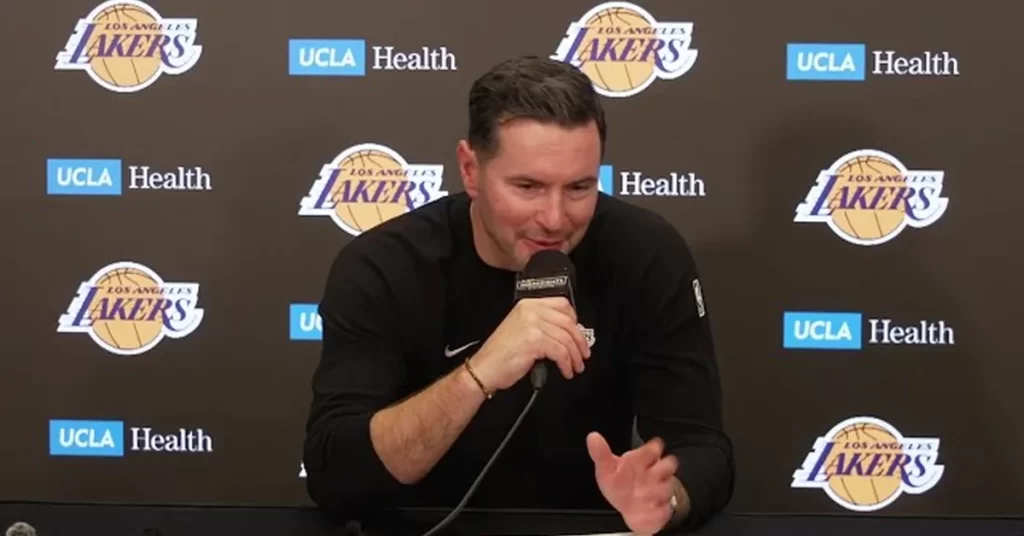
“I didn’t know the blood rule either,” Redick told reporters afterward. One reporter suggested the stoppage may give the defense more benefit because defenders can get set and talk through assignments. Redick asked whether the offense also gets to regroup. That explanation was the reporter’s interpretation. Redick’s question gets at what a 14-second minimum changes tactically. With 3.8 seconds, Charlotte likely needed an immediate shot or drive. With 14, it had enough time to run a screen or move the ball again. Had the Hornets scored late in that window, Los Angeles would have had only a few seconds to respond.
JJ Redick discusses why Charlotte received 14 seconds on the shot clock after the stoppage.
Original clip from Infanity TVWhat to watch for when play resumes
Watch who gets the ball, whether anyone has to leave the floor and which clock changes. The officials handle the restart, team medical staff handle treatment, and the scorer’s table records substitutions and adjusts the clock as directed. A broadcast can explain the stoppage in one sentence if it has those details. In Charlotte’s case, the Hornets kept the ball because it went off Sexton, Reid came out for treatment, and the offense went from 3.8 to 14 on the shot clock with 18.0 seconds still showing on the game clock.
More NBA coverage from SPMA on how the Raptors brought a fan-made logo to the arena scoreboard
Related organizations




Have experience with this topic?
Help make this SPMA resource better with a first-hand perspective, practical addition, or question. Use your SPMA account or contribute as a guest.