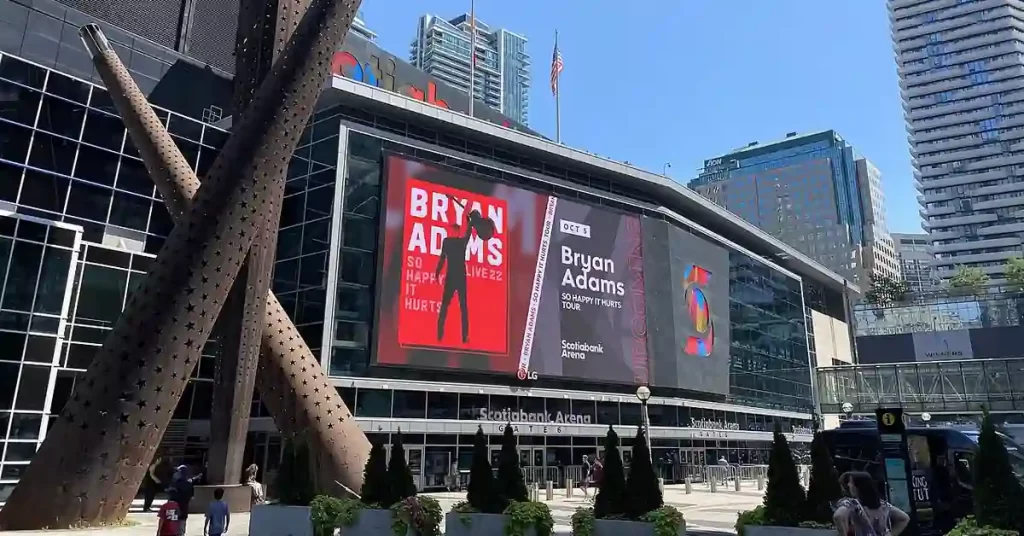
Two walls from Toronto’s old Postal Delivery Building still stand, and the mail tunnel became a public walkway. The story of how the Leafs and Raptors ended up sharing the arena takes a little more explaining.
Walk past Scotiabank Arena at Bay Street and Lake Shore Boulevard and you can see stone carvings of a steamship, an aircraft and a locomotive. They show how Canada moved mail long before the Leafs or Raptors played there. Those carvings are the best place to start if you want to understand Scotiabank Arena history, and they’re a good reason to pay attention to an Instagram reel about Toronto’s old mail depot.
The reel by @its.layers discloses its use of AI. Most of the story checks out. The trick is knowing which parts of the old building you can still see, what happened to the original tunnel, and who actually bought the basketball team.
What the reel gets right and what needs context
A postal building used during the war
National Defence occupied the building before it entered postal service. The on-site chronology dates the handover to 1941, while the arena’s history gives 1940 as the completion year.
The arena was built behind two historic walls
The project retained the east and south façades facing Bay Street and Lake Shore Boulevard. The hockey and basketball venue was new construction.
The mail tunnel survives as the Blue Route
The heritage display identifies the old passage under the railway tracks as the route now used by pedestrians between the arena and Union Station.
“The Leafs bought the Raptors”
Maple Leaf Gardens Ltd., the company that owned the Leafs, acquired the Raptors and their arena project in 1998. The company became Maple Leaf Sports & Entertainment.
From wartime storage to a working mail depot
The federal government commissioned the Toronto Postal Delivery Building in 1938. Its location by Union Station let postal workers move mail between the railway and the depot without sending it out onto the street. The stone reliefs tell a story about transportation and communication. Inside, conveyors carried unsorted mail upstairs. Chutes moved it back down as workers sorted it for dispatch by van or rail.
The Second World War interrupted that plan. The venue’s history says the building was completed in 1940 and immediately occupied by National Defence. The heritage display dates completion and the defence handover to 1941. Both agree on the sequence: wartime use came first, the building returned to the postal department in 1946, and alterations equipped it for mail sorting. Toronto designated the property under the Ontario Heritage Act in 1990, after postal operations had moved out.
How two teams ended up under one roof
The Raptors started out playing at SkyDome, now Rogers Centre. In 1996, the franchise acquired the former postal site for its own arena. Two years later, Maple Leaf Gardens Ltd. acquired the Raptors and the arena project while work was underway. The deal brought both teams and their future venue under one ownership group and gave the Leafs a successor to Maple Leaf Gardens.
One operator could schedule home dates for two major-league teams and use the same venue for concerts and other events. It could also sell premium seats, suites and sponsorship across a much busier calendar. That business decision explains why the Raptors’ arena project became a shared sports and entertainment venue.
Postal building takes shape
Raptors acquire the site
Maple Leaf Gardens Ltd. acquires the project
Air Canada Centre opens to both teams
The Leafs played Montreal there on February 20, 1999. The Raptors hosted the Vancouver Grizzlies the next day. The building opened as the Air Canada Centre and took the Scotiabank Arena name on July 1, 2018.
What you can still see on game night
The east and south façades and their restored carvings give fans something they can check for themselves. So does the old mail passage, now known as the Blue Route. The arena lists it alongside the Bay West Teamway as a connection from Union Station to the Galleria. There’s also a display of postal-building artifacts in the Galleria.
The reel also jumps to the Raptors’ 2019 playoff run. Kawhi Leonard’s Game 7 buzzer-beater against Philadelphia happened at Scotiabank Arena. The championship-clinching game against Golden State took place at Oracle Arena in Oakland.
The reel’s glowing cutaways and wartime scenes illustrate the history. The surviving walls, heritage records and venue documentation establish the details. That distinction mattered in our Toyota Center flood fact-check, too. In Toronto, the best evidence is still there on an ordinary game night. You can walk through the former mail route and see the carvings on your way in.
Read the short Answer on Scotiabank Arena’s postal history.
Related organizations
 Toronto RaptorsToronto, ON, CanadaView company
 Maple Leaf Sports & Entertainment (MLSE)Toronto, ON, CanadaView company
 Mattamy Athletic CentreToronto, ON, CanadaView company
 Rogers CentreToronto, ON, CanadaView company
 Toyota CenterHouston, TX, United StatesView company
 National Basketball Association (NBA)New York, NY, United StatesView company
Have experience with this topic?
Help make this SPMA resource better with a first-hand perspective, practical addition, or question. Use your SPMA account or contribute as a guest.