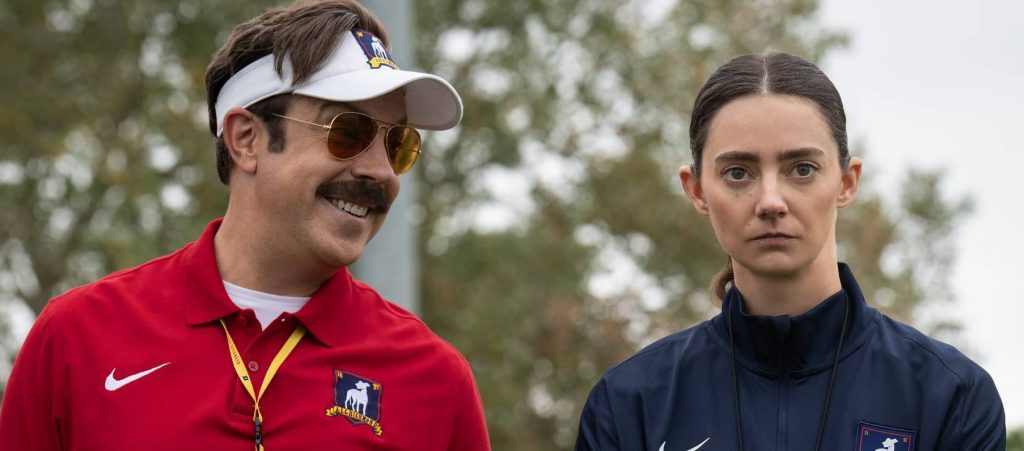
Ted Lasso has always been good at using fictional football problems to open the door to real sports conversations. Season 4 does it again with Alice Chilton, the blunt, protective assistant coach of AFC Richmond’s new women’s team. Her story is not built around a championship or a transfer. It starts with something much more uncomfortable: the playing career she lost.
Alice was once a promising footballer herself. Multiple ACL injuries ended that career and pushed her toward coaching. Season 4 makes the connection even harder to miss when one of the Lady Greyhounds suffers a serious knee injury and Alice immediately shifts from hard-edged coach to someone who understands exactly what the player is facing.
That storyline is what prompted this article. SPMA already covers Ted Lasso on The Shelf from a sport-business perspective, but Alice’s background raises a separate question worth exploring: what do career-ending sports injuries actually look like in real life?
The answer is not as simple as a list of torn ligaments and broken bones. Some careers end in one moment. Others fade through surgeries, failed comebacks, chronic pain, neurological risk or the realization that continuing to compete is no longer worth the long-term cost.
Who is Coach Alice Chilton in Ted Lasso Season 4?
Alice Chilton, played by Tanya Reynolds, is introduced as the assistant coach of AFC Richmond’s newly formed women’s side, the Lady Greyhounds. She is direct, skeptical of Ted’s relentlessly upbeat style and fiercely protective of the players. She also has a legitimate reason to believe she should have been considered for the head-coaching job herself.
Her playing background gives that frustration more weight. Alice was not somebody who drifted into coaching because she was finished with football. Football was taken away from her. In the show, repeated ACL injuries derail a promising playing career before she redirects that experience into coaching.
That distinction matters. There is a huge emotional difference between choosing to retire and being told, by your body or by medical reality, that the version of your future you had planned is no longer available.
It also explains why Alice can seem so guarded. A former athlete who has already lived through rehabilitation, setbacks and the end of a playing career is going to hear an injured player differently from a coach who has never been through it.
What does “career-ending sports injury” actually mean?
The phrase sounds definitive, but medicine rarely works that neatly.
An injury becomes career-ending when an athlete can no longer return safely or effectively to the demands of elite competition, or when the athlete decides the health risk, pain or rehabilitation cycle is no longer worth continuing.
That can happen for several reasons:
- the injury causes permanent loss of function;
- repeated surgery does not restore the athlete to the level the sport requires;
- reinjury risk becomes too high;
- neurological or cardiovascular concerns make continued competition unsafe;
- chronic pain or joint degeneration makes training unsustainable;
- the athlete can technically return, but no longer at a professional level;
- the physical and psychological cost of another rehabilitation becomes too much.
That last point is easy to overlook. A player does not have to be physically incapable of walking, running or exercising for an injury to end a professional career. The standard is not normal life. The standard is elite sport.
Why ACL injuries are such a powerful part of Alice Chilton’s story
An ACL tear is no longer automatically a career-ending injury. Modern surgical techniques and rehabilitation have helped countless athletes return to competition. But “many athletes return” is not the same as “every athlete returns exactly as before.”
The knee has to tolerate sprinting, cutting, landing, contact and sudden changes of direction. A soccer player may spend months rebuilding strength only to discover that the repaired knee is not the only issue. Compensation can affect the other leg. Meniscus and cartilage damage may accompany the ligament injury. Confidence in planting or changing direction can disappear. A second injury can reset the entire process.
That is why Alice’s fictional sequence of repeated ACL injuries feels believable rather than exaggerated. One tear can mean a year of work. Another can alter the direction of a career. Repeated injuries can change the question from “When will I be back?” to “Is there still a career to come back to?”
Season 4 also places that story inside women’s football, where ACL injuries have become a major welfare and performance issue. The show is not inventing the anxiety. It is using a fictional player and coach to dramatize a problem that women’s teams, medical staffs and governing bodies are actively trying to understand and reduce.
Real-life career-ending sports injuries do not all look the same
The most famous examples are useful because they show how many different paths can lead to the same result.
Ryan Shazier: when the priority becomes life beyond football
Ryan Shazier’s spinal injury during a 2017 Pittsburgh Steelers game changed the meaning of recovery almost instantly. Football became secondary to mobility, independence and long-term neurological health.
Shazier made remarkable progress in rehabilitation, but he never returned to NFL game action and later retired. His story is a reminder that the most important comeback is not always a comeback to the field.
Bo Jackson: one injury, two very different sporting outcomes
Bo Jackson’s hip injury is one of the most famous career-altering injuries in North American sport. The injury ended his NFL career, but not his athletic career altogether. Jackson eventually returned to Major League Baseball after hip replacement surgery.
That makes his case especially interesting. The same body could no longer meet the demands of an NFL running back, yet he was still able to compete professionally in another sport. “Career-ending” can depend on the exact physical demands of the job.
Sterling Sharpe: an elite career stopped at its peak
Wide receiver Sterling Sharpe was still one of the NFL’s best players when a serious neck condition ended his career after the 1994 season. There was no long farewell tour and no gradual decline into a smaller role.
Stories like Sharpe’s are difficult because the athlete’s ability is not necessarily gone. The risk of continuing is what changes.
Brandon Roy: when the knee can no longer absorb the workload
Brandon Roy’s NBA career became defined by chronic knee problems. He retired in 2011, attempted a comeback with Minnesota, then played only a handful of games before his knees forced the issue again.
His story is closer to what many athletes experience than the single catastrophic injury fans tend to remember. Degeneration can be gradual. A player may still be skilled enough to compete while the body becomes less able to survive the schedule required to do it.
Chris Bosh: when the medical risk is bigger than the athlete’s desire to play
Chris Bosh wanted to continue playing basketball. Recurring blood-clot issues made that far more complicated.
His case is important because it was not a traditional sports injury at all. He could train. He could still feel like an NBA player. But a professional sports career cannot be evaluated only by whether an athlete feels capable on a given day. Doctors and teams also have to consider what intense competition could trigger.
Andrew Luck: the accumulation can become the injury
Andrew Luck’s 2019 retirement shocked the NFL because he was only 29 and still viewed as one of the league’s best quarterbacks. There was no single injury that explains the whole decision. Years of shoulder trouble, other injuries, pain and rehabilitation had turned football into a cycle he no longer wanted to live through.
That is an important kind of career-ending injury story. Sometimes the body can probably keep going. The athlete simply decides the cost of keeping it going has become too high.
Concussions can end careers without leaving a visible scar
Head injuries have changed the way sport thinks about retirement because there is often no dramatic image that explains the decision. An athlete may look physically normal while dealing with headaches, light sensitivity, balance problems, memory issues or repeated concussion risk.
Former San Francisco 49ers quarterback Steve Young retired after a career that included multiple concussions. In collision sports, the decision to stop can become less about whether someone could physically take another snap and more about the uncertainty attached to taking another hit.
This is also where the language around toughness has had to evolve. Playing through pain is one thing. Playing through a brain injury is not a test of character.
The hidden injury is the loss of identity
When a professional athlete suffers a career-ending injury, the public sees the medical update. The athlete experiences something much bigger.
For years, sometimes since childhood, nearly every part of life has been organized around sport: training schedules, travel, teammates, competition, recovery, selection and performance. The answer to “What do you do?” has been obvious.
Then it is not.
That is what makes Alice Chilton such a useful fictional starting point. Coaching is not just her next job. It is a way back into a world she expected to occupy as a player. Her protectiveness toward the Lady Greyhounds makes more sense when viewed through that history.
Former athletes often move into coaching, scouting, player development, broadcasting, administration, medicine or performance roles. But the transition should not be romanticized. A second career can eventually become meaningful without making the loss of the first one painless.
What teams owe injured athletes
A career-ending injury is not only a medical issue. It is an organizational test.
Teams and sport organizations should be asking questions that go beyond the surgery date:
- Does the athlete have access to independent medical advice?
- Is mental-health support part of rehabilitation?
- Does the player remain connected to teammates while injured?
- Is the organization honest about the chances of returning?
- What support exists if the athlete cannot return?
- Can education, career development or mentoring begin before retirement becomes official?
An injured player can go from being central to a team’s plans to feeling invisible surprisingly quickly. Good organizations understand that rehabilitation is not just a performance project. It is a people-management responsibility.
Career-ending does not have to mean sport-ending
This is where the Alice Chilton story becomes more interesting than a standard injury plot.
Her playing career is over, but her relationship with football is not. She brings the experience of being an athlete into a role where it can affect dozens of other careers. That is common across real sport. Former players become coaches because they understand the rhythm of a season. They become scouts because they see details differently. They move into athlete development because they remember what they needed when they were younger.
None of that erases the injury. It changes what happens after it.
SPMA’s Ted Lasso page on The Shelf looks at the series through a sport-industry lens, including leadership, ownership and the behind-the-scenes operation of a club. Alice adds another useful layer to that discussion: the people running sport are often carrying experiences from their own playing careers with them.
What Ted Lasso gets right about the aftermath
The strongest part of the Alice storyline is not that injury magically made her a better coach. It is that the injury clearly changed her.
She is skeptical because she has lived through disappointment. She is protective because she knows what players can lose. She is ambitious because coaching is not a consolation prize to her. It is the career she built after the first plan disappeared.
That is much closer to real life than the usual sports-movie version of injury, where a montage ends with either a triumphant return or a neat acceptance of retirement.
Real careers rarely end that cleanly. There are second opinions, setbacks, rehab sessions, contracts, roster decisions, fear, anger and the difficult moment when an athlete has to decide whether hope is still helping or keeping them stuck.
Final thought
Career-ending sports injuries are compelling because they expose how fragile elite careers really are. Fans see contracts, championships and highlight reels. Athletes live with the knowledge that one awkward landing, one collision, one medical diagnosis or one too-many rehabilitation cycles can change everything.
Alice Chilton is fictional, but the idea behind her is not. Sport is full of coaches, executives, broadcasters and development staff whose original plan was to keep playing. Their careers did not unfold the way they expected, and that experience often follows them into whatever comes next.
That is why the most important question after a career-ending injury is not always “Could the athlete have played again?” Sometimes it is simply: what did they build after playing was no longer an option?
The people learning about sport careers here could be your next applicants.
Turn your next opening into a professional Sports Hired listing and give candidates a clear path from career research to your opportunity.
Have experience with this topic?
Help make this SPMA resource better with a first-hand perspective, practical addition, or question. Use your SPMA account or contribute as a guest.