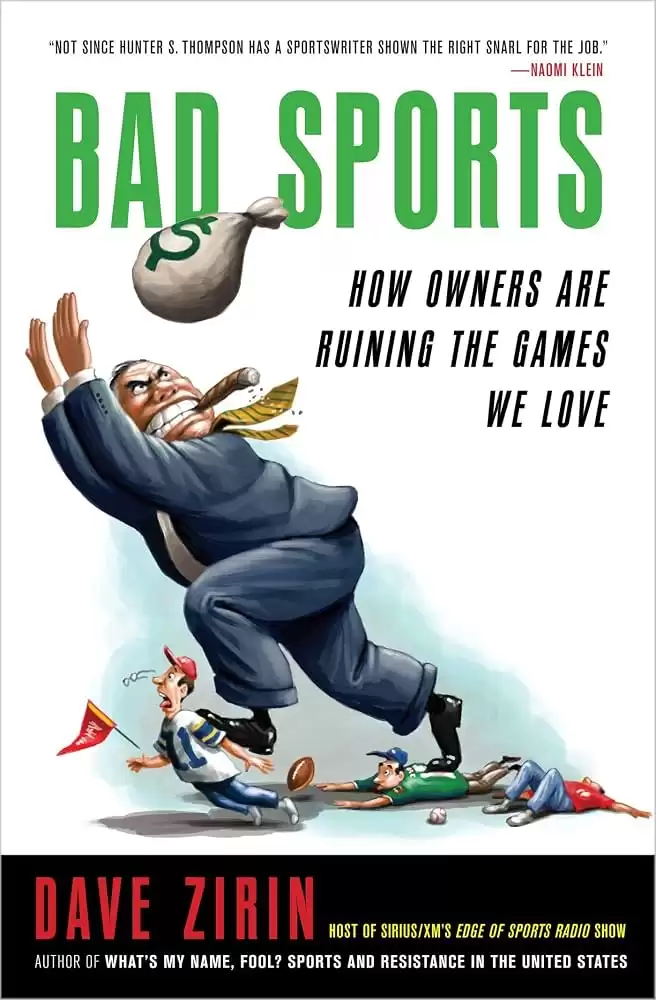
Fans often describe a team as something belonging to a city even when its legal owners have interests that extend well beyond local loyalties. In Bad Sports, published in 2010, writer Dave Zirin criticizes powerful owners and examines the consequences of stadium subsidies, commercial demands and political influence. His tone is openly argumentative, which is part of the book's character. It should be read as a sustained critique rather than a neutral survey of every ownership model. What makes the subject important to sports managers is the relationship between a team's symbolic status and its bargaining power. Owners can seek concessions by invoking community identity while also making decisions aimed primarily at private financial benefit.
The Shelf · Books
Bad Sports: How Owners Are Ruining the Games We Love
Dave Zirin's Bad Sports argues that major-league ownership should be judged by its public responsibilities as well as the financial value of a franchise.
The Gist
Why it caught our attention
At A Glance
Dave Zirin's Bad Sports argues that major-league ownership should be judged by its public responsibilities as well as the financial value of a franchise.
About This Shelf Item
About Bad Sports: How Owners Are Ruining the Games We Love
Zirin draws attention to cases where public resources support professional teams and asks whether the promised civic returns withstand scrutiny. The stadium debate is especially revealing because a venue has multiple constituencies. Owners pursue revenue and asset value; elected officials pursue investment and visibility; workers need stable jobs; and local residents bear costs that may not appear in a franchise's operating statement. The same event can genuinely unite a city and still be financed through a poor agreement. The book's criticism makes that distinction difficult to avoid. It also places ownership decisions within broader questions of power and accountability, rather than treating a sports club as an isolated entertainment product.
Why It Belongs
The Sport Connection
League officials and franchise executives should engage with the uncomfortable issue beneath the rhetoric: what obligations follow from a club's exceptional relationship with the public? Teams benefit from passionate identification and sometimes from direct subsidies or regulatory advantages. A manager does not need to agree with Zirin's every conclusion to recognize that transparent governance is essential. Stadium contracts, community benefits and changes to ticket pricing should be assessed with an understanding of who can influence the decision and who cannot. Public relations cannot compensate indefinitely for policies seen as exploitative. Conversely, sport organizations should be able to explain legitimate operating costs without pretending that every commercial interest is a betrayal of supporters.
Supporters are asked to think of clubs as civic institutions, while their legal structures often give owners considerable freedom to pursue private priorities. Zirin's critique is forceful, but it becomes most useful when turned into questions of governance. What obligations should a franchise have to the community that supports it? Which decisions can be made privately and which deserve public disclosure, particularly when a stadium uses public resources? A profitable club can still make choices that weaken its local relationships. Conversely, an owner can face genuine financial constraints that supporters cannot evaluate without access to credible information. The point is to demand transparency rather than assume every business decision has an obvious moral answer. For prospective sports executives, this is a reminder that organizational reputation is shaped by how institutions exercise power when they are not compelled to explain themselves. Ticket sales and victory totals will not capture the full cost of losing public trust.
Our Recommendation
Why Read Bad Sports: How Owners Are Ruining the Games We Love
The book is useful for stadium finance, public affairs and sport ethics discussions because it insists that the usual business-case language be questioned. Readers can compare its examples with more recent ownership practices, noting how much has changed and how much remains structurally familiar. They should also scrutinize the author's selection of cases and distinguish a legitimate disagreement over policy from verified misconduct. A polemical book is most valuable when it sends the reader looking for documents, lease agreements and evidence rather than merely adopting its indignation. That is precisely the kind of habit public-facing sport managers need when a development proposal attracts both excitement and concern.
Final Thoughts
Arash's Final Thoughts
Bad Sports earns a place on the Shelf by refusing to treat the owner as the only stakeholder who matters. Its sharp arguments invite debate, but its management challenge is clear: a franchise cannot rely on the language of community while asking to be exempt from community accountability. Sporting loyalty deserves a business model able to withstand public examination.
Keep Exploring
More On The Shelf