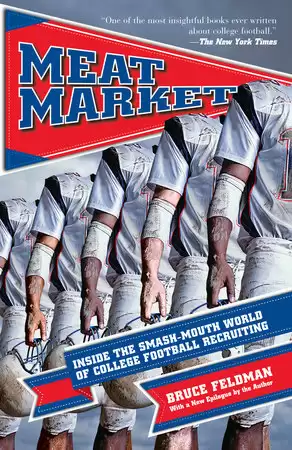
Bruce Feldman's reporting places readers inside the University of Mississippi football program as head coach Ed Orgeron and his assistants pursue recruits ahead of National Signing Day 2007. Originally published in 2007, Meat Market is less a conventional season diary than an account of college sport's unofficial second calendar, when decisions made in homes, on telephones and during visits determine the options available to a program months later. The title deliberately unsettles, reflecting the way young athletes can become scarce assets in a high-pressure marketplace. Feldman takes the reader into the work of persuading families, identifying talent and competing against schools with advantages that cannot be reversed in one recruiting cycle.
The Shelf · Books
Meat Market
Meat Market follows a college football recruiting operation closely enough to show that building a roster begins long before a coach calls a play on Saturday.
The Gist
Why it caught our attention
At A Glance
Meat Market follows a college football recruiting operation closely enough to show that building a roster begins long before a coach calls a play on Saturday.
About This Shelf Item
About Meat Market
The distinctive appeal is its attention to the mechanics. Coaches divide territories, assess prospects, nurture relationships and sometimes face the strange gap between what a teenager says and what he eventually signs. Recruiting combines rigorous observation with impression management. A prospect's measurable physical ability matters, but so do academics, personal circumstances, future development and whether the coaching staff can communicate a credible role. The book portrays the emotional intensity of a process in which dozens of decisions remain outside an organization's direct control. Orgeron's personality provides energy, but the story also exposes the people whose administrative and relationship work keeps a national recruiting effort functioning. Nothing about this system is effortless, despite the polished public announcement of a signing class.
Why It Belongs
The Sport Connection
For sport managers, recruiting sits at the meeting point of talent evaluation and organizational strategy. Offering a scholarship is a commitment with consequences for resources, team culture and the young person accepting it. Overestimating a prospect may close opportunities for others; underselling a role may damage trust before an athlete arrives. Feldman's account also highlights information problems. Programs gather incomplete evidence on rapidly developing teenagers, while families must choose among institutions whose promises concern a future no one can guarantee. Modern transfer rules, NIL arrangements and recruiting calendars differ from those in the book, making a direct comparison essential. Yet the underlying challenge remains: an organization must compete for talent without treating the recruit as merely an object to acquire.
Recruiting operations reward persistence, but the book makes clear that persistence needs organization behind it. A prospect may receive attention from many universities and assess each through a mixture of sporting ambition, family advice, academic needs and personal relationships. A head coach's enthusiasm cannot substitute for accurate eligibility information, careful communication or realistic expectations about playing opportunities. The staff must divide responsibilities, maintain reliable information and know when aggressive recruitment starts to undermine a young person's trust. Feldman's account of Orgeron's program is also rooted in a particular NCAA era; recruiting calendars, transfer rules and compensation opportunities have since shifted. That matters when using the book as a management case. Instead of copying every technique, readers should ask which systems would still be ethical and workable in a more transparent market. The transferable subject is not how to deliver the loudest sales pitch. It is how to coordinate a consequential decision involving a prospective student and an institution with considerably more experience negotiating the process.
Our Recommendation
Why Read Meat Market
Anyone interested in athletic department operations, scouting or youth sport should read Meat Market with two questions in mind. How do good evaluators separate a player's current advantages from his long-term capacity to improve? And what safeguards protect the recruit when adults are under strong pressure to close a commitment? Recruiting success is celebrated on signing day, but the true test may be what happens after a player joins the program. Did the promised support arrive? Was the developmental plan realistic? Did the institution respond responsibly when performance fell short? The book's intense atmosphere makes those later obligations easier to overlook, which is precisely why they deserve attention.
Final Thoughts
Arash's Final Thoughts
Meat Market is valuable not because every tactic it records should be repeated, but because it exposes the industry's incentives at close range. Feldman's recruiting trail reveals sports management as a long sequence of uncertain human judgments. The strongest organizations will be the ones able to turn those judgments into relationships that remain defensible after a recruit has signed.
Keep Exploring
More On The Shelf