Industry Profile
Every Treatment, Every Workout, Every Practice Should Be Goal-Oriented Says Delta College’s Jesse Torres

Every treatment, every workout, every practice, should have a goal and purpose in mind. If, it doesn’t, then why are you doing it?
Jesse Torres
The Conversation
Inside The Role
- Morning – workouts, administrative work
- Midday – evaluations, treatment, paperwork
- Afternoon – set up for practices, training sessions, and prepare athletes
- Evening – clean up practice, post-practice stretch/ice, recovery roll out/stretch
I had known I wanted to do something in the medical field just didn’t know what. In high school, I did not have an athletic trainer and I was injured and had to go to physical therapy. That’s what sparked my interest in working with athletes and helping them get back to doing what they love.
I was fortunate enough to play soccer at Saginaw Valley State University but they did not have a physical therapy program. All physical therapists I had talked to said Athletic Training is a great foundation for physical therapy. I then immersed myself into Athletic Training but needed that physical therapy rehabilitation strengthening part so I expanded in strength and conditioning to combine the best of both worlds.
With this, I’m not a typical Athletic Trainer equipped with emergency response, evaluation, & treatment, I have a physical therapy mindset (working with & in PT clinics, job shadowing, etc) the safety portion, and then advancing strengthening peak athletic performance. I am able to work with the athlete and come full circle from getting injured, treating them, getting them functionally moving again, and then back to athletic performance.
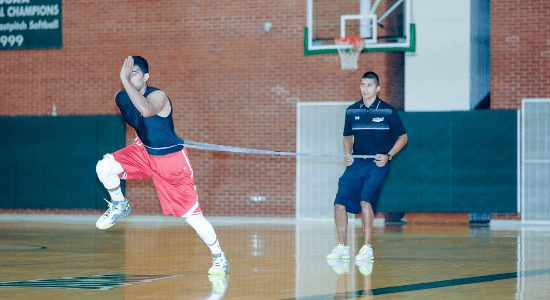
I believe in treating the whole athlete. I train athletic movements. If you were to breakdown the movements athletes need to prepare their bodies to perform, in thousandths of a second, they have to be able to adapt just as quickly.
In the grand scheme of it all, I train athletes, not specific sports players. Although we train athletic movements, training programming is different. All athletes need a solid foundation which everything is generated from, ‘the core’ and strong stable legs. We change the dynamics of programming to suit the demands of the sports and their season.
The great thing about being the Athletic Trainer and Strength coach is that I can seamlessly combine both the injury prevention and rehabilitation together. I believe in trying to prevent the injury before it happens. I have taken in how injuries have occurred, what was injured, and how to develop and strengthen body mechanics for that not to happen again. And if it does, it may not be as severe and help speed up recovery.
Injuries are going to happen, you just can’t stop them, but you can reduce the likelihood and decrease recovery time, with proper training. This is how I developed my strength and conditioning program. I also have individualized strengthening programs for those that have specific dysfunctions, imbalances, or chronic injuries.
Everything you do should have a purpose behind why you are doing it. Every treatment, every workout, every practice, should have a goal and purpose in mind. If it doesn’t, then why are you doing it? I look at it as your WHY? Why are you doing what you’re doing? It is hard to set a plan in place if you doing know where you’re going.
Then you have to develop the steps you are going to take to get you to the destination. I believe you should have a goal set for every day. What do you want to accomplish today, how does that small task align with your bigger vision of where you want to go and what do you want to achieve? I believe when setting goals you should have a daily goal, short-term goal (week-30days), and a long-term goal (90days-year).
Final Thoughts
Hayley's Final Thoughts
Jesse does incredible work within his role at Delta College. Being Head Athletic Trainer is not easy, especially when you train every single athlete within the school! Not to mention, the different, perhaps unseen facets that are involved in training athletes such as injury prevention, rehabilitation and administrative work. Despite Jesse's busy schedule, he executes his tasks seamlessly. Athletes need support to be at their best and Jesse does exactly that.
Connect With Jesse Torres
Continue Reading
Related Industry Stories