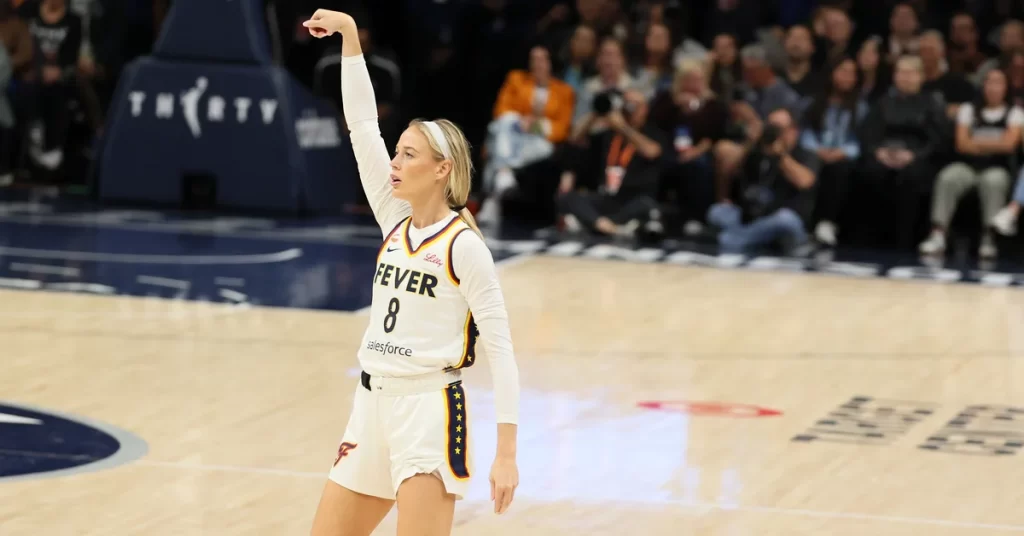
In November 2026, Sophie Cunningham appeared on the cover of Maxim. Earlier in the year, the Indiana Fever guard made her Sports Illustrated Swimsuit debut, got her own adidas Crazy Energy colorway, and took an equity stake in an insole company. Those are four different ways to build a business around a WNBA career, and they give a better picture of why brands want to work with her than a tally of sponsored posts.
The list of Sophie Cunningham endorsements includes an Arby’s game-day shirt, a Ring home-security ad, an adidas product release, and a brand ambassador deal with Once Upon A Coconut. She has also built a second line of work as a podcast host. For anyone who follows athlete marketing, the interesting part is how much each project asks her to do.
Sophie Cunningham endorsements and brand deals
This look at Sophie Cunningham endorsements covers publicly reported deals. Their structures differ. A brand can pay an athlete for a campaign, release a product bearing her name, or give her an interest in the business. Without the contract terms, the number of deals tells you very little about what she earned or what the companies got back.
What changed when Cunningham joined the Indiana Fever?
Cunningham spent six seasons with the Phoenix Mercury before Indiana acquired her in a trade ahead of the 2025 season. The Fever brought her back for 2026. By the time the cameras started following her into the arena tunnel, she had already spent years learning what it takes to stay on a WNBA roster. Indiana put her in front of a much larger audience.
One of the first moments that audience remembers came on June 17, 2025, in a game against the Connecticut Sun. Cunningham committed a hard foul on Jacy Sheldon late in the fourth quarter. The confrontation that followed led to three ejections, including Cunningham’s. Much of the coverage framed the sequence as Cunningham standing up for teammate Caitlin Clark. It became a defining part of Cunningham’s public image that summer.
Clark was already a major reason people were watching Indiana. Cunningham gave that audience another player to follow. The challenge for her representatives was deciding which opportunities made sense while the clip was still everywhere and which projects would still feel natural once the news cycle moved on. You can see that distinction in two of the campaigns she did that summer.
Ring and Arby’s used the same attention in different ways
Ring’s pitch was easy to get in one viewing. The company sells home security, and Cunningham was attracting headlines for protecting her teammates. Its campaign recast that reputation as protecting her own home court. The creative assignment for Cunningham was clear enough that the ad could get to the product quickly. Reuters covered the Ring campaign and podcast deal in July 2025.
Arby’s used a different piece of the game-day experience. Cunningham arrived for a July 2025 Fever game against the Chicago Sky wearing an Arby’s shirt. A joint Instagram post took the reveal beyond the arena. The activation worked with a routine that already had an audience. Fans were looking for pregame outfits and photographers were already there. The shirt gave both groups something specific to notice.
There’s a useful difference in how the partnerships could be evaluated. Ring could look at whether viewers remembered the home-security message once the spot was over. Arby’s could check how far the reveal travelled across the athlete’s account, the brand’s feed, and coverage of the game arrival. Both had exposure, but they were asking fans to pay attention to different things.
Inside the Sophie Cunningham adidas shoe
The July 2026 adidas WNBA Crazy Energy pack included player-exclusive colorways inspired by Cunningham and Satou Sabally, plus an All-Star edition. Cunningham’s version used a pink gradient with hints of blue and orange, a cowboy-inspired graphic on the sock liner, and “Giddy Up” tucked inside the tongue. Adidas described the design as a nod to her Midwestern roots.
A player-exclusive colorway gives an existing shoe a design connected to a specific athlete. In this case, fans could buy the release. The colorway made Cunningham’s background visible in a physical product and gave adidas a way to see how buyers responded. A sellout can be encouraging for a limited release. The size of the initial run, the time it took to sell, and demand for a restock give a brand a clearer read on whether the idea can be repeated.
Timing matters for the retailer, too. All-Star weekend gives a new colorway a reason to appear in coverage at the same time fans are already paying attention to shoes and uniforms. Once the weekend is over, adidas can still show the design, but the occasion that gave the launch its urgency has passed. A brand planning a release has to work backward from that date and make sure the story, inventory, and retail pages are ready together. The athlete’s post is one part of that coordination.
Once Upon A Coconut took the relationship into retail
Once Upon A Coconut named Cunningham a brand ambassador in August 2026. As a beverage partner, it could work with her in settings far removed from the arena tunnel, including social content and retail promotion. Later that year, the company also ran a limited-edition pink-can campaign supporting the National Breast Cancer Foundation.
For a grocery product, a fan’s first encounter with the campaign may happen on a phone and the purchase may happen days later at a store. The brand has to think about where the product is stocked, how easy the package is to recognize, and whether awareness translates into trial. Repeat purchases are especially useful here. A first sale can tell you someone tried the drink. A second purchase can tell you they remembered it or liked it enough to go back.
Why Cunningham’s Groov deal stands out
Groov makes personalized insoles. In an interview with Kicks On SI, Cunningham and founder Dan Cataldi discussed a deal that included an equity stake. Cunningham said she tried the product before signing. She also brought up people in occupations outside sports who spend much of the day on their feet, including farmers and workers in construction.
That matters because an athlete can help a company reach customers who know her work while opening a conversation with people who may never see her play. Cunningham can demonstrate why she might use the insoles in a basketball shoe. Her family’s ties to farming and construction give her other examples from her own life. For Groov, those stories help explain the practical problem it is trying to solve across several markets.
An ownership stake also changes the questions an athlete should ask. How big a stake does the deal include? What has to happen for it to have value? What work will the company expect after launch? Public reporting establishes that Cunningham has equity. The size and value of her stake are private, so readers can understand the structure without putting an unfounded dollar figure on it.
The deal also has a different time horizon from a game-night activation. Arby’s could photograph the shirt the night Cunningham wore it and see where the image travelled that week. With Groov, the work might continue through customer feedback, product updates, and new ways of reaching people outside sports. The structure gives Cunningham a stake in what happens after the first round of coverage, and it gives the company a reason to involve her beyond the announcement.
From Show Me Something to the No Hesitation podcast
Cunningham launched Show Me Something through The Volume in July 2025 with West Wilson, a longtime friend from Missouri and a cast member on Bravo’s Summer House. A WNBA player and a reality TV personality made for a show with more than one audience from the first episode. In 2026, Cunningham moved to No Hesitation with basketball trainer Drew Hanlen, bringing a different mix of basketball experience to the conversation.
A podcast lets fans spend more time with an athlete than they would in a game clip. It also gives Cunningham a regular opportunity to talk about the league, interview guests, and tell her own stories during the season and after it ends. For a podcast advertiser, an audience that returns and finishes episodes can tell a different story from a large view count on one clip.
That side of the business also helps explain Cunningham’s representation. In January 2026, TheWrap reported that she had signed with 3 Arts Sports for opportunities in entertainment, storytelling, and brand partnerships while continuing to work with Perry Rogers. Each of those areas involves different deals and relationships. A company casting a show, for example, looks for very different things from a team evaluating a free agent.
What can sponsors learn from these WNBA brand deals?
Start by asking what the athlete actually did in each arrangement. Ring cast Cunningham in a campaign, Arby’s put a product in a setting photographers already covered, and adidas collaborated on a colorway people could buy. Groov offered a stake in the company. Grouping all four under endorsements is convenient, but it obscures why each company signed the deal and what it could measure afterward.
There’s also something to learn from her November Maxim profile. In the cover interview, Cunningham discussed her background, competitive streak, and long-term interest in running the WNBA. The cover put her in front of people who might never look at a basketball box score. For a sponsor, that kind of crossover can open up a new audience. The hard part is deciding what to offer that audience after the first introduction.
There’s a practical lesson here for smaller properties, too. A local team may have neither a national television audience nor the budget for a footwear launch, but it can still build a sponsorship around a moment people actually look forward to. A pregame arrival, a recurring interview, or a postgame segment gives the sponsor a recognizable place in the event. Decide what the partner is paying for, who will capture it, and how the team will share it afterward. Cunningham’s campaigns are bigger, but those production decisions are familiar to anyone who has worked on a game day.
Sophie Cunningham endorsements and podcast FAQ
What companies sponsor Sophie Cunningham?
Publicly reported examples include adidas, Ring, Arby’s, Once Upon A Coconut, and Groov. They include advertising campaigns, a retail footwear release, an ambassador deal, and a partnership with equity.
Does Sophie Cunningham have an adidas shoe?
Yes. Adidas released her Crazy Energy player-exclusive colorway in July 2026. The shoe used the existing Crazy Energy model and featured design details inspired by Cunningham.
What is Sophie Cunningham’s podcast called?
Her 2026 show with basketball trainer Drew Hanlen is called No Hesitation. She previously co-hosted Show Me Something with West Wilson.
How much does Sophie Cunningham make from endorsements?
There is no reliable public total for Cunningham’s endorsement earnings. Brands have disclosed some of the projects and the structure of individual deals, but fee amounts and the value of her equity are generally private.
For another example of how sponsorship takes shape on game day, see SPMA’s San Antonio Spurs game presentation case study.
Related organizations
 Women's National Basketball Association (WNBA)New York, NY, United StatesView company
 AdidasHerzogenaurach, Bavaria, GermanyView company
 Indiana FeverIndianapolis, IN, United StatesView company
 Chicago SkyChicago, IL, United StatesView company
 Houston CometsHouston, TX, United StatesView company
 Phoenix MercuryPhoenix, AZ, United StatesView company
 San Antonio SpursSan Antonio, TX, United StatesView company
 Sports IllustratedNew York, NY, United StatesView company
 National Basketball Association (NBA)New York, NY, United StatesView company
Have experience with this topic?
Help make this SPMA resource better with a first-hand perspective, practical addition, or question. Use your SPMA account or contribute as a guest.