


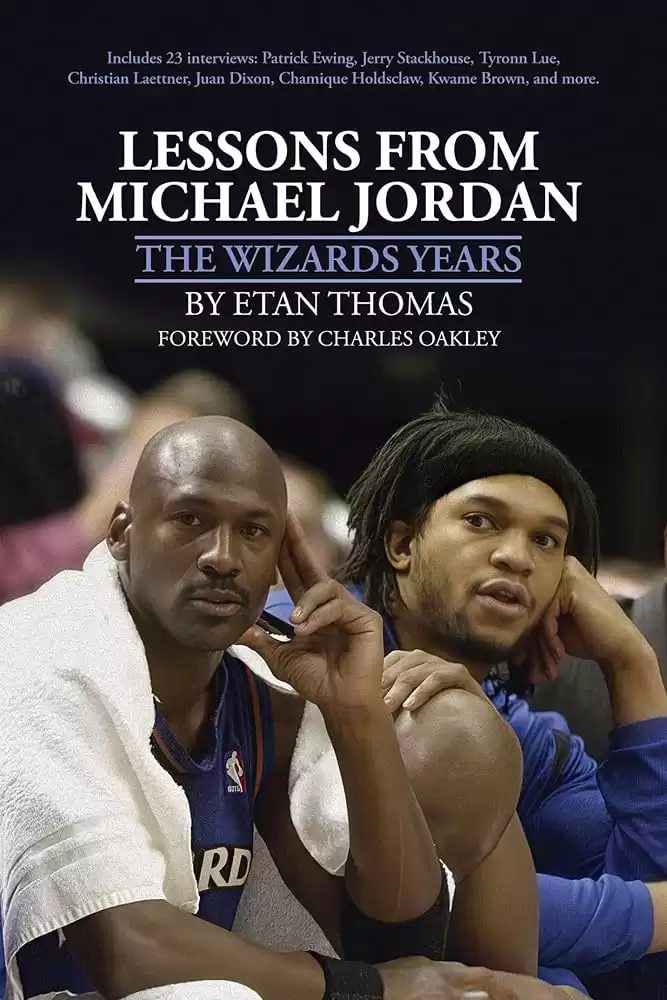
Most books about Michael Jordan concentrate on the championships, global fame and competitive mythology built in Chicago. Lessons from Michael Jordan: The Wizards Years turns to the more awkward final chapter. Akashic Books lists Etan Thomas's book for January 5, 2027, and describes a collection of 23 interviews with people who played alongside, competed against or worked with Jordan during his Washington period. Thomas was Jordan's teammate, giving the project a direct personal point of entry. But its more unusual feature is the collection of voices, not a claim that one witness can explain everything about two seasons in a complicated franchise.
The Shelf · Books
Lessons from Michael Jordan: The Wizards Years
By Etan ThomasReleased 2027Curated by SPMA Hub because sport culture lives beyond the field.
Etan Thomas's forthcoming Lessons from Michael Jordan approaches the Wizards years through teammates and colleagues rather than recycling the usual Chicago Bulls legend.
The Shelf
The Gist
Why it caught our attention
At A Glance
Etan Thomas's forthcoming Lessons from Michael Jordan approaches the Wizards years through teammates and colleagues rather than recycling the usual Chicago Bulls legend.
About This Shelf Item
About Lessons from Michael Jordan: The Wizards Years
The publisher's announced contributors include Charles Oakley, Jerry Stackhouse, Kwame Brown, Tyronn Lue, Christian Laettner, Patrick Ewing, and others associated with the period. Their perspectives promise a view of Jordan as an older superstar operating under conditions very different from those of the Bulls' dynasty. He had returned to playing after a period in Washington basketball's leadership structure, and the franchise was negotiating the competing imperatives of performance, development and commercial attention. The forthcoming book is described as reflecting on lessons drawn from those experiences. This entry is a preview based on the publisher's material, not an assessment of interviews that have not yet been read and checked in the finished volume.
Why It Belongs
The Sport Connection
The Wizards period invites a management question that the championship years can obscure. What happens when an extraordinarily successful figure enters an organization that cannot reproduce the ecosystem around his earlier success? Jordan's brand could generate attention and expectation, but a roster still had to establish roles, develop younger players and absorb daily decisions. The book's interview structure is promising for studying how those dynamics looked from different positions within the same organization. A veteran teammate, a young lottery pick and a member of the coaching staff may recall the same event through sharply different responsibilities. That variation is evidence to interpret rather than a problem to edit away.
Our Recommendation
Why Read Lessons from Michael Jordan: The Wizards Years
Thomas's project also touches the relationship between a franchise's sporting decisions and its public narrative. A celebrated athlete may drive ticket interest and media coverage even when the team's long-term objectives are uncertain. Sports executives must decide whether their short-term commercial opportunity supports or competes with player development, roster construction and the authority of coaches. Interviews can help illuminate that tension, but readers should resist treating recollections as infallible records. Retrospective accounts are influenced by relationships, time and reputations. Anyone using the book for case-study teaching should compare its stories with contemporaneous reports and clearly identify where interviewees disagree. That practice is especially important when discussing individual players' development or organizational failures.
There is a special danger in allowing Jordan's later reputation to flatten the period into a single simple lesson about greatness. The Wizards played in a distinct competitive environment, with a roster and management structure that did not reproduce the Bulls. Young players did not all enter those years with the same status or opportunity. A credible article about the finished book should distinguish what Thomas directly witnessed from what each interviewee remembers, and avoid declaring one disputed memory authoritative merely because its speaker is famous. That approach turns a collection of recollections into a stronger resource for studying accountability and organizational decision-making.
Final Thoughts
Arash's Final Thoughts
Lessons from Michael Jordan: The Wizards Years is a welcome candidate for the Shelf because it shifts attention toward a period that is usually treated as an epilogue. The publisher's information is sufficient to outline its subject, interview approach and potential management relevance, but not to declare its conclusions. A full critical assessment should follow the announced January 2027 publication. For now, the useful question is why leadership, fame and a compelling personal history did not automatically solve an organization's competitive challenges. Thomas's chosen witnesses may provide a much richer answer than a highlights package ever could.
Keep Exploring
More On The Shelf

Copied
