Career Guide
About This Role
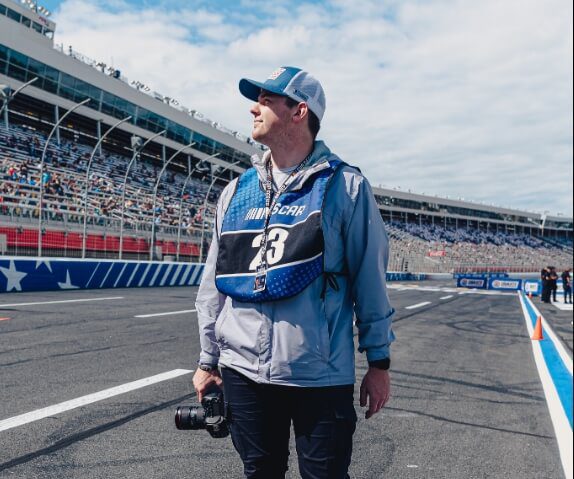
A Sports Photographer documents competition, personalities, and the atmosphere around a sporting event. The assignment might be an editorial game report, a team’s image library, a sponsor campaign, or a portrait session. Those are different briefs. A photograph that works beautifully as a magazine feature may not satisfy a client who needs a clear image of a particular activation before a publishing deadline.
The job therefore involves more than capturing an exciting moment. It requires understanding the assignment, obtaining the appropriate access, making visual decisions under changing conditions, and delivering organized, accurate files. Before choosing equipment or chasing a spectacular angle, a photographer needs to know what the client is trying to communicate and what they are permitted to photograph.
Start with the assignment, not the highlight
The Bureau of Labor Statistics photography profile identifies composition, image processing, digital portfolios, and archiving among the occupation’s activities. Sport adds an assignment context in which action and access can change quickly. The workflow below is a practical example, not a credentialing policy for every league or venue.
A useful brief identifies the intended audience, required subjects, deadlines, delivery format, and person who approves the work. Clarify whether the client needs an immediate selection during the event, a complete edited gallery afterward, or both. These decisions affect how much time can be spent shooting and how the photographer organizes the delivery process.
Planning access and positioning
Check the event’s instructions before arriving. A credential should not be treated as permission to enter every area or interrupt another person’s work. Confirm the permitted positions, arrival process, equipment restrictions, and contact for access questions. Plan movements around the venue’s directions rather than assuming that an empty space is an available shooting position.
Positioning should serve the story as well as the action. A useful assignment plan might include competition, reactions, establishing views, and the requested commercial details. Anticipating where those opportunities may occur helps avoid returning with dozens of similar action frames but no usable image of the setting or the people supporting the event.
Understanding the sport without predicting the result
Knowledge of a sport helps a photographer notice developing moments and choose a useful perspective. However, preparation should include more than the expected star or likely outcome. A complete visual account may depend on a substitute’s reaction, a coach’s interaction, or a quiet moment after the final result.
Maintain awareness of the event while working. Looking through a camera does not remove the need to follow instructions or stay clear of competitors and staff. The aim is to capture the assignment from authorized positions, not to create a disruption that becomes the main story.
Selecting and captioning images accurately
Editing begins with selection. Choose images that meet the brief, are technically usable, and add something to the gallery. Ten nearly identical frames can make the client work harder without providing ten different storytelling options. Organize the delivery so the strongest and most relevant images are easy to locate.
Captions need the same care as the photograph. Verify names, the event, and the action being described against reliable records. Do not identify a person from an uncertain visual guess. Any editing should follow the assignment’s standards, particularly where the image is being used as a record of a real event rather than a clearly identified creative treatment.
An illustrative deadline assignment
Many sports photographers combine photography with a content job. Kishan Mistry, then a social content producer at Yahoo Sports Canada, told SPMA in 2019: “Outside of my day job, I’m also a freelance photographer under my own name and work for clients such a Flow 93.5 shooting concerts.” Mistry was also clear that the craft was learned outside the classroom: “On a physical skills side, graphic design and photography are both self- taught.”
During the event, the photographer marks useful frames and follows the agreed transfer workflow. The first delivery answers the immediate brief rather than attempting to be the final archive. After the event, the fuller edit adds context, removes unnecessary repetition, and checks captions and file organization before submission.
The client receives two clear deliveries with different purposes. This is a better result than receiving an enormous unsorted folder late, even if that folder contains several excellent photographs. The example illustrates why reliability, selection, and communication belong in a photography portfolio alongside visual skill.
Protecting the work after the shutter closes
File handling should be planned before an assignment, not improvised when a memory card is full. Establish how images are copied, checked, backed up, and retained. Confirm successful transfer before removing the only available copy. Use the employer’s or client’s approved storage arrangements when the images contain restricted or sensitive material.
Naming and metadata also matter after delivery. A future colleague should be able to find an image without remembering which device or folder originally held it. An organized archive makes the work useful beyond its first publication, provided that any later use remains within the relevant permissions and agreement.
Staff roles and freelance assignments
A staff position and a freelance commission can place different responsibilities on the photographer. Before accepting work, clarify the expected deliverables, editing time, travel arrangements, equipment responsibilities, payment terms, and permitted uses of the images. These are questions to resolve in the actual agreement, not assumptions that follow from the word photographer.
Seek appropriate professional advice for contractual or rights questions that are outside your expertise. A portfolio page should not expose confidential client material or imply that every image is available for unrestricted reuse. Permission to attend an event, permission to publish, and the terms of a paid assignment are matters to clarify rather than conflate.
Building evidence that employers can assess
Show a complete assignment as well as individual favourites. Include a brief description of the objective, your contribution, the constraints, and the final delivery. A coherent gallery can demonstrate that you can cover an event rather than happen upon one outstanding frame.
In SPMA’s 2019 interview with Kishan Mistry (2019), he discussed creating social content, photographing sport, and the challenge of working within access restrictions. His account offers a specific historical perspective on combining visual skills with a publishing purpose. It is not a statement about his current employment or today’s credentialing arrangements.
From SPMA’s industry interviews
SPMA’s feature on sports photographer Kishan Mistry explores why great action shots are harder than professionals make them look: timing, anticipation and knowing the sport matter as much as equipment. Teams increasingly hire photographers as part of content teams; at clubs such as York United FC (2021), design, photo and video often sit together.
Photography also supports other departments. Alex Witherspoon of the Kitchener Rangers (2021) described running around the building on game days taking photos of fans for social content, while Claus Souza (2019) told SPMA he collects the action shots athletes give him, a reminder of how much those images mean to players.
Related roles and questions before applying
A Content Producer may coordinate a wider multimedia story, while a Digital Content Manager plans how material is commissioned and published. Photography can intersect with both, but a job description should explain whether those additional duties are included.
Ask how assignments are briefed, how quickly images must be delivered, who checks captions, and how success is evaluated. The strongest preparation combines visual judgement with an organized production process. A client needs photographs they can use, trust, find, and publish within the agreed terms.
Sports photographer jobs on SPMA: what the postings show
Since late 2023, SPMA has listed 12 jobs that match this role, including 1 in Canada and 11 in the United States. Employers used titles such as “Intern, Photography”, “Freelance Sports/ Live Action Travel Photographer”, “Photography and Digital Asset Management Coordinator” and “Photography Seasonal Assistant”. Organizations that posted them include DanceBUG Inc., Jacksonville Jaguars, Major League Baseball, Baltimore Orioles and Florida Panthers Hockey Club, Ltd.
Among 5 U.S. postings that listed hourly pay, the median midpoint was US$25.00 an hour (middle half US$25.00–US$25.00).
Source: SPMA’s database of 3,289 sport job postings in Canada and the U.S., late 2023 to November 2026, matched by job title. Pay figures use the midpoint of each posted range and exclude postings without pay. See current photographer openings on SPMA.
Sports photographer salary and job outlook
Pay for Sports Photographer positions depends heavily on the level of sport, the size of the organization and the region. The closest occupation tracked by the U.S. Bureau of Labor Statistics is photographers, which had a median annual wage of $44,660 in May 2025 across all industries, with employment projected to decline by 1% from 2025 to 2035. Many sports photographers work freelance.
Treat any national figure as a broad benchmark rather than a sport-specific salary. Jobs with junior, minor-league, university and nonprofit sport organizations often pay below all-industry figures, while senior roles at major professional teams and leagues can pay more. In Canada, use Job Bank’s wage search to check current wages for the closest occupation in your province, and compare with pay ranges in live postings on SPMA’s jobs board.
Common career questions
How much does a sports photographer make?
Pay varies widely by level of sport and organization. The closest U.S. government occupation category, photographers, had a median annual wage of $44,660 in May 2025 across all industries, but many sport jobs pay less, especially at junior, minor-league, university and nonprofit organizations.
What does a sports photographer do?
A sports photographer captures action, portraits and behind-the-scenes images for teams, media or agencies, then selects, captions and delivers them quickly and accurately.
Do sports photographers need expensive equipment?
Professional work usually needs fast cameras and long lenses, but skill in timing, positioning and editing matters most. Many start with entry-level gear at local events.
Is sports photography a full-time job?
Some teams and media outlets employ staff photographers, but many sports photographers work freelance or combine photography with other content roles.