Career Guide
About This Role
A Strength and Conditioning Coach plans, teaches and supervises the physical training that prepares athletes for the demands of their sport: strength, power, speed, conditioning and robustness against injury. The job is not handing every athlete the same gym workout. A good program reflects the sport’s movement demands, each athlete’s training history and injury restrictions, the competition calendar and how much recovery time actually exists.
The role looks different by setting. In a university program, one coach may serve several varsity teams from a shared weight room. In professional sport, a head strength coach usually leads assistants and works daily with a sports science and medical staff. In private practice, coaches train youth athletes and adults one-on-one or in small groups.
What a strength and conditioning coach does day to day
When SPMA interviewed Claus Souza, Assistant Strength and Conditioning Coach for the NBA’s Denver Nuggets (2019), he described the job as building the best possible environment for players to improve, with a plan that covers sleep and recovery, nutrition and hydration as well as the training itself. A normal day started with checking that players ate and hydrated before training, then sessions on the court or in the weight room, followed by skill work and post-training nutrition.
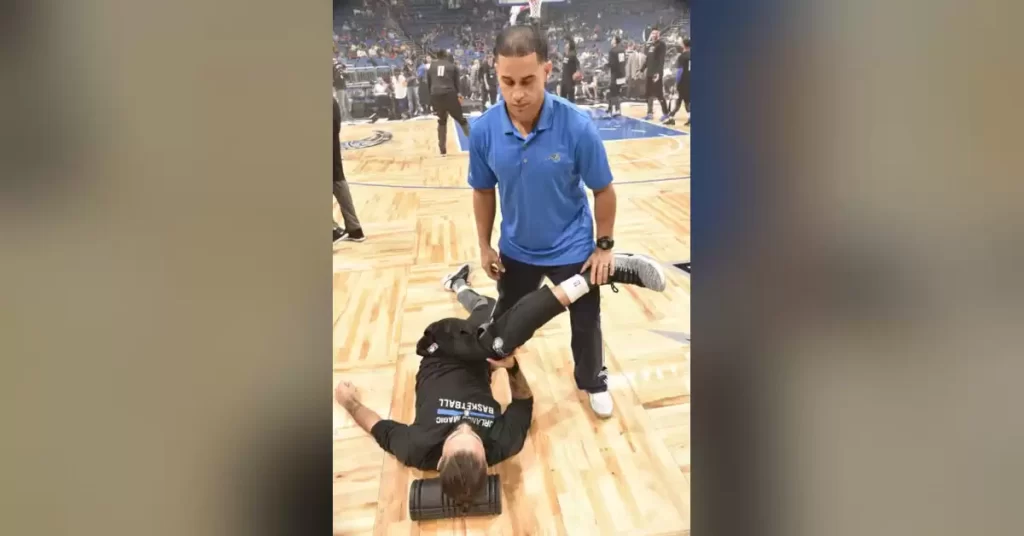
That breadth is typical. Most of a strength coach’s week is spent on four things: designing and adjusting programs, coaching technique on the floor, monitoring how athletes respond, and communicating with the head coach and medical team about what each athlete can safely do.
Claus Souza told SPMA in 2019: “Currently, I’m the Assistant Strength and Conditioning Coach for the Denver Nuggets. Our roles as strength coaches are to provide our players with the best environment possible in order to enhance their abilities to perform at an even higher level.” Souza added that “we have to make sure we have to have a sound plan for their development.”
What a strength and conditioning coach decides, and what sits with others
The strength coach typically owns exercise selection, loading, session structure and how the weight room runs. Training load across the whole week is shared with the Head Coach and, where one exists, a Head of Performance or Sports Scientist.
Clinical decisions are not the strength coach’s to make. Diagnosis, rehabilitation plans and return-to-play clearance belong to physicians, a Sports Physiotherapist or an Athletic Therapist. The strength coach works within the restrictions they set, and often takes over in the later stages of return to training once an athlete is cleared. Nutrition advice beyond general guidance belongs with a Sports Dietitian.
Coaching the athlete, not the spreadsheet
Programming is the visible part of the job, but coaching is what makes it work. Athletes need to understand why a session matters, lift with sound technique, and trust that the coach will adjust when they are sore or carrying a knock. Souza told SPMA that the best part of the job is working with people, and that he hoped the time spent with players would shape their habits when they were away from the facility.
Youth athletes need particular care. Programs should match developmental stage rather than copying a professional team’s plan, supervision ratios should be realistic, and safeguarding procedures apply in the weight room as much as anywhere else.
Skills employers look for in a strength and conditioning coach
- Program design: a sample annual plan for a specific sport showing off-season, pre-season and in-season phases.
- Coaching on the floor, often assessed with a live practical session during interviews.
- Monitoring and communication: how you track load and readiness, and how you report it to coaches in a few minutes.
- Certification. Common credentials include the NSCA’s Certified Strength and Conditioning Specialist (CSCS), the CSCCa’s SCCC for collegiate roles in the U.S., and CSEP certifications in Canada. Many employers also require first aid and CPR.
- Education in kinesiology, exercise science or a related field, which most full-time roles expect.
How to become a strength and conditioning coach
Most strength coaches start with internships and graduate assistant positions in university athletics departments, where they coach large numbers of athletes under supervision. Souza described his own path as far from easy, including a low point during graduate school while working as a graduate assistant, before roles with Auburn women’s basketball and then the Nuggets.
Many coaches also build experience in private training. Kendel Ross (2019), Head Coach of Lambton College women’s basketball, told SPMA she starts many days at 6 or 7 a.m. training strength and conditioning clients before teaching and coaching. When you interview, ask how many athletes and teams the role covers, who decides training load, what monitoring technology is available, and how the strength staff and medical staff share information.
Strength and conditioning coach jobs on SPMA: what the postings show
Since late 2023, SPMA has listed 10 jobs that match this role, including 5 in Canada and 5 in the United States. Employers used titles such as “Strength and Conditioning Coach”, “Player Development Strength & Conditioning Coach”, “Head Coach, Strength and Conditioning” and “Lead, Strength and Conditioning Coach”. Organizations that posted them include San Francisco Giants, Baltimore Orioles, Thompson Rivers University, Carleton University and Canadian Sport Institute Pacific.
Examples of posted pay: Strength & Conditioning Coach, Canadian Sport Institute Alberta (Calgary): C$60,000–C$80,000 a year; Strength and Conditioning Coach, Toronto Pan Am Sports Centre Inc. (Scarborough): C$35.00 an hour. With so few postings listing pay, treat these as examples rather than a market rate.
Source: SPMA’s database of 3,289 sport job postings in Canada and the U.S., late 2023 to November 2026, matched by job title. Pay figures use the midpoint of each posted range and exclude postings without pay. See current strength and conditioning coach openings on SPMA.
Strength and conditioning coach salary and job outlook
Pay for Strength and Conditioning Coach positions depends heavily on the level of sport, the size of the organization and the region. The closest occupation tracked by the U.S. Bureau of Labor Statistics is fitness trainers and instructors, which had a median annual wage of $47,160 in May 2025 across all industries, with employment projected to grow by 7% from 2025 to 2035.
Treat any national figure as a broad benchmark rather than a sport-specific salary. Jobs with junior, minor-league, university and nonprofit sport organizations often pay below all-industry figures, while senior roles at major professional teams and leagues can pay more. In Canada, use Job Bank’s wage search to check current wages for the closest occupation in your province, and compare with pay ranges in live postings on SPMA’s jobs board.
Common career questions
How much does a strength and conditioning coach make?
Pay varies widely by level of sport and organization. The closest U.S. government occupation category, fitness trainers and instructors, had a median annual wage of $47,160 in May 2025 across all industries, but many sport jobs pay less, especially at junior, minor-league, university and nonprofit organizations.
What does a strength and conditioning coach do?
A strength and conditioning coach designs and delivers physical training programs that improve athletes’ strength, speed, power and conditioning for their sport, while helping to reduce injury risk. They coach technique, monitor athletes’ responses and adjust plans around the competition schedule.
What certification do you need to be a strength and conditioning coach?
Requirements vary by employer. The NSCA’s CSCS is the most widely requested credential; collegiate roles in the U.S. often ask for the CSCCa’s SCCC, and Canadian employers may ask for CSEP certification. Check each posting.
Is a strength coach the same as a personal trainer?
Not quite. Both design exercise programs, but a strength and conditioning coach prepares athletes for a specific sport and competition calendar, usually working inside a team with coaches and medical staff.
Can a strength coach clear an injured athlete to train?
No. Clearance comes from the medical team. The strength coach works within their restrictions and often leads the final stages of return to training.
Further reading and qualification checks
See the U.S. Bureau of Labor Statistics Fitness Trainers and Instructors profile for broad occupational data, and the certifying bodies’ own sites for current requirements. Related SPMA guides: Mental Performance Consultant and Performance Analyst.