The Shelf · Books

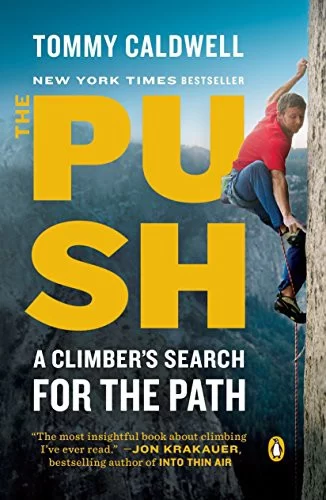
The Push

By Tommy CaldwellReleased 2017Curated by SPMA Hub because sport culture lives beyond the field.

The Push follows Tommy Caldwell's life toward an extraordinary climbing objective without pretending that the route explains everything that came before it. The Dawn Wall offers a visible achievement. The memoir's more complicated subject is how ambition develops through family influence, trauma, physical adaptation and the people who share the work.

Alex Bennett
Covered by Alex Bennett
The Shelf
The Push
The Push
The Gist Of The Push

The Gist

Why it caught our attention

Published in 2017, Caldwell's memoir connects his early development as a climber with the long project of free climbing the Dawn Wall on Yosemite's El Capitan. In 2015, he and Kevin Jorgeson completed that ascent. The book places the celebrated result inside a much longer history of preparation and personal change.

Free climbing is an important distinction here. It means using the rock for upward progress while ropes and protective equipment serve safety functions; it is not the same as climbing without a rope. Understanding that difference allows the achievement to be discussed through difficulty, execution and sustained problem-solving rather than through a mistaken image of unprotected ascent.

The Details

Quick facts

Format
Book
Author
Tommy Caldwell
Published
2017
Relevant Sport
Climbing

At A Glance

The Push follows Tommy Caldwell's life toward an extraordinary climbing objective without pretending that the route explains everything that came before it. The Dawn Wall offers a visible achievement. The memoir's more complicated subject is how ambition develops through family influence, trauma, physical adaptation and the people who share the work.

About This Shelf Item

About The Push

Caldwell's upbringing makes the origins of his ambition part of the account. His father's involvement in climbing provides exposure, challenge and a model of toughness. That relationship raises questions about how an athlete inherits a way of valuing difficulty. What begins as family influence can become a personal commitment, but the transition is not necessarily simple or free from tension.

The memoir includes the hostage ordeal Caldwell experienced in Kyrgyzstan and the later accident in which he lost an index finger. These events should not be reduced to convenient obstacles placed before an inevitable sporting triumph. They involve consequences that exceed climbing, while also changing the physical and emotional circumstances in which he continued to pursue demanding routes.

The Dawn Wall project gives persistence a practical form. A difficult section has to be studied, attempted and understood rather than defeated by a general declaration of determination. The long preparation makes the final ascent less miraculous and more specific. It is the culmination of accumulated knowledge, repeated failure and decisions about how to keep working on a problem.

Why It Belongs

The Sport Connection

For sport development, Caldwell's story invites a distinction between persistence and simply repeating the same attempt. Productive persistence includes adaptation: learning what a failure reveals and changing the conditions of the next effort. The climbing context makes that process unusually concrete because progress depends on solving particular movements rather than appearing generally more motivated.

Jorgeson's partnership is also central to the achievement. Two climbers sharing an objective must coordinate effort while accepting that their difficulties and rates of progress will not always match. A shared ascent therefore involves more than two independent performances occurring together. It requires decisions about support, patience and what completing the project together actually means.

The memoir's personal relationships complicate the language of total commitment. An ambitious project consumes attention that could be directed elsewhere, and becoming a partner or parent changes the surrounding responsibilities. The question is not whether dedication is admirable in isolation. It is how an athlete negotiates its costs with people whose lives are also affected by the chosen objective.

Our Recommendation

Why Read The Push

The Push will interest readers of climbing memoirs and those drawn to detailed accounts of mastery. It offers more substance when read as one person's account of a particular life than as a universal promise that adversity produces achievement. Caldwell's experience can illuminate adaptation and partnership without suggesting that every injury, trauma or setback must be redeemed through an exceptional public accomplishment.

Alex Bennett

Final Thoughts

Alex's Final Thoughts

The Dawn Wall is the book's spectacular destination, but the more useful sporting insight lies in the years required to make that destination possible. Caldwell's account gives ambition texture through specific work and relationships. The climb matters because it emerges from a complicated life, not because reaching the top makes that life suddenly uncomplicated.