



Published in 2002, the book belongs to the period when Barkley was establishing a major broadcasting presence after his NBA career. Michael Wilbon edited the material and wrote the introduction. The structure is closer to a sequence of personal reflections and conversations than to a season-by-season autobiography. Basketball supplies experiences and relationships, but the subjects move well beyond the court. That approach fits Barkley's public personality: humour and bluntness are part of how he asks readers to engage. The title offers a joke about certainty while preparing the reader for someone who is unlikely to soften an opinion merely to make it easier to receive.
The Shelf · Books
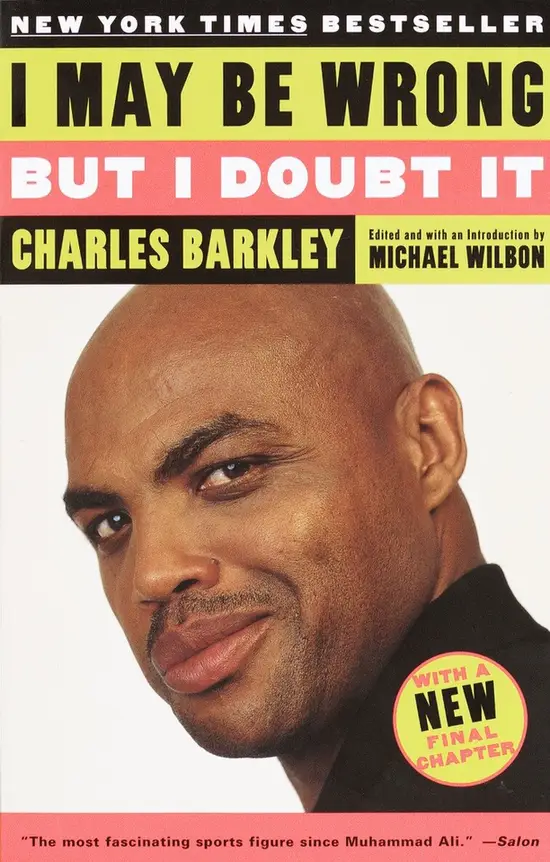
I May Be Wrong but I Doubt It: Some Things I've Learned So Far
By Charles BarkleyReleased 2002Curated by SPMA Hub because sport culture lives beyond the field.
Charles Barkley has opinions about basketball, but he is not willing to stop there. I May Be Wrong but I Doubt It brings his outspoken voice to race, money, celebrity and responsibility, mixing memories of an exceptional playing career with arguments about what a famous athlete can contribute to public conversation.
The Shelf
The Gist
Why it caught our attention
The Details
Quick facts
- Format
- Book
- Author
- Charles Barkley
- Published
- 2002
- ISBN
- 9780812966282
- Genre
- Biography
- Relevant Sport
- Basketball

At A Glance
Charles Barkley has opinions about basketball, but he is not willing to stop there. I May Be Wrong but I Doubt It brings his outspoken voice to race, money, celebrity and responsibility, mixing memories of an exceptional playing career with arguments about what a famous athlete can contribute to public conversation.

About This Shelf Item
About I May Be Wrong but I Doubt It: Some Things I've Learned So Far
Barkley discusses the relationship between race, class and opportunity, including the distribution of influence within sport. His success gives him access to wealthy and powerful circles without removing his interest in people outside them. The book's political observations therefore sit alongside questions about who owns, manages and benefits from a business in which Black athletes are highly visible performers.
His well-known resistance to being treated as a role model introduces another tension. Rejecting the idea that sporting fame automatically confers moral authority does not make a celebrity's influence disappear. Barkley considers responsibility, education and the need for direct discussion while also reflecting on mistakes and memorable career experiences, including the Olympic Dream Team. These shifts are part of the book's conversational character. They reveal an athlete working out how to use a public voice whose reach now depends on more than his ability to play.

Why It Belongs
The Sport Connection
The book has clear relevance to athlete media and career transition. Barkley's move from player to commentator involved carrying a recognisable personality into a new professional setting, where judgement and conversation became the work. His wider ambitions also challenge the tendency to treat an athlete's public contribution as limited to technical knowledge of a game. For sport communicators, the account raises questions about the relationship between candour, audience expectations and commercial identity. A distinctive voice can attract attention precisely because it is difficult to manage into predictability. Barkley's reflections allow readers to consider the opportunities and obligations that accompany that kind of visibility.

Our Recommendation
Why Read I May Be Wrong but I Doubt It: Some Things I've Learned So Far
Readers who enjoy Barkley's humour will find an obvious reason to read, but the book also suits people interested in athlete expression and the social position of sporting celebrities. It rewards a willingness to engage with a speaker rather than expect a tightly organised policy argument. Some observations belong unmistakably to the early 2000s, making the volume a record of Barkley's thinking at that stage of his life. That historical setting is useful: readers can consider how an athlete framed public responsibility when television remained the main setting for his new career, while recognising that the underlying questions about influence and credibility continue to recur.
Final Thoughts
Arash's Final Thoughts
I May Be Wrong but I Doubt It is most interesting as a portrait of a person refusing to let a finished playing career define the limits of his public life. Barkley's confidence can invite disagreement, but the willingness to discuss uncomfortable subjects gives the conversation a purpose. The book does not require readers to accept fame as expertise. It asks them to hear an athlete's experience and arguments as contributions worth considering, with humour keeping the exchange lively and personal responsibility giving it weight.
Related organizations

Keep Exploring
Similar Books on The Shelf



Same sport
More Basketball on The Shelf

Stay in the loop
Follow SPMA
New jobs, interviews and sport-industry news in your feed.






Hiring now on Sports Hired
6766133 new jobs in sport this week
Teams, leagues, agencies and brands in Canadain the USAin Canada & the USA are hiring. Find your next role, or let new ones come to you.
317315632 open jobs2,3043,6215,925 organizations
Just posted
 Content Creation InternSport Management Hub · Toronto, ON★ Featured
 Community Engagement & Events InternNiagara River Lions · Thorold, ON1 hour ago
 Basketball CoachElite Camps · Toronto, ON1 hour ago
 Director, FinanceFront Office Sports · New York, NY20 hours ago
 Staff Engineer, Balance and Ledger - CoreFanatics Betting & Gaming · New York, NY22 hours ago
 Game Day Operator (New Jersey)Brodie Rec League2 days ago
- Content Creation InternSport Management Hub · Toronto, ON★ Featured
- Community Engagement & Events InternNiagara River Lions · Thorold, ON1 hour ago
- Basketball CoachElite Camps · Toronto, ON1 hour ago
Copied
