



Published in 2005, the book uses a season to give those questions concrete form. St. Anthony's reputation brings expectations, but the athletes do not arrive as interchangeable parts of an established winning machine. They bring different histories, abilities and needs. A coach's standards must operate through those differences, making discipline a relationship between people rather than a set of rules that produces identical results whenever it is applied.
The Shelf · Books
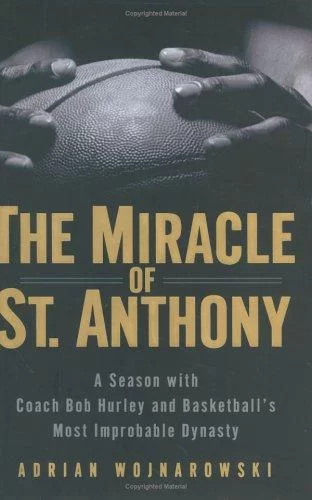
The Miracle of St. Anthony
By Adrian WojnarowskiReleased 2005Curated by SPMA Hub because sport culture lives beyond the field.
The Miracle of St. Anthony follows high school basketball where the stakes reach well beyond a winning record. Adrian Wojnarowski centres coach Bob Hurley and the St. Anthony programme in Jersey City, placing a demanding sporting culture beside the lives of the young people within it. The result asks what a coach can provide, what he can expect and how much responsibility a small school is being asked to carry.

The Shelf
The Gist
Why it caught our attention
The Details
Quick facts
- Format
- Book
- Author
- Adrian Wojnarowski
- Published
- 2005
- Genre
- Non-Fiction
- Relevant Sport
- Basketball

At A Glance
The Miracle of St. Anthony follows high school basketball where the stakes reach well beyond a winning record. Adrian Wojnarowski centres coach Bob Hurley and the St. Anthony programme in Jersey City, placing a demanding sporting culture beside the lives of the young people within it. The result asks what a coach can provide, what he can expect and how much responsibility a small school is being asked to carry.

About This Shelf Item
About The Miracle of St. Anthony
Hurley's forceful presence is central to the account. His commitment to the programme cannot be understood only through tactical knowledge or the ability to prepare a team for an opponent. The role extends into education, conduct and the possibilities basketball might create for a student's future. That broader involvement gives the story emotional weight, while also making the concentration of authority in one influential adult a subject worth examining carefully.
The setting keeps success from becoming a purely sporting idea. A player may need stability, academic progress and a credible next step as much as improved performance on court. Those needs can support one another, but they do not always align neatly. A team can win while an individual remains vulnerable, and a demanding intervention can feel different to the adult who intends it and the young person who receives it.

Why It Belongs
The Sport Connection
For SPMA readers, the book provides a strong starting point for discussing how youth programmes define their purpose. If basketball is presented as a route to education, the educational support must be visible in the programme's actual work. Results and scholarships are important measures, but they do not tell the entire story. The experiences of players who do not become stars also belong in an honest assessment of what the institution provides.
Hurley's centrality raises a further organisational question about continuity. A programme shaped by an unusually committed coach may achieve things that a more ordinary structure struggles to reproduce. That makes it necessary to distinguish the person's qualities from the systems surrounding him. Which forms of support can be shared, documented and sustained? Which depend on constant personal intervention? The book encourages that discussion without reducing a complicated coaching life to a simple formula for others to copy.

Our Recommendation
Why Read The Miracle of St. Anthony
Readers who know Wojnarowski mainly through professional basketball reporting may find the close scale of this account especially compelling. The attention rests on a school team and the adults and students around it, where ambitions are still taking shape. The season format allows pressure to accumulate through relationships, giving everyday expectations a significance that a short profile of a successful coach might acknowledge but have little room to explore in depth.
The book is best read with room for both admiration and scrutiny. Valuing a coach's dedication does not require assuming that every demanding practice is justified by a successful result. Equally, recognising the risks of strong authority does not erase the value of sustained adult commitment. Holding those ideas together produces a more useful conversation about coaching than choosing between the flawless mentor and the simplistic portrait of discipline as harm.
Final Thoughts
Alex's Final Thoughts
The Miracle of St. Anthony makes high school basketball a setting for questions about care, opportunity and expectation. Wojnarowski's account gives the programme's achievements a human context, showing why a season can matter so intensely to those within it. On the SPMA shelf, it encourages readers to judge a youth sport institution by the lives it helps shape as well as by the games its teams manage to win.
Keep Exploring
Similar Books on The Shelf



Same sport
More Basketball on The Shelf


Stay in the loop
Follow SPMA
New jobs, interviews and sport-industry news in your feed.






Hiring now on Sports Hired
6872140 new jobs in sport this week
Teams, leagues, agencies and brands in Canadain the USAin Canada & the USA are hiring. Find your next role, or let new ones come to you.
319318637 open jobs2,3063,6215,927 organizations
Just posted
 Content Creation InternSport Management Hub · Toronto, ON★ Featured
 Marketing InternLUG Sports Group · Remote1 hour ago
 Sales & Business Development InternWager Chatter · Toronto, ON1 hour ago
 Inside Sales Representative (Seasonal Position)Myrtle Beach Pelicans · Myrtle Beach, SC1 hour ago
 Director, FinanceFront Office Sports · New York, NY21 hours ago
 Staff Engineer, Balance and Ledger - CoreFanatics Betting & Gaming · New York, NY23 hours ago
- Content Creation InternSport Management Hub · Toronto, ON★ Featured
- Inside Sales Representative (Seasonal Position)Myrtle Beach Pelicans · Myrtle Beach, SC1 hour ago
- Marketing InternLUG Sports Group · Remote1 hour ago
Copied
