



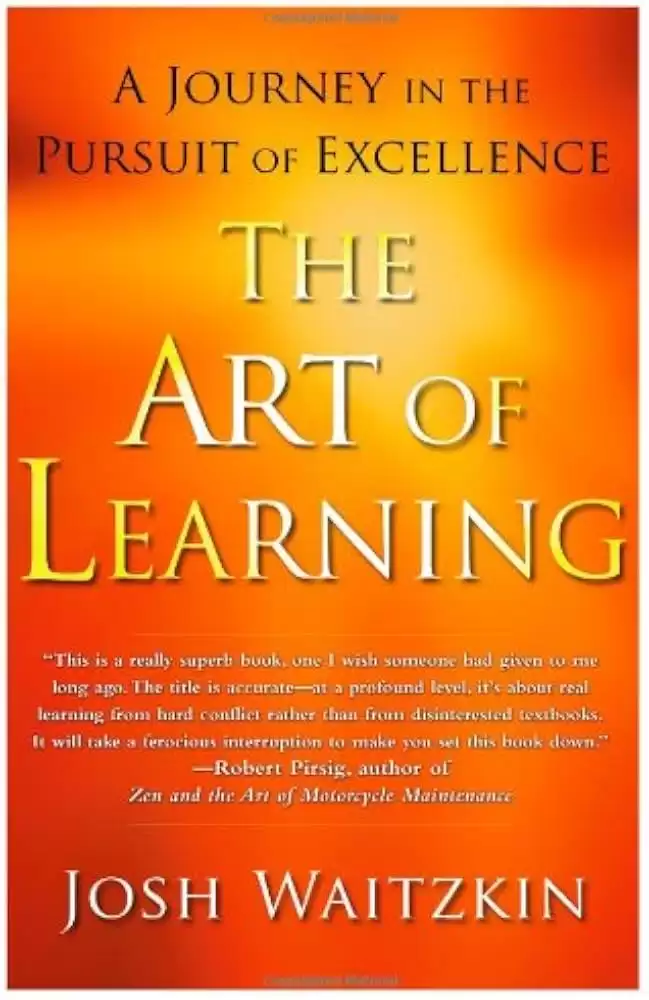
Becoming outstanding at one pursuit does not automatically make someone excellent at a second. Josh Waitzkin's experience offers a more interesting question: which habits of learning can survive the transition? In The Art of Learning: An Inner Journey to Optimal Performance, published in 2007, Waitzkin reflects on a childhood in competitive chess and his later involvement in the martial art of tai chi chuan. Readers may recognize his early life through Searching for Bobby Fischer, the film based on his father's account. Yet the book is more concerned with what happens after the fascination surrounding a prodigy fades. Waitzkin examines practice, stress, setbacks and the process of finding workable patterns beneath apparently different activities. Its usefulness to sports management lies in the design of development environments, not in promising quick mastery.
The Shelf · Books
The Art of Learning
Josh Waitzkin's The Art of Learning is unusual among performance books because its author moved between championship chess and competitive tai chi. The connection is not a secret formula, but a demanding approach to understanding how skill develops.
The Gist
Why it caught our attention
The Details
Quick facts
- Format
- Book
- Author
- Josh Waitzkin
- Published
- 2007
- Genre
- Non-Fiction

At A Glance
Josh Waitzkin's The Art of Learning is unusual among performance books because its author moved between championship chess and competitive tai chi. The connection is not a secret formula, but a demanding approach to understanding how skill develops.

About This Shelf Item
About The Art of Learning
Chess and martial arts reward different kinds of decisions. A chess player can examine a position and calculate possibilities, while a martial arts competitor must interpret balance, pressure and movement in real time. Waitzkin describes how his training moved between understanding details and allowing practiced responses to become more fluid. The book also considers the psychological difficulty of competition, especially when an athlete's identity becomes attached to appearing talented. A loss can then feel like evidence of personal failure rather than information that guides improvement. Waitzkin's account challenges that interpretation by emphasizing the value of examining mistakes and creating increasingly demanding practice conditions. Those claims are rooted in one person's experience; they should be tested against the needs of other performers rather than presented as universal neuroscience.

Why It Belongs
The Sport Connection
For academy leaders, the book raises an important question about talent identification. A child who wins early may have advantages in access, maturity or prior training that do not guarantee a sustainable elite career. An organization that rewards only immediate victory can discourage experimentation and make athletes afraid to expose weaknesses. Development staff should measure whether players are building skills that allow them to adjust when competition becomes stronger. Waitzkin's discussion of learning suggests practices that gradually introduce pressure and complexity without making every mistake consequential. Coaches can also help athletes recognize the difference between useful struggle and training so poorly designed that it teaches little. The point is to cultivate durable capacity, not simply a reputation for giftedness.

Our Recommendation
Why Read The Art of Learning
The book can inform how staff members learn as well as how athletes practise. Analysts may become attached to one method because it produced results in the past. Coaches may avoid changing a drill because they are known for it. Waitzkin's cross-disciplinary journey encourages deliberate reflection on which principles are truly transferable. Transfer still requires caution. Expertise in chess does not establish expertise in another sport, and the conditions of a martial arts contest are not identical to a football match. A sporting director should ask which underlying mechanisms are shared and which differences require new preparation. The most productive use of the book is therefore critical: identify an insight, design a modest experiment, observe outcomes and revise the approach when evidence calls for it.
Final Thoughts
Arash's Final Thoughts
The Art of Learning is an engaging resource for people responsible for development pathways because it treats mastery as a process rather than an identity. Waitzkin's career provides vivid material for thinking about attention, setbacks and practice design. For sport organizations, the enduring question is whether their systems reward growth after the first signs of promise. A development program is stronger when athletes can take risks, receive meaningful feedback and keep learning after early success no longer provides an advantage.
Keep Exploring
Similar Books on The Shelf








Stay in the loop
Follow SPMA
New jobs, interviews and sport-industry news in your feed.






6872140 new jobs in sport this week
Teams, leagues, agencies and brands in Canadain the USAin Canada & the USA are hiring. Find your next role, or let new ones come to you.
Just posted
 Content Creation InternSport Management Hub · Toronto, ON★ Featured
 Marketing InternLUG Sports Group · Remote1 hour ago
 Sales & Business Development InternWager Chatter · Toronto, ON1 hour ago
 Inside Sales Representative (Seasonal Position)Myrtle Beach Pelicans · Myrtle Beach, SC1 hour ago
 Director, FinanceFront Office Sports · New York, NY21 hours ago
 Staff Engineer, Balance and Ledger - CoreFanatics Betting & Gaming · New York, NY23 hours ago
- Content Creation InternSport Management Hub · Toronto, ON★ Featured
- Inside Sales Representative (Seasonal Position)Myrtle Beach Pelicans · Myrtle Beach, SC1 hour ago
- Marketing InternLUG Sports Group · Remote1 hour ago
