The Shelf · Movies

The Cutting Edge

Released 1992Curated by SPMA Hub because sport culture lives beyond the field.

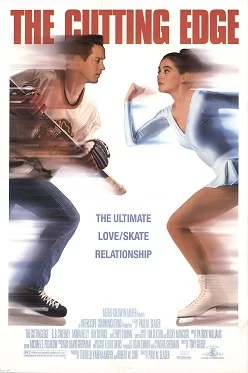
A former hockey player and an accomplished figure skater become an unlikely pairs team because each has run out of attractive options. Doug Dorsey understands contact and speed; Kate Moseley knows precision, presentation and the relentless demands of judged competition. Their partnership begins badly. The Cutting Edge finds its comedy in the fact that neither athlete can succeed without taking the other's expertise seriously.

Arash Sayed
Covered by Arash Sayed
The Shelf
The Cutting Edge

The Gist

Why it caught our attention

Paul M. Glaser directed this 1992 romantic comedy from a Tony Gilroy screenplay. D. B. Sweeney plays Doug, a hockey player whose Olympic prospects vanish after an injury, and Moira Kelly plays Kate, a gifted pairs skater whose difficult reputation has exhausted a succession of partners. Roy Dotrice is the formidable coach Anton Pamchenko. The premise takes two kinds of skating that share a surface and reveals how little that common ice guarantees.

Doug is recruited because Kate needs a physically capable partner prepared to commit to her Olympic objective. For Doug, figure skating initially looks like a humiliating consolation prize. For Kate, his lack of polished technique is an insult to years of specialized training. The friction powers the romance, but the best jokes grow out of a sporting reality: mastering one discipline does not entitle an athlete to immediate authority in another.

The Details

Quick facts

Format
Movie
Released
1992
Genre
Drama

At A Glance

A former hockey player and an accomplished figure skater become an unlikely pairs team because each has run out of attractive options. Doug Dorsey understands contact and speed; Kate Moseley knows precision, presentation and the relentless demands of judged competition. Their partnership begins badly. The Cutting Edge finds its comedy in the fact that neither athlete can succeed without taking the other's expertise seriously.

About This Shelf Item

About The Cutting Edge

Sweeney gives Doug the wary confidence of somebody whose previous sport rewarded collisions and quick recovery. Kate's routine is different. Her career depends on matching another person's movement, executing difficult lifts and persuading judges that control appears effortless. Kelly plays her defensiveness with enough force to be irritating, which makes her gradual willingness to trust more satisfying. The film is more balanced than a story in which an easygoing man simply teaches an uptight woman to enjoy herself.

Pamchenko's coaching regime supplies the pressure. He has an Olympic programme to deliver, with limited time for personality differences or romantic confusion. His authority can appear unyielding, but the athletes are genuinely attempting an enormous technical transition. The pair must develop a shared sense of timing in which a slight hesitation can turn a lift or landing into danger. Training scenes repeatedly bring them back to the ice after personal arguments that cannot be solved by winning one exchange of insults.

The film plays loose with the ease of Doug's conversion and eventually embraces the fantasy of a near-impossible signature move. It is, after all, a romantic comedy. What saves it from feeling like a generic love story in skates is its attention to mutual dependence. Kate cannot perform the programme alone, and Doug cannot simply replace the sport's technical language with hockey toughness. They are forced to become legible to one another.

Why It Belongs

The Sport Connection

The Cutting Edge offers an accessible picture of career transition in elite sport. An injury ends Doug's first Olympic path, but his athletic ability has not vanished. The opportunity to use it elsewhere depends on finding a partner, trainer and institution willing to invest in a risky conversion. Kate faces a different constraint: her individual quality is not enough in a discipline where selection depends on a reliable partnership.

Figure skating's combination of athletic demands, aesthetic presentation and judging adds another layer. The sport evaluates the pair as a unit. That produces pressure to make disagreement invisible during a performance, even when considerable work is required to manage it beforehand. The film makes the tension funny without pretending it is insignificant.

Our Recommendation

Why Watch The Cutting Edge

Watch for the quick exchanges between Kelly and Sweeney, and for the way the romance remains tied to practical training problems. The movie knows that ice-sport expertise is specialized. Its unlikely match works because it gives both characters knowledge the other lacks, rather than assigning all insight to the supposedly more relaxed partner.

Anyone interested in athlete retraining, the emotional demands of pairs competition or judged sports will find useful material beneath the broad comic devices. The competitive climax is proudly improbable, and the dialogue is occasionally too neat. Still, the picture has more affection for actual sporting labour than its premise might suggest.

Arash Sayed

Final Thoughts

Arash's Final Thoughts

The Cutting Edge begins with two athletes convinced that their individual standards should govern the partnership. It ends by making that assumption impossible to maintain. Their trust is not merely a romantic reward; it is the condition that makes their sport feasible. The movie's delight comes from watching expertise become shared, even as it indulges an extravagant final flourish. For all its silliness, it knows that a pair is not the same thing as two talented people.