Career Guide
About This Role
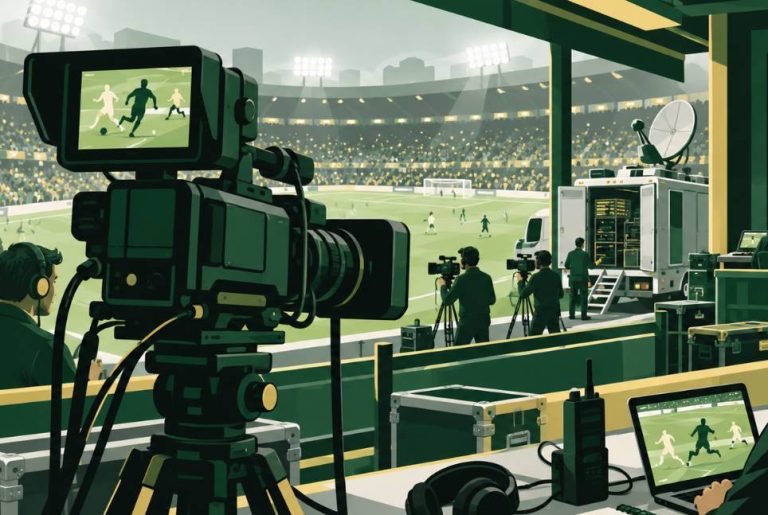
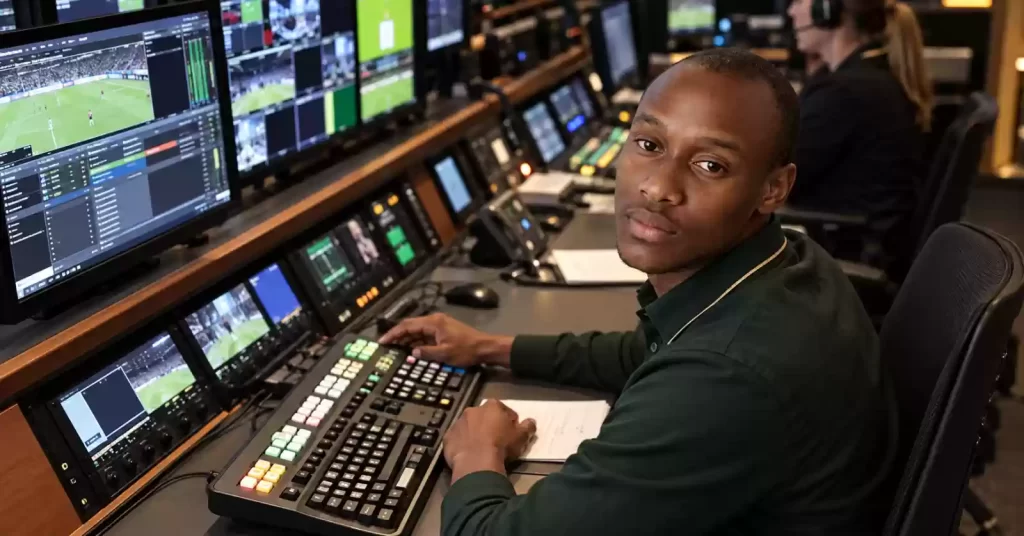
A Broadcast Graphics Operator puts the on-screen information into a live sports production: the score bug, lower-third name captions, player statistics, lineups, replay wipes, sponsor elements and full-screen graphics. Working from a graphics system in the production truck or control room, they build, check and fire each graphic on the director’s or producer’s cue, often seconds after something happens in the game.
The job exists in two closely related settings. In television and streaming, operators work for a broadcaster or production company on a game broadcast. In venues, graphics operators run the videoboard and ribbon boards for the crowd as part of a team’s game presentation crew. The tools and pace are similar; the audience is different.
What a broadcast graphics operator does day to day
Before a live game, the operator loads the graphics template package, imports rosters and statistics, builds and spell-checks names and pronunciations, prepares sponsor graphics required by contracts, and rehearses with the producer. During the game, they update the score and clock data feeds, build stat graphics as storylines develop, and fire elements on cue. Accuracy matters as much as speed: a wrong name or score on air is visible to every viewer.
In-venue graphics follow a similar rhythm. When SPMA spoke with Clara Koeltzow, Motion Graphics Artist for the Colorado Rockies (2019), she described non-game days from 8 a.m. to 5 p.m. building content and planning for the next homestand. On a night-game day she arrived around noon to set up the graphics operating system, joined a 3 p.m. series meeting with corporate partnerships, and ran graphics from the 6 p.m. pre-game show through the end of the game around 10:30 p.m. She built crowd prompts, sponsor features, ribbon board graphics and packages for hype videos.
Clara Koeltzow, Motion Graphics Artist for the Colorado Rockies, described a game day to SPMA in 2019: “Game days, on the other hand, if it’s a night game I’ll show up to work around 12 pm and set up our graphics operating system for the game that night.” Asked about a career highlight, Koeltzow recalled “Scrambling to build playoff graphics in 2018 for the Rockies’ first home playoff game since 2009, and watching my content play live for thousands of people to see and react to.”
What a broadcast graphics operator decides, and what sits with others
The operator owns graphic accuracy, readiness and execution: names spelled correctly, numbers checked, templates loaded, sponsor elements built to spec. They should flag anything that looks wrong before it goes on air.
Editorial decisions belong to others. The producer decides which stories and stats to feature; the director calls when graphics go on screen. Sponsor obligations are set by sales and partnership contracts. The graphic design itself (fonts, colours, animation templates) is usually created by a design team or graphics vendor; the operator works within that package. A Broadcast Producer and an Instant Replay Operator are the operator’s closest partners during a show.
Working inside a high-volume production team
Large broadcasters produce enormous volumes of graphic-heavy content. Matt Chisamore-Robert, a Production Manager at Sportsnet (2021), told SPMA that on a night with 13 hockey games and 8 NBA games his team had to staff every game, create highlight content for every platform and push social clips out in real time, while still delivering longer projects. He described a typical night as controlled chaos. Graphics operators in that environment need to work fast, follow templates and communicate clearly.
In-venue teams have similar intensity on a smaller crew. SPMA’s profile of Melissa Bromley, Game Presentation Specialist with the Toronto Maple Leafs (2020), describes a part-time game-night staff of about 60 people split into crews, all working from a season blueprint of promotions and partner obligations.
Skills employers look for in a broadcast graphics operator
- Graphics systems: experience with broadcast character generators and real-time graphics platforms such as Vizrt, Ross XPression or Chyron, or videoboard control systems.
- Accuracy under pressure, often tested with a timed practical.
- Sport knowledge to anticipate what graphics will be needed next.
- Motion graphics skills in tools like Adobe After Effects for operators who also build content.
- Clear communication on headset with the producer and director.
How to become a broadcast graphics operator
Many operators start on game-day crews. Koeltzow worked show control, replay and camera positions before being promoted to build motion graphics full-time. University athletics departments, junior and minor-league teams, campus TV stations and streaming productions all offer entry points. Freelance crew work is common in broadcast, so building relationships with production companies matters.
Keep a reel or portfolio of graphics you built or operated, with your exact role stated. When applying, ask which graphics system the production uses, whether you will build templates or only operate them, and what training is provided.
Broadcast graphics operator jobs on SPMA: what the postings show
Since late 2023, SPMA has listed 30 jobs that match this role, including 0 in Canada and 30 in the United States. Employers used titles such as “Graphic Designer”, “Graphic Design Intern”, “Intern, Graphic Design” and “Social Graphics Designer”. Organizations that posted them include Fanatics Collectibles, Florida Panthers Hockey Club, Ltd, Baltimore Orioles, Green Bay Booyah and Detroit Pistons.
Examples of posted pay: Seasonal Graphics Designer/Animator, National Football League (NFL) (Inglewood): US$37.00–US$80.00 an hour. With so few postings listing pay, treat these as examples rather than a market rate.
Source: SPMA’s database of 3,289 sport job postings in Canada and the U.S., late 2023 to November 2026, matched by job title. Pay figures use the midpoint of each posted range and exclude postings without pay. See current broadcast graphics operator openings on SPMA.
Broadcast graphics operator salary and job outlook
Pay for Broadcast Graphics Operator positions depends heavily on the level of sport, the size of the organization and the region. The closest occupation tracked by the U.S. Bureau of Labor Statistics is broadcast, sound, and video technicians, which had a median annual wage of $60,150 in May 2025 across all industries, with employment projected to grow by 1% from 2025 to 2035.
Treat any national figure as a broad benchmark rather than a sport-specific salary. Jobs with junior, minor-league, university and nonprofit sport organizations often pay below all-industry figures, while senior roles at major professional teams and leagues can pay more. In Canada, use Job Bank’s wage search to check current wages for the closest occupation in your province, and compare with pay ranges in live postings on SPMA’s jobs board.
Common career questions
How much does a broadcast graphics operator make?
Pay varies widely by level of sport and organization. The closest U.S. government occupation category, broadcast, sound, and video technicians, had a median annual wage of $60,150 in May 2025 across all industries, but many sport jobs pay less, especially at junior, minor-league, university and nonprofit organizations.
What does a broadcast graphics operator do?
A broadcast graphics operator prepares and fires on-screen graphics during a live sports broadcast, including the score bug, name captions, statistics and sponsor elements, on cue from the director or producer.
What software do broadcast graphics operators use?
Common systems include Vizrt, Ross XPression and Chyron for broadcast, plus videoboard control systems in venues. Motion graphics are often built in Adobe After Effects.
Is broadcast graphics operator a full-time job?
Some positions are staff roles, but many operators work freelance or per-game, especially in broadcast. Venue roles are often part-time or seasonal.
Do you need a degree?
Not always. Broadcast, media production or design programs help, but hands-on experience on game crews and a strong reel are often more important.
Further reading and qualification checks
See the U.S. Bureau of Labor Statistics Broadcast, Sound, and Video Technicians profile. Related SPMA guides: Content Producer, Sports Statistician and Fan Experience Manager.