





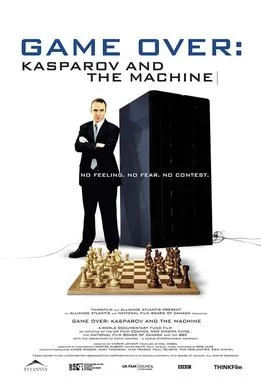
Game Over: Kasparov and the Machine is a 2003 documentary directed by Vikram Jayanti, produced in connection with Alliance Atlantis, the National Film Board of Canada and British partners. It revisits the 1997 rematch between world chess champion Garry Kasparov and IBM's Deep Blue, in which the computer prevailed. Unlike a conventional sport retrospective built around an unfamiliar winner, Jayanti begins with a result that was already famous. The question is what that result meant to the person who lost and to the company that staged the confrontation. Kasparov appears as a man who cannot regard the match as a neutral experiment once the playing conditions and IBM's conduct become objects of suspicion. The film's atmosphere borrows from a corporate thriller, allowing chess's normally quiet playing surface to become a stage for competing claims about integrity and power.
The Shelf · Movies
Game Over: Kasparov and the Machine
When Garry Kasparov lost a six-game match to IBM's Deep Blue in 1997, the contest became an international story about computers overtaking human intelligence. Vikram Jayanti's documentary returns to the chess champion and the men behind the machine. It is as interested in mistrust, corporate control and public spectacle as it is in chess.
The Gist
Why it caught our attention
The Details
Quick facts
- Format
- Movie
- Released
- 2003
- Genre
- Documentary

At A Glance
When Garry Kasparov lost a six-game match to IBM's Deep Blue in 1997, the contest became an international story about computers overtaking human intelligence. Vikram Jayanti's documentary returns to the chess champion and the men behind the machine. It is as interested in mistrust, corporate control and public spectacle as it is in chess.

About This Shelf Item
About Game Over: Kasparov and the Machine
The dramatic material lies in the match's peculiar asymmetry. Kasparov was expected to exhibit judgment, stamina and psychological composure as an individual. Deep Blue was a machine, but it was also the public face of a large technical organization whose engineers could adjust and interpret its work. That difference complicates the usual picture of two opponents sitting across from each other. Jayanti revisits Kasparov's frustration after unusual machine moves and the debate over how transparent IBM should have been about the system's decisions. Importantly, the film records Kasparov's perspective; his suspicions are not proof that the company cheated. The distinction matters because the documentary's thriller-like tone can encourage a viewer to confuse unresolved questions with established wrongdoing. The archival material makes the atmosphere of 1997 palpable, when a computer defeating a chess champion seemed to threaten an entire cultural definition of intelligence. Kasparov's anger is not simply a poor loser's complaint. His performance had been converted into an unusually public demonstration, and he did not control how the demonstration would be interpreted afterward.

Why It Belongs
The Sport Connection
A corporate-sponsored competition produces more than a winner. It creates a story a brand can circulate, especially when the opponent is an internationally recognizable champion. IBM's investment in Deep Blue was both a technological venture and a powerful communications opportunity, and the match's rules and disclosure practices became part of that reputational exercise. For sport governance, the example raises questions about how competitions remain credible when an organizer or sponsor has interests in a particular narrative. Chess brings a special complication because analysis, preparation and access to information are essential to participation. The film remains relevant to contemporary debates over performance technology and algorithmic systems, but it should not be read as an account of modern artificial intelligence; it is a record of a particular technological moment and its disputed public meaning.

Our Recommendation
Why Watch Game Over: Kasparov and the Machine
Viewers who already know the chess moves can still find the documentary absorbing because it focuses on the conditions under which the moves were made and publicized. Kasparov is a compelling but not necessarily disinterested witness, which makes it valuable to approach his account critically. Jayanti's editing gives the match tension without requiring expert chess knowledge. Students of sport media and corporate partnerships may find it especially useful as a study in how the meaning of a result is negotiated after the score is final. The human-machine premise is dramatic; the institutional relationships are the lasting material.
Final Thoughts
Arash's Final Thoughts
The scoreboard in Game Over records a machine's victory, but it cannot settle every question about the event that produced it. Kasparov wanted a sporting contest; IBM also possessed a platform to demonstrate technological capability. Jayanti understands the distance between those aims and the uncertainty it left behind. The film's fascination is not that a computer won, but that victory became a dispute about who was entitled to tell the story.
Keep Exploring
Similar Movies on The Shelf






Stay in the loop
Follow SPMA
New jobs, interviews and sport-industry news in your feed.






58225283 new jobs in sport this week
Teams, leagues, agencies and brands in Canadain the USAin Canada & the USA are hiring. Find your next role, or let new ones come to you.
Just posted
 Policy Analyst & Committee LeadSport, Physical Activity and Recreation Council (SPARC) · within Canada3 hrs ago
 Head Coach, Synchro 9 National TeamSkate Canada · Ottawa, ON3 hrs ago
 Analyst | AnalysteOttawa Rapid FC · Ottawa, ON4 hrs ago
 2027 Summer Camp InternFirst Tee · Richmond, VA6 hrs ago
 Triple-a Athletic TrainerDetroit Tigers · Toledo, OH7 hrs ago
 Development CoachHouston Astros · Houston, TX7 hrs ago
- Policy Analyst & Committee LeadSport, Physical Activity and Recreation Council (SPARC) · within Canada3 hrs ago
- Head Coach, Synchro 9 National TeamSkate Canada · Ottawa, ON3 hrs ago
- Analyst | AnalysteOttawa Rapid FC · Ottawa, ON4 hrs ago
