The Shelf · Movies

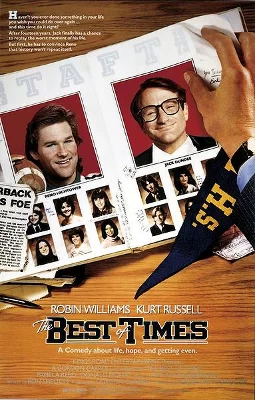
The Best of Times

Released 1986Curated by SPMA Hub because sport culture lives beyond the field.

Jack Dundee has spent years replaying a high-school football mistake. His solution is ridiculous: reunite the players and stage the game again. Robin Williams gives Jack an almost exhausting need to repair the past, while Kurt Russell plays the former quarterback who has moved into an entirely different life. The comedy has an uncomfortable insight into how towns keep score long after players leave school.

Arash Sayed
Covered by Arash Sayed
The Shelf
The Best of Times

The Gist

Why it caught our attention

Roger Spottiswoode directed The Best of Times from a screenplay by Ron Shelton, several years before Shelton's Bull Durham made him a touchstone for American sports films. Released in 1986, it stars Robin Williams as Jack Dundee and Kurt Russell as Reno Hightower. The childhood mythology of a football town has become a burden on both men, though it has marked them in different ways.

Jack dropped a vital pass in a game between Taft and Bakersfield. He is now a bank employee who cannot stop imagining the catch he might have made. Reno, the gifted quarterback who threw it, runs a garage and has financial and marital troubles more urgent than a school game. Jack's proposal for a rematch recruits old teammates, town pride and eventually the attention of people who should know better than to indulge him. That is the joke, but also the film's subject.

The Details

Quick facts

Format
Movie
Released
1986
Genre
Drama
Relevant Sport
American Football

At A Glance

Jack Dundee has spent years replaying a high-school football mistake. His solution is ridiculous: reunite the players and stage the game again. Robin Williams gives Jack an almost exhausting need to repair the past, while Kurt Russell plays the former quarterback who has moved into an entirely different life. The comedy has an uncomfortable insight into how towns keep score long after players leave school.

About This Shelf Item

About The Best of Times

Williams plays Jack as a man who mistakes embarrassment for a life sentence. Even when the dialogue is broad, the premise is psychologically credible: a very public error can become more durable in memory than any number of private successes. The town helps him sustain the grievance by retelling the same piece of football history. His failure has become communal property. The rematch is presented as liberation, but there is a distinct possibility it will simply make the memory more powerful.

Russell's Reno gives the story a different register. Where Jack has turned the old pass into a defining moment, Reno cannot afford to live entirely in the past. His adult work, money problems and marriage complicate the popular image of the former high-school star. He was once the person everyone expected to win; athletic promise has not provided an uncomplicated adult life. The humour improves whenever the movie allows the two men to disagree about what they are actually trying to recover.


Shelton knows that games become local folklore through repetition. The film uses team meetings, rivalries and an implausible training effort to show a community financing its own nostalgia. It is affectionate about that impulse without being wholly fooled by it. Some jokes are dated and the final contest follows the emotional logic of a studio comedy rather than the physical reality of aging players. But the film has already established that what these men are chasing is an interpretation of the past, not a competitive ranking.

Why It Belongs

The Sport Connection

The professional sports industry is not the direct subject here; community sport is. The rematch demonstrates how a school programme can become part of a town's identity and how former players are kept in their old roles by spectators who enjoyed them decades earlier. That continuity supplies enthusiasm, donations and volunteer labour. It can also become a trap when an athlete's later life is judged against a single performance at seventeen.

A school team creates genuine relationships, but local mythology has costs. The film gives those costs faces in Jack and Reno, each struggling with an audience's version of his younger self. The question for school and community sport is not whether winning matters. It is whether the institution leaves room for its participants to become somebody else.

Our Recommendation

Why Watch The Best of Times

This is a good choice for viewers who enjoy sports comedies with an adult perspective and the occasionally chaotic energy of Williams's early leading roles. Russell is essential to its balance, making Reno weary, proud and less easily persuaded than the script's increasingly elaborate scheme requires. The small-town setting gives the football more meaning than a generic stadium would.

It also makes a revealing companion to serious films about athlete identity. Here the pressure comes not from national selectors or sponsors, but from friends and neighbours who never quite allow a sporting moment to end. The humour does not erase the sadness underneath the idea.

Arash Sayed

Final Thoughts

Arash's Final Thoughts

Jack believes a second chance will settle the first one. The Best of Times is smart enough to suggest that the desire for a perfect replay may be the real problem. A football game lasts an evening; a town can keep telling its story indefinitely. The film's warmth comes from finding affection inside that absurd arrangement, even while showing how hard it is to stop being the player everybody remembers.