The Shelf · Movies

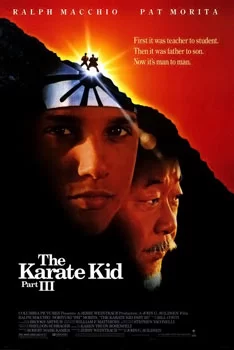
The Karate Kid Part III

Released 1989Curated by SPMA Hub because sport culture lives beyond the field.

Daniel LaRusso wants to leave tournament karate behind. Terry Silver, a wealthy businessman nursing somebody else's grudge, has other plans. The Karate Kid Part III turns its young champion into the target of a manufactured sporting crisis, testing his trust in Mr. Miyagi more than his ability to land a kick. The most consequential contest happens well before the final bout.

Arash Sayed
Covered by Arash Sayed
The Shelf
The Karate Kid Part III

The Gist

Why it caught our attention

John G. Avildsen returned to direct this 1989 sequel, with Robert Mark Kamen again writing Daniel and Miyagi. Ralph Macchio and Pat Morita resume their roles, while Thomas Ian Griffith plays Terry Silver, Sean Kanan plays the hired fighter Mike Barnes and Martin Kove returns as John Kreese. The story begins after Daniel and Miyagi's trip to Okinawa, with Daniel reluctant to defend his tournament title and Miyagi more interested in an honest life than collecting trophies.

Silver operates at an altogether different scale. He has money, influence and a personal reason to punish Daniel on Kreese's behalf. Rather than challenge the young man fairly, he recruits people to frighten him and engineers situations that make Miyagi's caution look like weakness. Sport is supposed to offer a transparent set of competitive rules. Silver's scheme shows what happens when somebody manipulates everything around the rules before an athlete ever enters the arena.

The Details

Quick facts

Format
Movie
Released
1989
Genre
Drama

At A Glance

Daniel LaRusso wants to leave tournament karate behind. Terry Silver, a wealthy businessman nursing somebody else's grudge, has other plans. The Karate Kid Part III turns its young champion into the target of a manufactured sporting crisis, testing his trust in Mr. Miyagi more than his ability to land a kick. The most consequential contest happens well before the final bout.

About This Shelf Item

About The Karate Kid Part III

The film repeats familiar franchise territory, sometimes to its disadvantage. Another tournament, another intimidating rival and another period of estrangement between Daniel and Miyagi can feel like a deliberate attempt to recreate the first film's emotional machinery. Yet the middle portion has a darker idea: Daniel is not merely preparing for an opponent; he is being persuaded to distrust his own teacher.

Griffith makes Silver theatrical, expansive and at times almost absurdly pleased with his own cruelty. That excess suits a figure who sees influence as the ability to control the story everyone else believes. He stages threats, supplies a supposed solution and waits for Daniel to accept both as facts. Mike Barnes does the physical work of intimidation, but Silver is the architect. The resulting violence matters because it is organized rather than incidental.

Daniel's insecurity gives the manipulation traction. His previous victories have made him proud, and pride makes him vulnerable to the promise of a method that seems faster or tougher than Miyagi's. When Silver's instruction pushes him toward aggression, the change is visible in Daniel's behaviour outside the dojo. It is not a subtle psychological study, but it is a recognizable account of how training can become a way of remaking a young person's values. Miyagi's resistance is not based on fear of losing a title. He objects to what Daniel is becoming in pursuit of one.

Why It Belongs

The Sport Connection

The film's business relevance is unusually literal for a martial-arts sequel: a wealthy backer uses resources and intermediaries to influence who competes and under what emotional conditions. Silver's stated interest in expanding Cobra Kai presents coaching as a commercial venture with a reputation to protect. His methods expose the danger when a training organization's brand matters more than the welfare of the people it trains.

Daniel has no meaningful way to check the story he is told by adults with greater power. He is offered instruction, pressured into a rivalry and drawn toward a contest he did not originally want. For youth sport, that makes the relationship between coach, athlete and outside interests the real issue. Winning cannot justify every tactic used to secure participation.

Our Recommendation

Why Watch The Karate Kid Part III

The sequel is not as fresh as its predecessors. Its villains are broad, and the plot demands repeated failures of communication from people who should know one another better. Those weaknesses are worth acknowledging rather than smoothing over. But Griffith's outrageous performance gives the film a distinctive shape, and Morita's refusal to turn Miyagi into a trophy-hunting trainer remains appealing.

Watch it as a franchise story about bad coaching and manufactured rivalry, especially if you are interested in the difference between a sporting culture that builds confidence and one that profits from fear. Its best moments are not the tournament moves. They are the moments when Daniel has to notice the effect of his training on his own conduct.

Arash Sayed

Final Thoughts

Arash's Final Thoughts

The Karate Kid Part III uses an exaggerated villain to expose a serious vulnerability: young athletes can be persuaded to abandon sound judgement when somebody promises a quicker route to status. Daniel's achievement is not simply surviving another final. It is learning to refuse a definition of strength supplied by people who have already arranged the contest in their own favour. The movie is untidy, but that conflict gives it a place on the Shelf.