





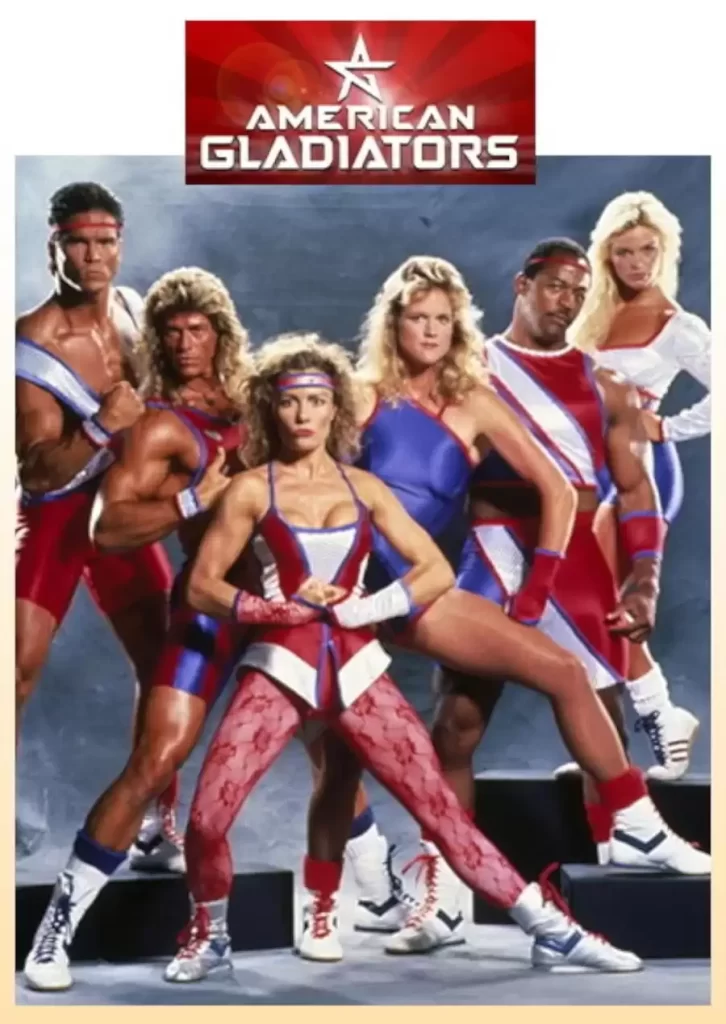
The syndicated original emerged from an idea Johnny Ferraro developed in Erie, Pennsylvania, before television producers brought it to a national audience. Debuting in 1989, American Gladiators combined elements of amateur competition, professional wrestling presentation and game-show jeopardy. Rather than documenting an existing sport, it created events specifically for the camera. Competitors took on a roster of recurring Gladiators, whose costumes, physiques and invented identities gave viewers someone to recognize from week to week. The show asked the public to care about individuals without decades of results or a familiar league structure behind them. That challenge, and the way the production solved it, deserves attention alongside the more obvious physical spectacle.
The Shelf · TV Series
American Gladiators
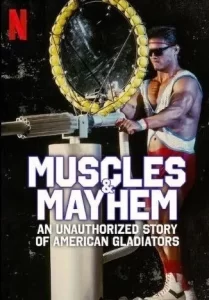
American Gladiators turned a studio obstacle course into a sporting universe of its own. Beginning in 1989, ordinary contestants faced performers with names like Nitro, Gemini and Lace, then scrambled through the Eliminator for a chance to win. The contests were theatrical and often ridiculous, yet the show's longevity reveals something serious about what television can manufacture from athletic ability and character.
The Gist
Why it caught our attention
The Details
Quick facts
- Format
- TV Series
- Released
- 1989

At A Glance
American Gladiators turned a studio obstacle course into a sporting universe of its own. Beginning in 1989, ordinary contestants faced performers with names like Nitro, Gemini and Lace, then scrambled through the Eliminator for a chance to win. The contests were theatrical and often ridiculous, yet the show's longevity reveals something serious about what television can manufacture from athletic ability and character.

About This Shelf Item
About American Gladiators
Some events rewarded speed, some balance, and others a willingness to absorb contact while a crowd shouted. Assault invited competitors to advance through a course under pressure from a Gladiator's projectile fire; the Joust reduced the drama to two people, elevated platforms and padded poles. The final Eliminator condensed accumulated fatigue into a race that could undo an earlier advantage. Not every event was a fair measure of sporting skill, and different body types benefited from different tasks. But the production understood a basic visual principle: the audience should be able to tell immediately who was in trouble.
The Gladiators themselves were the show's second invention. A contestant might appear once, while Nitro or Zap could become a weekly fixture. Their personalities operated as continuity across otherwise disconnected matchups. Mike Adamle's presentation helped sell the competition as legitimate without ignoring the spectacle. The camp aesthetics sometimes overwhelm the athletic work, which is partly why the original programme is more revealing than a simple nostalgia piece. Viewers can see how editing, music, commentary and character branding produce a feeling of rivalry even when the sport did not exist before the television format. Contemporary fitness reality programmes owe much to that design, whether they acknowledge it or not.

Why It Belongs
The Sport Connection
American Gladiators shows the commercial potential—and the limitations—of owning the format as well as the footage. Producers controlled the rules, the names, the apparatus and the tournament structure; successful characters could support touring, merchandise and international adaptations. Yet making a proprietary sport attractive also required constant attention to participant safety and the credibility of the outcomes. Its 2008 revival demonstrates that a recognized property can be relaunched, though recognition alone does not guarantee the original cultural moment can be reproduced.

Our Recommendation
Why Watch American Gladiators
This is particularly entertaining when watched with the question “What makes a contest feel like a sport?” rather than with a demand for Olympic-style legitimacy. Compare an event's rules with the camera positions chosen to explain it. Watch how the permanent cast gains prominence over the challengers. For sports marketers, the programme provides an unusually clear example of building an audience around repeatable moments and identifiable personalities. For viewers seeking technical excellence, the collisions and contraptions are a different kind of attraction.
Final Thoughts
Arash's Final Thoughts
American Gladiators was never merely a test of who could run, lift or climb fastest. It was a television construction that made muscular spectacle legible to an enormous audience and gave that spectacle a recurring cast. Its successes and absurdities belong together. The show remains a useful reminder that a sports property may be created through design and distribution as much as inherited from a long-established competition.
Related organizations


Keep Exploring
Similar TV Series on The Shelf








Stay in the loop
Follow SPMA
New jobs, interviews and sport-industry news in your feed.






58225283 new jobs in sport this week
Teams, leagues, agencies and brands in Canadain the USAin Canada & the USA are hiring. Find your next role, or let new ones come to you.
Just posted
 Policy Analyst & Committee LeadSport, Physical Activity and Recreation Council (SPARC) · within Canada3 hrs ago
 Head Coach, Synchro 9 National TeamSkate Canada · Ottawa, ON3 hrs ago
 Analyst | AnalysteOttawa Rapid FC · Ottawa, ON4 hrs ago
 2027 Summer Camp InternFirst Tee · Richmond, VA6 hrs ago
 Triple-a Athletic TrainerDetroit Tigers · Toledo, OH7 hrs ago
 Development CoachHouston Astros · Houston, TX7 hrs ago
- Policy Analyst & Committee LeadSport, Physical Activity and Recreation Council (SPARC) · within Canada3 hrs ago
- Head Coach, Synchro 9 National TeamSkate Canada · Ottawa, ON3 hrs ago
- Analyst | AnalysteOttawa Rapid FC · Ottawa, ON4 hrs ago
