





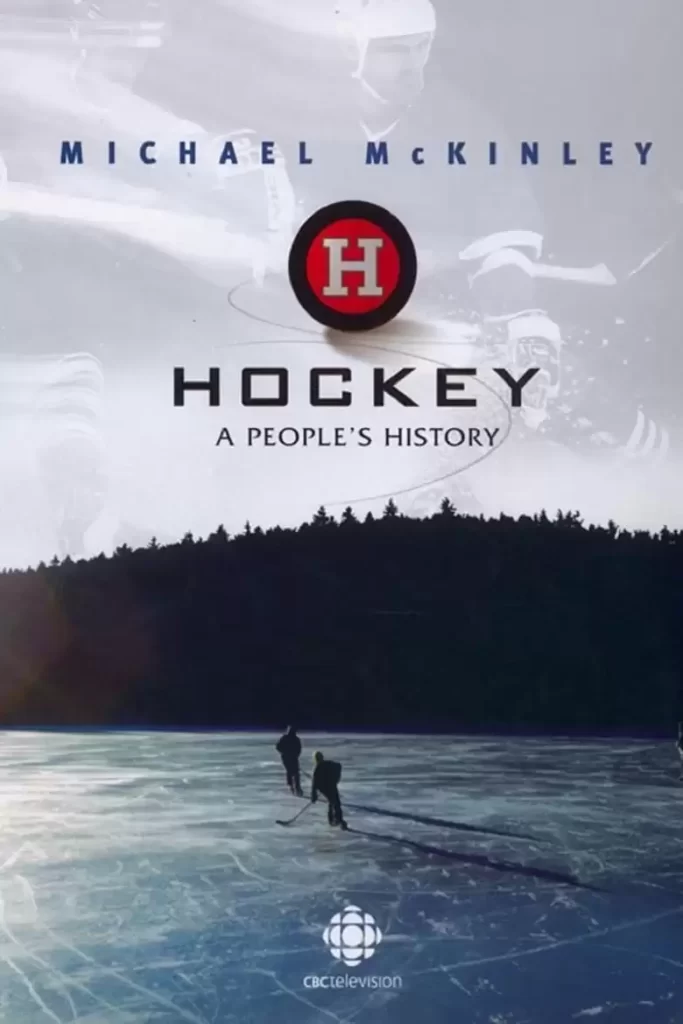
Broadcast in 2006, the documentary was developed in the tradition of CBC’s large-scale historical storytelling. Its chronological scope begins in nineteenth-century Canada and extends into the early 2000s, including the 2002 Olympic gold-medal victory. Actor Paul Gross narrates a production that brings together period material, reconstructed early scenes and interviews with prominent hockey figures. The title matters: rather than presenting the NHL as the only measure of hockey’s importance, the program sets professional growth against local participation and the cultural habits through which the sport spread. Its ten-part structure makes room for the shift from informal and regional versions of the game to nationally followed teams, mass broadcasting and international rivalry.
The Shelf · TV Series
Hockey: A People's History
The CBC’s Hockey: A People’s History tells the story of a sport that became a way for Canadians to debate who they were. Across ten episodes, archival footage, interviews and reenactments trace hockey’s development from early organized play to the modern professional and international stage. It is a history of the game, but also of the institutions and communities built around it.
The Gist
Why it caught our attention
The Details
Quick facts
- Format
- TV Series
- Released
- 2006
- Genre
- Documentary
- Relevant Sport
- Hockey

At A Glance
The CBC’s Hockey: A People’s History tells the story of a sport that became a way for Canadians to debate who they were. Across ten episodes, archival footage, interviews and reenactments trace hockey’s development from early organized play to the modern professional and international stage. It is a history of the game, but also of the institutions and communities built around it.

About This Shelf Item
About Hockey: A People's History
The episodes follow more than changing rules and great players. Early clubs, spectators and organizers help explain how hockey acquired authority as a public pastime. Later stories consider the professionalization of competition, the power of owners and the growth of a media audience. The result is a familiar national history told with enough institutional detail to be useful beyond nostalgia. Archival footage gives some periods a directness that reenactment cannot; the staged scenes are more obviously interpretive, and viewers should keep that distinction in mind. Voices such as Ken Dryden and Wayne Gretzky place the series in conversation with people who helped define the sport at very different moments. Not every chapter can be equally deep in a project spanning well over a century, and a national documentary inevitably makes choices about which regional or marginalized experiences receive airtime. Those omissions are worth examining alongside the moments the series celebrates.

Why It Belongs
The Sport Connection
For sport business, the documentary’s central value is its account of how a community game becomes an economic and cultural institution. Arenas, club structures, league organization, professional contracts and broadcasting did not simply follow hockey’s popularity; they helped create the sport that large audiences now recognize. The CBC’s own role is part of that history. National television helped transform distant athletes and teams into shared public reference points, even for communities that had never seen them play in person. The economic story is therefore inseparable from a media story, with questions about access, commercial priorities and regional loyalties running throughout. There is also a useful caution against treating Canadian hockey culture as uniform: the popularity of a symbol does not guarantee equal opportunities to participate in the reality behind it.

Our Recommendation
Why Watch Hockey: A People's History
This is especially rewarding for viewers who know the contemporary NHL but have little sense of what preceded its dominance. The extended format permits episodes to consider the growth of fandom and the power of institutions as seriously as individual sporting achievement. For students and practitioners of sport management, the material opens discussions about league development, civic identity, public broadcasting and the commercial uses of tradition. It is not a substitute for specialized scholarship on women’s hockey, Indigenous participation or regional histories; those topics deserve dedicated sources. Instead, the series works as an accessible foundation whose framing can itself be questioned.
Final Thoughts
Arash's Final Thoughts
Hockey: A People’s History makes a convincing case that the sport’s Canadian significance cannot be measured solely in championships. Its strongest episodes show the game changing as the communities, organizations and technologies around it changed. The history is selective, as every national narrative must be, but it offers a useful starting point for asking who made hockey important, who benefited from that importance and who has too often been left outside the frame.
Related organizations


Keep Exploring
Similar TV Series on The Shelf











Same sport
More Hockey on The Shelf








Stay in the loop
Follow SPMA
New jobs, interviews and sport-industry news in your feed.






58225283 new jobs in sport this week
Teams, leagues, agencies and brands in Canadain the USAin Canada & the USA are hiring. Find your next role, or let new ones come to you.
Just posted
 Policy Analyst & Committee LeadSport, Physical Activity and Recreation Council (SPARC) · within Canada3 hrs ago
 Head Coach, Synchro 9 National TeamSkate Canada · Ottawa, ON3 hrs ago
 Analyst | AnalysteOttawa Rapid FC · Ottawa, ON4 hrs ago
 2027 Summer Camp InternFirst Tee · Richmond, VA6 hrs ago
 Triple-a Athletic TrainerDetroit Tigers · Toledo, OH7 hrs ago
 Development CoachHouston Astros · Houston, TX7 hrs ago
- Policy Analyst & Committee LeadSport, Physical Activity and Recreation Council (SPARC) · within Canada3 hrs ago
- Head Coach, Synchro 9 National TeamSkate Canada · Ottawa, ON3 hrs ago
- Analyst | AnalysteOttawa Rapid FC · Ottawa, ON4 hrs ago
