





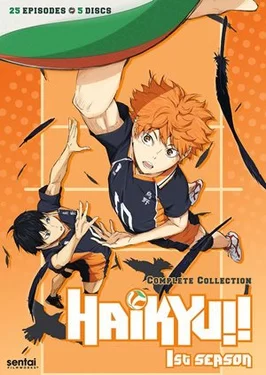
Based on Haruichi Furudate's manga, Haikyu!! premiered as a television anime in April 2014. Hinata is short for a front-row volleyball player but compensates with speed, timing and a willingness to pursue every ball. He joins Karasuno determined to become the next “Little Giant,” only to discover that the player who embarrassed his school team is now his teammate. Kageyama is technically gifted, but his insistence on control has damaged relationships before. Their partnership gives the story its opening tension, while Karasuno's broader squad turns it into something much more interesting than an unlikely star's ascent.
The Shelf · TV Series
Haikyu!!
Released 2014Curated by SPMA Hub because sport culture lives beyond the field.
Shoyo Hinata loves volleyball before he has a team capable of playing it properly. Haikyu!! begins with that mismatch, then places him at Karasuno High alongside Tobio Kageyama, the gifted setter who once defeated him. The series' great strength is that it treats a point as the outcome of many small decisions, not as a miracle performed by one unusually determined player.
The Shelf
The Gist
Why it caught our attention
The Details
Quick facts
- Format
- TV Series
- Released
- 2014
- Genre
- Drama

At A Glance
Shoyo Hinata loves volleyball before he has a team capable of playing it properly. Haikyu!! begins with that mismatch, then places him at Karasuno High alongside Tobio Kageyama, the gifted setter who once defeated him. The series' great strength is that it treats a point as the outcome of many small decisions, not as a miracle performed by one unusually determined player.

About This Shelf Item
About Haikyu!!
Volleyball is a particularly good subject for serialized team drama because the sport places strict limits on individual control. A setter cannot choose the quality of a reception, an attacker needs a well-timed ball, and a libero's contribution may be invisible to anyone watching only the final hit. Haikyu!! understands those dependencies. Hinata's jumping ability is spectacular, yet he cannot succeed simply by leaping higher. Kageyama must learn to tailor a set to the person receiving it rather than demanding that every teammate serve his preferred rhythm.
Other players give the show a sense of institutional memory. Karasuno is not an empty stage awaiting two newcomers; it is a school team with seniors, coaches, disappointments and habits that require negotiation. Rival schools have their own systems and perspectives. The best matches reveal a recognizable tactical argument—blocking choices, service pressure, the timing of a quick attack—so even a long rally has a clear sporting logic. The animation exaggerates the subjective intensity of a point without abandoning the underlying team mechanics. That balance explains why the programme can make a routine adjustment to positioning feel significant.

Why It Belongs
The Sport Connection
Haikyu!! is a useful fictional account of development pathways in school sport. Coaches and captains must balance individual ability with team chemistry, help players accept specialized roles and maintain a culture that survives the graduation of senior athletes. The series also reveals how a sporting identity can travel through media: Hinata is inspired by footage of an earlier Karasuno player, showing how visibility creates participation long before a school has resources to recruit a child. Its commercial success belongs to the broader interaction between manga, animation and sport fandom.

Our Recommendation
Why Watch Haikyu!!
Start with Hinata and Kageyama's early training before skipping to celebrated tournament episodes. Their initial inability to communicate gives later teamwork its meaning. The series is particularly valuable for readers interested in coaching, athlete development and how technical sport can be made accessible through storytelling. It does contain lengthy exchanges and dramatic pauses, conventions of its form. Those devices are usually in service of a precise question about what a player should do next.
Final Thoughts
Arash's Final Thoughts
Haikyu!! deserves its reputation because it refuses to confuse enthusiasm with competence. Hinata's love of volleyball matters, but the series makes him learn reception, communication and patience before that love can help a team. Its view of competition is generous toward opponents and specific about technique. Beneath the exaggerated intensity is an excellent account of how people learn to contribute to a system larger than themselves.
Keep Exploring
Similar TV Series on The Shelf








Stay in the loop
Follow SPMA
New jobs, interviews and sport-industry news in your feed.






Hiring now on Sports Hired
58225283 new jobs in sport this week
Teams, leagues, agencies and brands in Canadain the USAin Canada & the USA are hiring. Find your next role, or let new ones come to you.
3701,0541,424 open jobs3,8668,20712,073 organizations
Just posted
 Policy Analyst & Committee LeadSport, Physical Activity and Recreation Council (SPARC) · within Canada3 hrs ago
 Head Coach, Synchro 9 National TeamSkate Canada · Ottawa, ON3 hrs ago
 Analyst | AnalysteOttawa Rapid FC · Ottawa, ON4 hrs ago
 2027 Summer Camp InternFirst Tee · Richmond, VA6 hrs ago
 Triple-a Athletic TrainerDetroit Tigers · Toledo, OH7 hrs ago
 Development CoachHouston Astros · Houston, TX7 hrs ago
- Policy Analyst & Committee LeadSport, Physical Activity and Recreation Council (SPARC) · within Canada3 hrs ago
- Head Coach, Synchro 9 National TeamSkate Canada · Ottawa, ON3 hrs ago
- Analyst | AnalysteOttawa Rapid FC · Ottawa, ON4 hrs ago
Copied
