



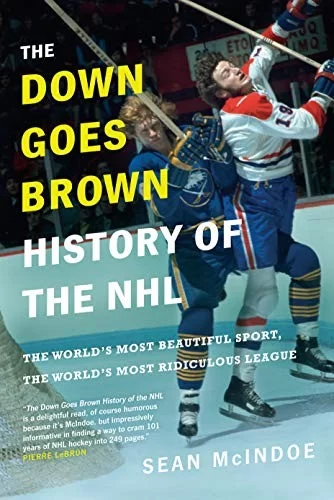
Published in 2018, the book draws on the voice associated with McIndoe's Down Goes Brown writing. It approaches a familiar institution through the parts that polished anniversary accounts tend to smooth out. Alongside the skill and emotion that make hockey compelling sits a record of organisational confusion. The point is not that the sport is a joke, but that loving it does not require pretending every chapter of its history was dignified.
The Shelf · Books
The Down Goes Brown History of the NHL
By Sean McIndoeReleased 2018Curated by SPMA Hub because sport culture lives beyond the field.
The Down Goes Brown History of the NHL treats hockey's past as something too interesting to leave entirely to official celebration. Sean McIndoe looks at the league's strange decisions, awkward episodes and enduring capacity to surprise its own supporters. The humour comes from close attention rather than distance: this is a fan's history written by someone who knows how often affection for the game survives frustration with the people running it.

The Shelf

The Gist
Why it caught our attention
The Details
Quick facts
- Format
- Book
- Author
- Sean McIndoe
- Published
- 2018
- Genre
- Non-Fiction
- Relevant Sport
- Hockey

At A Glance
The Down Goes Brown History of the NHL treats hockey's past as something too interesting to leave entirely to official celebration. Sean McIndoe looks at the league's strange decisions, awkward episodes and enduring capacity to surprise its own supporters. The humour comes from close attention rather than distance: this is a fan's history written by someone who knows how often affection for the game survives frustration with the people running it.

About This Shelf Item
About The Down Goes Brown History of the NHL
That distinction gives the book its particular tone. McIndoe can admire the game while making its authorities and traditions available for scrutiny. A strange episode becomes more than a chance to laugh when it reveals the assumptions behind a decision. History then looks less like a steady march toward the league supporters recognise and more like a series of choices whose consequences were not always understood by the people making them.
The author's visible attachment to the Toronto Maple Leafs is useful in this respect. He is not writing from a position of invulnerability, safely directing jokes at everyone else's disappointments. A supporter whose own team can become part of the joke demonstrates a more flexible form of loyalty. That makes it easier for the reader to enjoy the absurdities without treating every criticism as an attack on belonging.

Why It Belongs
The Sport Connection
For SPMA readers, the book offers an alternative entry into governance. A formal report can identify a weak process; a memorable historical fiasco can show how that weakness feels to players and supporters. Humour makes an incident accessible, but the underlying questions remain serious. Who had authority, what information was available and why did the organisation struggle to make a decision that later appears so obviously sensible?
It also invites thought about how leagues manage their own histories. An institution that admits only triumph leaves supporters to tell the more complicated stories elsewhere. Acknowledging mistakes can make heritage work more credible, provided the acknowledgement does not trivialise genuine harm. The balance is especially important in sport, where harmless eccentricity, poor planning and serious failures should not all be treated as interchangeable material for a funny anecdote.

Our Recommendation
Why Read The Down Goes Brown History of the NHL
The book suits established hockey followers who enjoy having half-remembered stories brought into a larger narrative. It can also welcome newcomers who find an official roll call of champions and records difficult to enter. A peculiar event gives a reader a reason to care about how the league operated. From there, the organisational setting becomes easier to follow because it is attached to a concrete and memorable problem.
Its comic perspective is a choice, so readers should not expect an evenly weighted institutional encyclopedia. The selection naturally favours episodes that reveal an oddity or puncture a proud assumption. That is part of the design rather than a hidden limitation. Reading it alongside more conventional hockey history can be productive, because the two approaches ask different questions about what deserves to be preserved and how the past should sound.
Final Thoughts
Alex's Final Thoughts
The Down Goes Brown History of the NHL earns its place by making scepticism compatible with devotion. McIndoe shows that a sport can be loved without being protected from laughter or historical embarrassment. For people working inside sporting organisations, that is a useful perspective to retain: supporters often notice the absurdity already, and taking their intelligence seriously can be a better response than insisting that every institutional choice was inevitable.
Related organizations


Keep Exploring
Similar Books on The Shelf








Same sport
More Hockey on The Shelf






Stay in the loop
Follow SPMA
New jobs, interviews and sport-industry news in your feed.






Hiring now on Sports Hired
6766133 new jobs in sport this week
Teams, leagues, agencies and brands in Canadain the USAin Canada & the USA are hiring. Find your next role, or let new ones come to you.
317315632 open jobs2,3043,6215,925 organizations
Just posted
 Content Creation InternSport Management Hub · Toronto, ON★ Featured
 Community Engagement & Events InternNiagara River Lions · Thorold, ON1 hour ago
 Basketball CoachElite Camps · Toronto, ON1 hour ago
 Director, FinanceFront Office Sports · New York, NY20 hours ago
 Staff Engineer, Balance and Ledger - CoreFanatics Betting & Gaming · New York, NY22 hours ago
 Game Day Operator (New Jersey)Brodie Rec League2 days ago
- Content Creation InternSport Management Hub · Toronto, ON★ Featured
- Community Engagement & Events InternNiagara River Lions · Thorold, ON1 hour ago
- Basketball CoachElite Camps · Toronto, ON1 hour ago
Copied
