




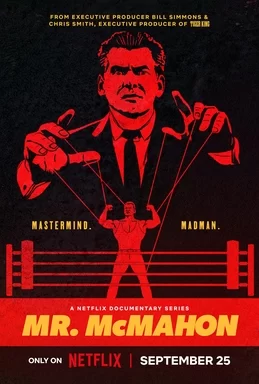
WWE's transformation into an international television and live-event property is impossible to explain without Vince McMahon. Yet making him the central figure can also obscure the workers, partners and rivals who helped build wrestling's modern marketplace. Chris Smith's Mr. McMahon, released by Netflix in September 2024, attempts to cover both the commercial history and the allegations that brought McMahon's leadership under intense scrutiny. The documentary was assembled from more than two hundred hours of interviews with McMahon recorded before his departure, as well as material from family members, industry figures and journalists. Its six episodes move through the national expansion of wrestling, television competition and controversies that blurred McMahon's public character with his real-life authority.
The Shelf · TV Series
Mr. McMahon
Mr. McMahon examines how Vince McMahon helped turn regional wrestling into a global entertainment empire while facing serious allegations and public controversy. Chris Smith's six-part Netflix documentary draws on extensive interviews with McMahon, wrestlers, associates and journalists. Its essential tension is between a remarkably influential business model and the people and institutions affected by the power behind it.
The Gist
Why it caught our attention
The Details
Quick facts
- Format
- TV Series
- Released
- 2024
- Genre
- Documentary
- Relevant Sport
- Wrestling

At A Glance
Mr. McMahon examines how Vince McMahon helped turn regional wrestling into a global entertainment empire while facing serious allegations and public controversy. Chris Smith's six-part Netflix documentary draws on extensive interviews with McMahon, wrestlers, associates and journalists. Its essential tension is between a remarkably influential business model and the people and institutions affected by the power behind it.

About This Shelf Item
About Mr. McMahon
The early chapters establish how local promotions were brought into a new business environment organised around television exposure, major events and marketable personalities. Subsequent episodes cover the Monday Night Wars, the Attitude Era and the wrestling storylines in which McMahon performed an authoritarian owner figure. The difficulty for a viewer is that professional wrestling routinely turns real tensions into fictional entertainment and fictional hostilities into public curiosity. The series uses that uncertainty as a recurring subject. Its later chapters turn toward wrestler safety, corporate expansion and the sexual misconduct allegations McMahon has faced. Those allegations must be described as allegations, with relevant denials and legal context preserved rather than presented as adjudicated findings. The production includes interviews conducted before some later developments, another reason to avoid treating it as the last word on the disputes it documents. Its value lies partly in showing how an institution became accustomed to its most powerful executive also being a central onscreen character.

Why It Belongs
The Sport Connection
The commercial history gives sports administrators a stark case study in vertical integration, media rights, talent contracts, brand control and executive governance. WWE's ability to own characters, build events and expand into new distribution channels created enormous value. The documentary also invites examination of power imbalances when performers depend on a dominant company for income, exposure and career opportunities. The allegations concerning leadership sharpen the distinction between a successful entertainment property and a healthy institutional culture. Corporate governance, board oversight, safeguarding and credible complaint procedures are not peripheral concerns just because an executive has produced strong financial results. The programme illustrates the risks of allowing an organisation's identity and authority to become concentrated in one individual.

Our Recommendation
Why Watch Mr. McMahon
The film is most useful when watched as both business history and a disputed account of personal conduct. Compare its archival footage of public personas with the interviewees' descriptions of private decision-making. Pay attention to which developments are documented through records and which depend on recollection. For sports management students, the series offers substantial material on media expansion and governance failures; for wrestling fans, it complicates familiar storylines by examining the organisation that produced them. It includes disturbing allegations and should not be treated as light nostalgia.
Final Thoughts
Arash's Final Thoughts
Mr. McMahon documents an industry whose commercial influence reached far beyond the wrestling ring. It shows how a founder's audacity could remake a market, while refusing to allow that achievement to settle questions about responsibility. The programme is not a legal verdict, and its access is not unrestricted truth. Its enduring value is the insistence that business success and the exercise of power must be examined together.
Related organizations

Keep Exploring
Similar TV Series on The Shelf











Same sport
More Wrestling on The Shelf





Stay in the loop
Follow SPMA
New jobs, interviews and sport-industry news in your feed.






7568143 new jobs in sport this week
Teams, leagues, agencies and brands in Canadain the USAin Canada & the USA are hiring. Find your next role, or let new ones come to you.
Just posted
 Digital Content & Social Media InternSport Management Hub · Toronto, ON★ Featured
 Senior Software Engineer, Bet EnginePENN Interactive · Remote2 hours ago
 High Performance Intern (Winter 2027)Rugby Ontario · Toronto, ON2 hours ago
 Player Development Associate (Arizona)San Francisco Giants · Papago, AZ17 minutes ago
- Account ExecutivePENN Interactive · Los Angeles, CA2 hours ago
 Baseball Operations Intern (Summer 2027)Royal Oak Leprechauns · Royal Oak, MI3 hours ago
- Digital Content & Social Media InternSport Management Hub · Toronto, ON★ Featured
- Player Development Associate (Arizona)San Francisco Giants · Papago, AZ17 minutes ago
- Account ExecutivePENN Interactive · Los Angeles, CA2 hours ago
