




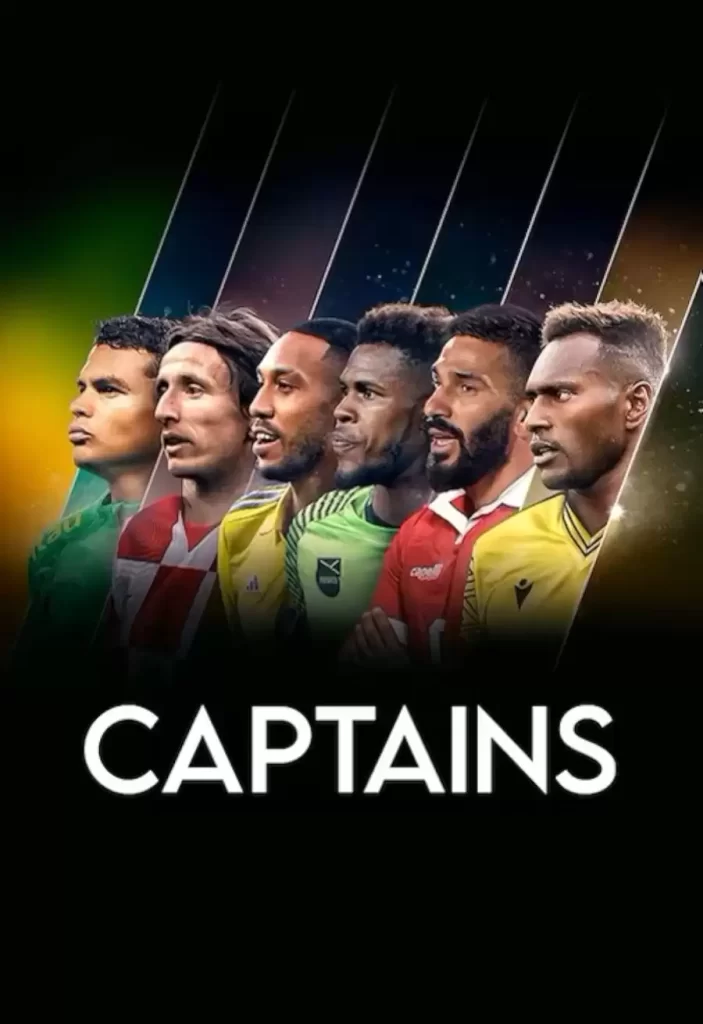
The captain's armband looks similar in every international match, but the job changes dramatically from one country to another. Captains, developed with FIFA+ and released on Netflix in 2022, follows six men's national-team leaders during qualification for the Qatar World Cup. The cast includes Croatia's Luka Modrić, Brazil's Thiago Silva and Gabon's Pierre-Emerick Aubameyang, along with Jamaica's Andre Blake, Lebanon's Hassan Maatouk and Vanuatu's Brian Kaltak. Their situations could hardly be less alike. Some play for established contenders with worldwide followings; others represent teams whose route to the tournament is shaped by fewer resources and far narrower margins. That contrast gives the series its structure.
The Shelf · TV Series
Captains
Released 2022Curated by SPMA Hub because sport culture lives beyond the field.
Captains follows national football leaders through the qualifying campaigns for the 2022 World Cup. Luka Modrić, Thiago Silva and Pierre-Emerick Aubameyang feature alongside captains whose countries face very different odds of reaching Qatar. The eight-part documentary reveals how much international football leadership depends on geography, national expectations and circumstances no player can control.
The Shelf
The Gist
Why it caught our attention
The Details
Quick facts
- Format
- TV Series
- Released
- 2022
- Genre
- Documentary
- Relevant Sport
- Soccer

At A Glance
Captains follows national football leaders through the qualifying campaigns for the 2022 World Cup. Luka Modrić, Thiago Silva and Pierre-Emerick Aubameyang feature alongside captains whose countries face very different odds of reaching Qatar. The eight-part documentary reveals how much international football leadership depends on geography, national expectations and circumstances no player can control.

About This Shelf Item
About Captains
The episodes repeatedly return to the fact that a captain does not control a national team's circumstances. Modrić carries the memory of Croatia's 2018 final and the pressure of proving it was not a one-off achievement. Silva must operate within Brazil's tradition of judging even convincing wins against an almost impossible standard of style. Aubameyang's Gabon faces a different calculation about qualification, while the programmes following Lebanon and Vanuatu widen the viewer's sense of the football world beyond the permanent television powers. The documentary's interviews and match coverage distinguish a captain's public role from the more fragile authority exercised among teammates. A captain can encourage, represent, negotiate and explain; they cannot guarantee tactical coherence, available players or a favourable draw. The best passages show leadership through those constraints, rather than as a motivational speech delivered before kickoff.

Why It Belongs
The Sport Connection
International football creates governance problems that do not arise in the same way at clubs. Players arrive from different employers, national federations control resources, travel and scheduling vary enormously, and a captain's words may be heard as representing a country rather than a dressing room. Captains makes those differences visible, particularly when a commercially prominent star competes alongside athletes working in less affluent football environments. The series also reflects FIFA's interest in marketing qualification as a global story, not merely a route to a final tournament. Viewers should recognise that an official production has its own institutional perspective even while valuing the access it provides.

Our Recommendation
Why Watch Captains
Watch episodes from different continents close together. The comparison highlights how camera time, staff support and national media scrutiny are distributed unevenly in the global game. The series works especially well for students examining federation management, player welfare, national identity and the limits of individual leadership. It is also a more revealing account of the World Cup cycle than a sequence devoted only to the teams that ultimately reached Qatar, because unsuccessful qualifying journeys contain their own consequential decisions.
Final Thoughts
Arash's Final Thoughts
Captains offers a broader definition of the armband than the usual television image of an athlete shouting instructions. Its subjects inherit histories, institutions and obligations that cannot be overcome through personality alone. The series is strongest when the distances between their situations remain visible, and when football's global appeal does not erase the unequal conditions in which it is played.
Related organizations

Keep Exploring
Similar TV Series on The Shelf








Same sport
More Soccer on The Shelf



Stay in the loop
Follow SPMA
New jobs, interviews and sport-industry news in your feed.






Hiring now on Sports Hired
7568143 new jobs in sport this week
Teams, leagues, agencies and brands in Canadain the USAin Canada & the USA are hiring. Find your next role, or let new ones come to you.
343321664 open jobs2,8676,2869,153 organizations
Just posted
 Digital Content & Social Media InternSport Management Hub · Toronto, ON★ Featured
 Senior Software Engineer, Bet EnginePENN Interactive · Remote2 hours ago
 High Performance Intern (Winter 2027)Rugby Ontario · Toronto, ON2 hours ago
 Player Development Associate (Arizona)San Francisco Giants · Papago, AZ17 minutes ago
- Account ExecutivePENN Interactive · Los Angeles, CA2 hours ago
 Baseball Operations Intern (Summer 2027)Royal Oak Leprechauns · Royal Oak, MI3 hours ago
- Digital Content & Social Media InternSport Management Hub · Toronto, ON★ Featured
- Player Development Associate (Arizona)San Francisco Giants · Papago, AZ17 minutes ago
- Account ExecutivePENN Interactive · Los Angeles, CA2 hours ago
Copied
