The Shelf · Movies

Jockey

Released 2021Curated by SPMA Hub because sport culture lives beyond the field.

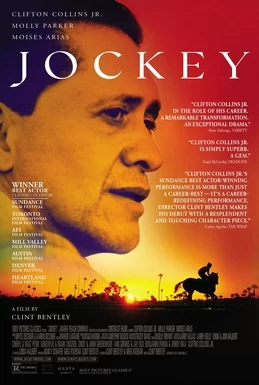
An aging horse-racing jockey reaches a career crossroads while a younger rider claims to be his son. The film's quietness conveys how difficult leaving a sporting identity can be when it has shaped an entire life. An aging rider's next mount offers less security than racing's glamorous public image suggests.

Arash Sayed
Covered by Arash Sayed
The Shelf
Jockey

The Gist

Why it caught our attention

Jackson's weakening body and precarious future stand in contrast to the fleeting exhilaration of the next mount.

The film's fictional racehorse world has a lived-in quality derived from its restrained performances and attention to working spaces. Jackson's age is visible in the way he moves and in his hesitation about what remains possible. His relationship with the young rider adds emotional uncertainty without turning the film into a neat family reconciliation. The drama is shaped around the fact that a job can define a person's entire sense of self while offering little security once the body can no longer perform it.

The Details

Quick facts

Format
Movie
Released
2021
Genre
Drama
Relevant Sport
Horse Racing

At A Glance

An aging horse-racing jockey reaches a career crossroads while a younger rider claims to be his son. The film's quietness conveys how difficult leaving a sporting identity can be when it has shaped an entire life. An aging rider's next mount offers less security than racing's glamorous public image suggests.

About This Shelf Item

About Jockey

Clifton Collins Jr's restrained performance and the film's understated stable atmosphere resist romantic racing glamour.

Jackson is an aging rider whose skills have survived longer than his body comfortably permits. The film moves through stables, tracks and modest living spaces with an economy that suits Clifton Collins Jr.'s restrained performance. A young man claiming to be Jackson's son creates another kind of uncertainty at a moment when the protagonist can no longer assume there will always be a next race. The result is a small, sad film about an occupation whose speed and glamour are mostly experienced by spectators, not by the people doing the work.

The film notices the daily routines of a working rider: the stable conversations, the effort to manage a deteriorating body and the knowledge that a younger competitor may soon take his place. Horse racing's glamorous public events are only a fraction of that life. Jackson's possible son introduces another form of responsibility that cannot be addressed through a winning ride. The spare storytelling makes room for uncertainty, which is often missing from films about athletes approaching retirement.

Why It Belongs

The Sport Connection

Jockey income volatility, occupational injuries and retirement transitions are central industry issues.

Jockeys take repeated physical risks for careers that may offer little long-term security outside the most successful ranks. Their income depends on mounts, owners and trainers, while injury can remove earning capacity immediately. Jackson's aging body makes retirement an urgent issue rather than an abstract pension discussion. The film's careful attention to working spaces is especially valuable: racing is an industry of early mornings, precarious labor and animals requiring constant care, even when the public sees only a brief burst of competition.

Our Recommendation

Why Watch Jockey

The film's quietness conveys how difficult leaving a sporting identity can be when it has shaped an entire life.

The film is deliberately small in scale. It rarely makes a dramatic announcement out of events that would be life-changing for someone whose earnings depend on remaining fit enough to ride. That refusal of spectacle is the reason to watch it: the physical cost of horse racing becomes visible in gestures, pauses and the ordinary uncertainty of the next morning.

Arash Sayed

Final Thoughts

Arash's Final Thoughts

Jockey is recommended for its quiet precision rather than a rousing racing finale. Clifton Collins Jr. makes the ordinary physical strain of the profession convincing, and the stable atmosphere gives the film an intimacy that grand horse-racing pictures often lack. Its sport-business relevance lies in what happens to a worker when the opportunities, income and identity attached to a dangerous job begin to narrow at the same time.