
The Shelf · Movies

Meru

Released 2015Curated by SPMA Hub because sport culture lives beyond the field.

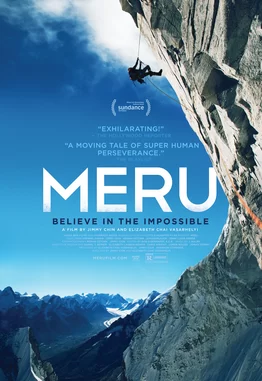
Meru follows three climbers pursuing a route that refuses to yield to reputation alone. Conrad Anker, Jimmy Chin and Renan Ozturk bring considerable ability to the Shark's Fin on Meru Peak, but the documentary makes their dependence on one another as important as their individual skill.

Alex Bennett
Covered by Alex Bennett
The Shelf
Meru
Meru
The Gist Of Meru

The Gist

Why it caught our attention

Released in 2015 and directed by Chin and Elizabeth Chai Vasarhelyi, the film centres on the team's attempts in the Indian Himalayas. The route demands a combination of alpine climbing, big-wall technique and aid climbing, placing different kinds of expertise within a single undertaking.

That mixture distinguishes the challenge from a simple race toward altitude. The mountain presents problems that must be solved in sequence, under conditions that make carrying equipment, resting and maintaining judgement part of the climbing itself. Technical versatility matters as much as a willingness to continue.

The Details

Quick facts

Format
Movie
Released
2015
Relevant Sport
Climbing

At A Glance

Meru follows three climbers pursuing a route that refuses to yield to reputation alone. Conrad Anker, Jimmy Chin and Renan Ozturk bring considerable ability to the Shark's Fin on Meru Peak, but the documentary makes their dependence on one another as important as their individual skill.

About This Shelf Item

About Meru

The team's earlier unsuccessful attempt gives the later expedition a history of unfinished work. Returning is not a fresh start in an emotional sense. It means revisiting decisions, remembering how close the objective appeared and asking whether the circumstances now justify another effort.

Anker's experience makes him an important figure of authority, but the film does not suggest that leadership removes vulnerability. Chin's role is similarly complicated by being both climber and filmmaker. He must participate in the undertaking while helping create the images through which others will understand it.

Ozturk's serious injury before the return adds another layer of uncertainty. Recovery is not merely a personal subplot when a team intends to enter a remote environment together. One person's condition affects the group's options, and trust must involve candid assessment rather than reassurance alone. These intersecting histories give the summit objective emotional weight without making it the only meaningful measure of what happens between the climbers.

Why It Belongs

The Sport Connection

Meru is a useful film about team selection because it shows why a collection of strong individuals is not automatically a functioning expedition. Partners need complementary skills, confidence in one another's judgement and a shared understanding of when to advance or retreat.

The return attempt also raises the problem of commitment to an unfinished goal. Previous investment can provide valuable knowledge, but it can also make withdrawal harder to contemplate. The film allows viewers to consider that tension without assuming that persistence is always wiser than stopping.

For sport leaders, the relevant question is how a team keeps honest communication possible when everyone cares deeply about the same outcome. The ability to express doubt may protect the group more effectively than a culture in which confidence is the only acceptable public emotion.

Our Recommendation

Why Watch Meru

The documentary's images are striking partly because they are made from within the expedition. They convey exposure and confinement in ways a distant overview could not. That proximity also reminds viewers that recording an extreme undertaking requires labour and attention from people already performing demanding tasks.

The personal histories broaden the climbing story rather than replacing it. Relationships, previous losses and recovery affect how each participant understands the mountain. The film is most rewarding when those elements are read as sources of different perspectives within a team, not as a collection of obstacles inserted to make a final achievement seem inevitable. The uncertainty remains important to the account.

The contrast between immense surroundings and cramped working space is particularly effective. Expedition scale does not prevent daily life from becoming a series of awkward, intimate negotiations.

Alex Bennett

Final Thoughts

Alex's Final Thoughts

Meru gives collaboration a physical seriousness. The climbers share equipment, decisions and consequences in a setting where the quality of their relationship has immediate practical effects. Its appeal lies in the combination of technical difficulty and human history, with neither fully explaining the other. For a sport-focused collection, it offers a strong case for examining leadership as responsibility among capable peers, and ambition as something a team must continually reassess rather than simply affirm.