
The Shelf · Movies

Hardball

Released 2001Curated by SPMA Hub because sport culture lives beyond the field.

Hardball begins with a coach whose reasons for showing up are anything but admirable. Conor O'Neill accepts a youth baseball job because he needs money, and the children on his team gradually force him to confront the difference between being present for payment and becoming someone they can trust.

Alex Bennett
Covered by Alex Bennett
The Shelf
Hardball
Hardball
The Gist Of Hardball

The Gist

Why it caught our attention

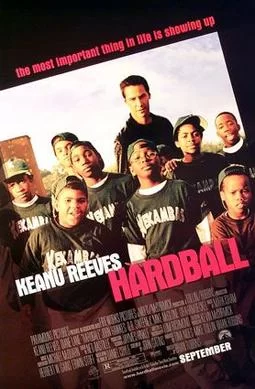
Brian Robbins's 2001 film stars Keanu Reeves as Conor, a gambler burdened by debt. He agrees to coach a team of boys from Chicago's ABLA housing projects in exchange for a weekly fee. Diane Lane plays their teacher, Elizabeth Wilkes, whose expectations provide a contrast to his unreliable approach.

The film draws from Daniel Coyle's book about youth baseball, while constructing a fictional dramatic story around Conor and the team. The baseball season supplies a clear framework, but the players' lives cannot be contained within the boundaries of their field or the optimism of a sporting turnaround.

The Details

Quick facts

Format
Movie
Released
2001
Genre
Comedy
Relevant Sport
Baseball

At A Glance

Hardball begins with a coach whose reasons for showing up are anything but admirable. Conor O'Neill accepts a youth baseball job because he needs money, and the children on his team gradually force him to confront the difference between being present for payment and becoming someone they can trust.

About This Shelf Item

About Hardball

Conor initially treats coaching as a temporary arrangement that will solve his own problem. That self-interest is important because the film does not begin with an adult already equipped to rescue anyone. The boys receive a coach whose personal conduct is unstable and whose willingness to stay is uncertain.

The team itself needs more than instructions about hitting and fielding. Players argue, react harshly to mistakes and face obstacles to participation. Conor's gradual attention to those details changes his involvement. He begins to see a collection of children with specific personalities rather than an obligation attached to a payment.

Young G-Baby, who is eager to belong despite being smaller than the others, gives that change a particularly affecting focus. His attachment to the team makes inclusion feel concrete. The question is not whether the programme can produce a future professional, but whether a child is allowed to share in its everyday life.

The film's violence prevents the season from functioning as a simple cure for the conditions around it. Baseball can create relationships and moments of joy without guaranteeing safety once practice ends. That painful limit is central to understanding the story, especially when its sporting progress begins to resemble a conventional success narrative.

Why It Belongs

The Sport Connection

Hardball offers a direct discussion of reliability in youth coaching. An adult's decision to quit may appear temporary or practical from his own perspective, while children experience it as another withdrawal of attention. Conor's growth matters when he begins to understand the meaning of his actions to people with less control over the arrangement.

The film also makes material differences visible. Uniforms, access to experiences and league decisions affect whether players feel they belong on equal terms. A programme cannot assume that enthusiasm will compensate indefinitely for being treated as an afterthought within its own competition.

There is an important limit to the adult-centred redemption story. The children's hardship should not be valued mainly because it helps Conor become a better man. Watching with attention to their relationships and vulnerability keeps the film's emotional stakes where they belong, rather than allowing the coach's transformation to absorb every other meaning.

Our Recommendation

Why Watch Hardball

Hardball is worth watching for the tension between the small good a team can accomplish and the larger problems it cannot solve. Reeves's uncertain, often uncomfortable coach gives the relationships room to develop through actions rather than instant authority. The players' humour also matters to the film's texture.

The story includes gambling, threats and the death of a child, so its youth-sport setting should not be mistaken for a light family film. Those elements are integral to its argument about the limits of the field as a protected space, not simply obstacles placed before a final game.

Alex Bennett

Final Thoughts

Alex's Final Thoughts

Hardball makes showing up a serious promise. Its most meaningful change is not that Conor learns how to win, but that he begins to understand why leaving would matter. The team offers connection and responsibility while the film refuses, at its hardest point, to pretend that sport can keep every danger outside.