The Shelf · TV Series

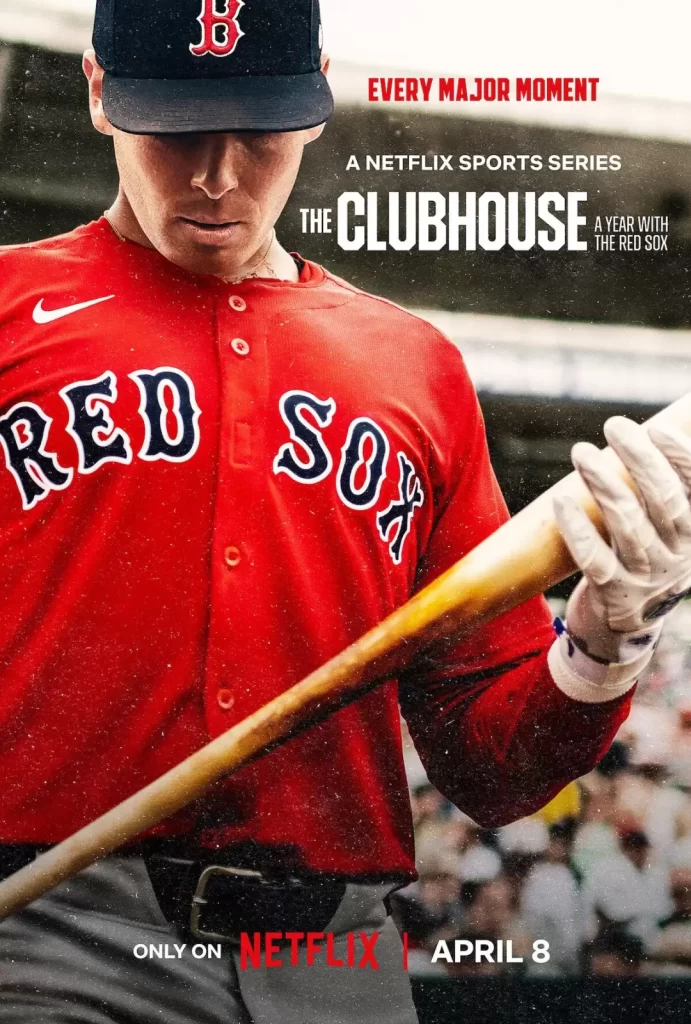
The Clubhouse: A Year with the Red Sox

Released 2025Curated by SPMA Hub because sport culture lives beyond the field.

The Clubhouse: A Year with the Red Sox finds its story in a season that refuses to become a championship fairy tale. Boston's 2024 campaign ends at an even 81 wins and 81 losses. The documentary's interest lies in the daily work and private consequences hidden inside that apparently unremarkable balance.

Alex Bennett
Covered by Alex Bennett
The Shelf
The Clubhouse: A Year with the Red Sox
The Gist Of The Clubhouse: A Year with the Red Sox

The Gist

Why it caught our attention

The eight-part series premiered in 2025 and was directed by Greg Whiteley. Cameras followed the Red Sox through the 2024 Major League Baseball season, entering a workplace shaped by the relentless rhythm of a 162-game schedule. The title points toward that shared working space rather than promising an account organised only around decisive highlights.

Boston's history makes the ordinary difficulties of a season unusually visible. Supporters know what the franchise has achieved and expect reasons to believe another successful period is taking shape. The players must perform inside those expectations while dealing with immediate problems that cannot always be understood through the larger language of organisational direction or competitive windows.

The Details

Quick facts

Format
TV Series
Released
2025
Relevant Sport
Baseball

At A Glance

The Clubhouse: A Year with the Red Sox finds its story in a season that refuses to become a championship fairy tale. Boston's 2024 campaign ends at an even 81 wins and 81 losses. The documentary's interest lies in the daily work and private consequences hidden inside that apparently unremarkable balance.


About This Shelf Item

About The Clubhouse: A Year with the Red Sox

The series follows players including Jarren Duran, Triston Casas, Brayan Bello, Wilyer Abreu and Masataka Yoshida. Their different positions and circumstances prevent the team from becoming a single emotional unit. Sharing a uniform and schedule does not mean experiencing the season in the same way, or needing the same kind of support from the people around them.

Baseball's repeated opportunities create a distinctive pressure. A difficult game is followed quickly by another chance, but the schedule also leaves little time to step outside the environment. Failure can be routine in statistical terms and still feel intensely personal. Understanding that difference is essential to appreciating the labour beneath a season-long line of numbers.

The even final record is useful because it resists a simplistic judgment of the people involved. It does not prove that the season lacked effort, development or meaningful individual performances. Nor does access to personal struggles make competitive evaluation unnecessary. The documentary holds those realities together by giving attention to lives that a standings table cannot explain.

Why It Belongs

The Sport Connection

For sport management, the strongest issue is the organisation of sustained performance. A long season requires more than occasional motivation. Communication, recovery and the handling of setbacks become repeated practices. An environment that works for one player may not work equally well for another, making attention to individual circumstances part of the operating task rather than an optional kindness.

The documentary also invites discussion of privacy inside a collective workplace. A clubhouse is shared by people whose public visibility varies and whose willingness to disclose personal experiences may differ. Filming can create understanding, but it changes the potential audience for a difficult conversation. Access should therefore be valued without assuming that more exposure is automatically better for every participant.

Boston's media environment adds another layer. Public discussion necessarily compresses a complicated season into clear judgments about effort, ability and the future. The series can complicate those judgments by showing how many separate experiences sit behind a team label. That does not make criticism illegitimate; it gives criticism a stronger reason to distinguish evidence from speculation about character.

Our Recommendation

Why Watch The Clubhouse: A Year with the Red Sox

The Clubhouse suits baseball viewers interested in daily professional life rather than only postseason achievement. Its bounded 2024 setting should not be confused with the separate documentary about Boston's celebrated 2004 comeback. This series offers a different proposition: a year can be worth examining closely even when it does not finish with the trophy that would make its narrative easiest to sell.

Alex Bennett

Final Thoughts

Alex's Final Thoughts

The final record tells viewers where the Red Sox finished, but not what the season required from the people who played it. The Clubhouse gives that distinction substance. Its most useful sporting insight is that routine, uncertainty and repeated recovery are not the empty spaces between memorable games; they are much of the professional career itself.