The Shelf · Books

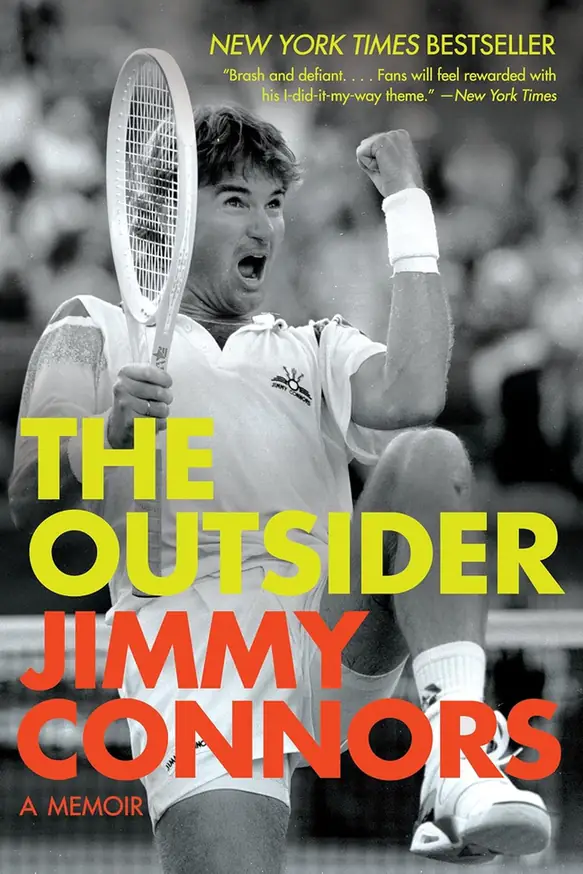
The Outsider: A Memoir

By Jimmy ConnorsReleased 2013Curated by SPMA Hub because sport culture lives beyond the field.

A Jimmy Connors match could feel like a dispute involving everyone in the stadium. The Outsider carries that confrontational energy onto the page, as the American tennis champion revisits the family who formed him, opponents who challenged him and private decisions that were harder to control than a return of serve.

Arash Sayed
Covered by Arash Sayed
The Shelf
The Outsider: A Memoir

The Gist

Why it caught our attention

Connors published The Outsider in 2013, looking back across a career that helped turn professional tennis into mass entertainment. The memoir moves between his East St. Louis upbringing, major rivalries and life beyond the tournament circuit. Its governing perspective is the player's own: proud, defensive, affectionate and often unwilling to leave an old argument alone.

That voice is part of the book's appeal. Connors does not present a polished institutional history of tennis. He describes what competition felt like from inside a personality built around resistance, making the memoir a revealing account of how an athlete explains himself after the crowds have gone.

The Details

Quick facts

Format
Book
Author
Jimmy Connors
Published
2013
ISBN
9780061243004
Relevant Sport
Tennis

At A Glance

A Jimmy Connors match could feel like a dispute involving everyone in the stadium. The Outsider carries that confrontational energy onto the page, as the American tennis champion revisits the family who formed him, opponents who challenged him and private decisions that were harder to control than a return of serve.

About This Shelf Item

About The Outsider: A Memoir

His mother, Gloria, and grandmother occupy an essential place in the story. Early instruction is inseparable from family conviction about his potential. The account gives the development of a champion a domestic setting, with tennis shaped by the people closest to him before it becomes a public profession.

On court, Connors recalls rivalries involving Bjorn Borg, John McEnroe and Ivan Lendl. These relationships help explain an era in which contrasting temperaments were part of the attraction. His 1991 US Open run adds a different perspective: an older player drawing on experience, crowd connection and stubborn competitive appetite against younger opponents.

Away from the matches, the memoir addresses marriage, gambling and the difficulties of retirement. Those subjects expose the limits of carrying a competitive personality into every part of life. The qualities that create a formidable opponent do not automatically produce a considerate partner or an easy transition after a career. The book is particularly revealing when the certainty of the on-court persona gives way to dependence on other people.

Why It Belongs

The Sport Connection

The Outsider gives sport marketers a vivid example of the commercial power of personality. Connors understood a match as an encounter with the crowd as well as the person across the net. Spectators could admire him, dislike him or change their minds during the same afternoon, but indifference was difficult. His account makes audience engagement feel like an athletic skill in its own right.

The implications for athlete representation are more complicated. A confrontational identity can attract attention while creating problems for officials, colleagues and the athlete's private relationships. This memoir offers material for separating the value of a distinctive public voice from the assumption that entertaining behaviour needs no boundaries.

Its family history also belongs in discussions of player development. Connors' early support was intensely personal, and his attachment to it remained part of his career. The book shows why a development pathway cannot be understood solely through tournament rankings and professional coaching appointments.

Our Recommendation

Why Read The Outsider: A Memoir

Tennis readers interested in the personalities behind the sport's expansion will find plenty to argue with and enjoy. Connors' account works best for an audience that welcomes a forceful narrator and wants to understand his version of events, including the contradictions.

It is also a revealing choice for people studying athlete identity and retirement. The man who could command a stadium still has to learn how to live when competition no longer structures every day. Those passages give the memoir a human dimension beyond its famous disputes.

Arash Sayed

Final Thoughts

Arash's Final Thoughts

The Outsider captures a champion who made opposition part of his identity. Its most interesting tension is whether a person can keep the fighting spirit that served him so well without turning every relationship into another contest. Connors provides no tidy resolution, and the unresolved edges are part of the portrait.