



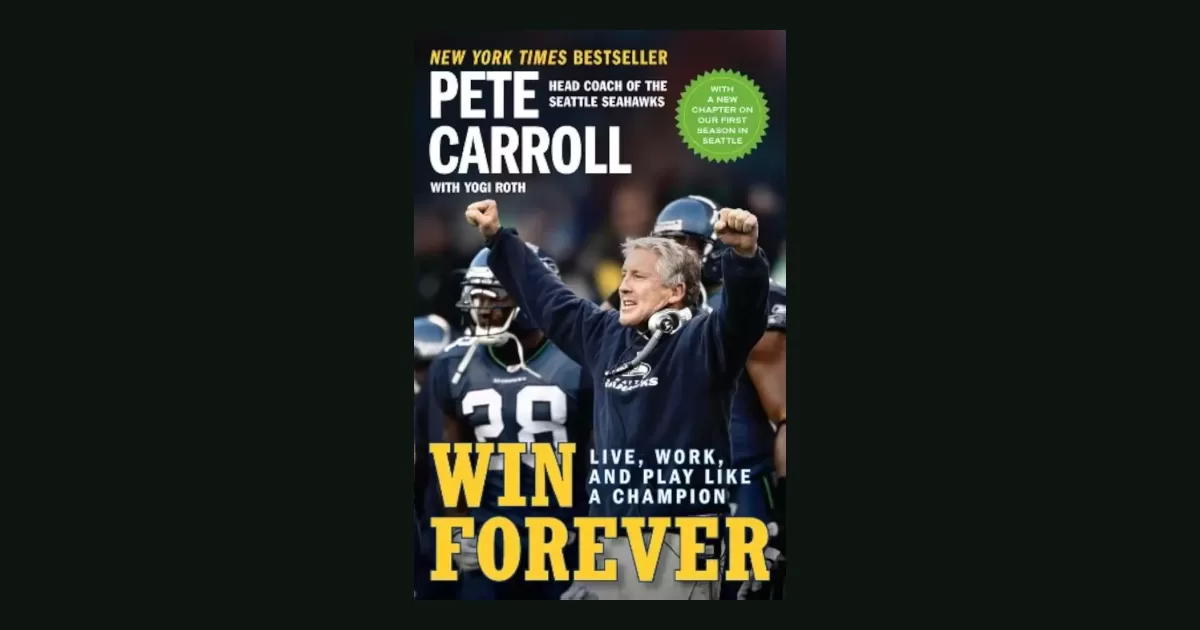
Football coaches often speak about building a culture without explaining what athletes should encounter in an ordinary practice. Pete Carroll tries to close that gap in Win Forever: Live, Work, and Play Like a Champion. The book was published in 2010, with contributions credited to Yogi Roth and Kristoffer A. Garin. It reflects Carroll's experience coaching at the University of Southern California and his broader career as he moved back into the NFL with the Seattle Seahawks. Carroll argues that competition can be a means of developing people rather than simply ranking them. That idea sounds straightforward until a staff must decide who receives an opportunity, how a mistake is handled or whether a player fits a particular role. The book becomes useful when those practical decisions are brought into view.
The Shelf · Books
Win Forever
Pete Carroll's Win Forever describes a coaching philosophy built around competition, energy and personal growth. Its most interesting question is whether a recognizable culture can be translated into everyday decisions across a major sports program.

The Gist
Why it caught our attention
The Details
Quick facts
- Format
- Book
- Author
- Pete Carroll, Yogi Roth & Kristoffer A. Garin
- Published
- 2010
- Genre
- Non-Fiction
- Relevant Sport
- American Football

At A Glance
Pete Carroll's Win Forever describes a coaching philosophy built around competition, energy and personal growth. Its most interesting question is whether a recognizable culture can be translated into everyday decisions across a major sports program.

About This Shelf Item
About Win Forever
Carroll's approach is associated with optimism, consistent messaging and a belief in helping athletes discover their competitive strengths. The philosophy developed in a high-profile college program, where the pressure to win is substantial and a roster contains players at different stages of maturity. A positive environment still requires boundaries, training demands and the possibility of losing a starting position. The book argues for a system in which those realities can exist alongside enthusiasm and personal relationships. An administrator should distinguish the principles Carroll advocates from the outcomes associated with one successful period. USC's football history also includes institutional controversies, so any discussion of program culture must allow room for oversight and accountability beyond a head coach's own narrative.

Why It Belongs
The Sport Connection
For staff development, Win Forever invites an examination of consistency. Athletes quickly notice when one coach praises competition while another punishes a player for taking reasonable risks. A technical director can translate a stated philosophy into hiring criteria, feedback standards and training design. New assistants should understand not only the slogans but also the kinds of behaviour the program rewards. At the same time, consistency does not require uniform personalities. Different athletes respond to different explanations, and a strong staff should adapt communication without abandoning principles. Carroll's emphasis on energy can be motivating, but it must not become an expectation that every participant appear cheerful or confident regardless of injury, stress or circumstances. Culture should make room for honest communication.

Our Recommendation
Why Read Win Forever
A useful question is how an organization knows whether its culture is working. A championship is visible, but it is not a complete measure of development. Managers should also consider retention, athlete feedback, trust in coaches and the experiences of people who are not central to a winning campaign. Carroll's account provides an opportunity to test the difference between a distinctive coaching brand and an institution able to sustain good practices when its leader leaves. Program leaders should document why routines exist, develop successors and allow qualified colleagues to challenge decisions. A culture owned entirely by one personality may become fragile. The book's value grows when readers ask what a team would need to preserve its best habits without depending on Carroll's energy in every room.
Final Thoughts
Arash's Final Thoughts
Win Forever is relevant to sport management because it makes coaching identity an organizational issue. Carroll offers a distinctive philosophy that links competition to learning and confidence. The best takeaway is not to imitate his mannerisms or assume positivity will overcome structural problems. It is to ensure that a program's stated values appear in practice design, feedback, staff selection and athlete support. A culture becomes meaningful when people can experience it consistently, including during difficult seasons.
Related organizations


Keep Exploring
Similar Books on The Shelf








Same sport
More American Football on The Shelf










Stay in the loop
Follow SPMA
New jobs, interviews and sport-industry news in your feed.






6872140 new jobs in sport this week
Teams, leagues, agencies and brands in Canadain the USAin Canada & the USA are hiring. Find your next role, or let new ones come to you.
Just posted
 Content Creation InternSport Management Hub · Toronto, ON★ Featured
 Marketing InternLUG Sports Group · Remote1 hour ago
 Sales & Business Development InternWager Chatter · Toronto, ON1 hour ago
 Inside Sales Representative (Seasonal Position)Myrtle Beach Pelicans · Myrtle Beach, SC1 hour ago
 Director, FinanceFront Office Sports · New York, NY21 hours ago
 Staff Engineer, Balance and Ledger - CoreFanatics Betting & Gaming · New York, NY23 hours ago
- Content Creation InternSport Management Hub · Toronto, ON★ Featured
- Inside Sales Representative (Seasonal Position)Myrtle Beach Pelicans · Myrtle Beach, SC1 hour ago
- Marketing InternLUG Sports Group · Remote1 hour ago
