The Shelf · Books

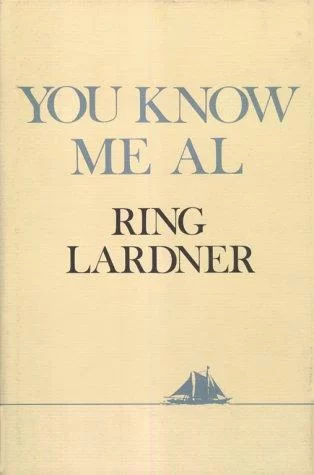
You Know Me Al

By Ring LardnerReleased 1916Curated by SPMA Hub because sport culture lives beyond the field.

You Know Me Al lets a young pitcher explain himself so enthusiastically that he repeatedly reveals what he cannot recognise. Ring Lardner turns Jack Keefe's letters into a sharp baseball comedy about confidence, money and the stories people tell to protect their pride.

Alex Bennett
Covered by Alex Bennett
The Shelf
You Know Me Al
You Know Me Al
The Gist Of You Know Me Al

The Gist

Why it caught our attention

Jack believes he is giving his friend Al a reliable account of his rise in professional baseball. The reader soon has reasons to doubt that confidence. His declarations of modesty arrive beside conspicuous boasting; his certainty about other people's motives frequently exposes his own misunderstanding. Lardner builds the comedy within the act of telling.

The effect depends on letting Jack keep talking. An external narrator does not need to interrupt and correct him. Details accumulate across the letters until the gap between Jack's interpretation and the situation becomes the main source of pleasure. Baseball provides an ideal environment for that collision between self-belief and evidence.

The Details

Quick facts

Format
Book
Author
Ring Lardner
Published
1916
Genre
Fiction
Relevant Sport
Baseball

At A Glance

You Know Me Al lets a young pitcher explain himself so enthusiastically that he repeatedly reveals what he cannot recognise. Ring Lardner turns Jack Keefe's letters into a sharp baseball comedy about confidence, money and the stories people tell to protect their pride.

About This Shelf Item

About You Know Me Al

Published in book form in 1916, You Know Me Al follows fictional pitcher Jack Keefe through letters addressed to his friend at home in Bedford, Indiana. His move from Terre Haute to the Chicago White Sox opens a world of contracts, travel, teammates and expectations that he believes himself ready to master.

An early salary negotiation establishes the pattern. Jack announces what he intends to demand, then presents the much less impressive arrangement he actually accepts as a satisfactory outcome. His account supplies the information needed to see through his conclusion. Lardner makes the reader work with the evidence Jack provides, rather than simply asking us to accept the judgement Jack attaches to it.

Why It Belongs

The Sport Connection

The novel's sporting interest lies partly in the unstable usefulness of confidence. A pitcher needs conviction to compete, but conviction can also obstruct learning. Jack's habit of explaining away difficulty protects him from embarrassment while limiting his ability to recognise what needs to change. The same personality trait can therefore support performance and undermine development.

His letters also expose the gap between belonging to a professional system and understanding how it operates. A new uniform does not confer negotiating skill, financial judgement or social awareness. Entry into elite competition can create the appearance of maturity before an athlete has acquired all the resources needed to manage the surrounding life.

That makes the book surprisingly productive for thinking about athlete communication. A self-authored account promises direct access, yet it remains a performance addressed to a particular audience. Jack wants Al to retain a certain view of him. The reader's task is to consider not only what happened, but what the storyteller needs the listener to believe about it.

Our Recommendation

Why Read You Know Me Al

Read You Know Me Al for the voice. Lardner's spelling, grammar and verbal habits are integral to the character, giving the letters a rhythm that polished paraphrase would destroy. The humour develops through repetition with variation: certainty meets experience, then finds a way to announce itself again.

The historical setting also deserves attention. These letters come from an earlier baseball world and contain period language and attitudes. Reading them carefully means noticing that setting without assuming every social detail maps neatly onto the present. The mechanisms of self-justification may feel familiar even when the surrounding conventions do not.

It is a particularly good Shelf choice for readers interested in fiction's ability to reveal more than its narrator understands. Jack is neither a reliable guide nor merely a target for easy mockery. His need to look capable gives the comedy a human foundation. The reader can recognise his evasions while also recognising why a young person entering an unfamiliar world might cling to them.

Alex Bennett

Final Thoughts

Alex's Final Thoughts

You Know Me Al turns baseball ambition into an enduring study of self-description. The results on the field matter, but Jack's explanations create another contest, between what he says and what his own evidence allows the reader to see. Lardner's achievement is to make that contest funny, revealing and inseparable from the specific voice carrying every letter.