




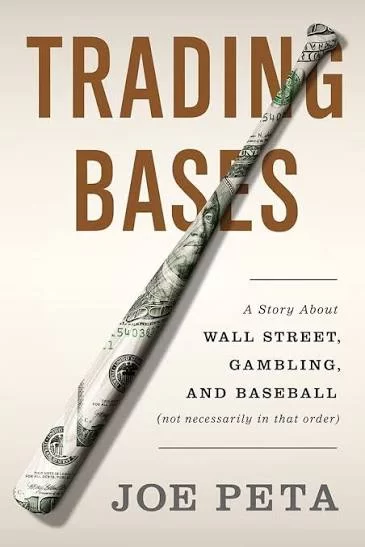
Wall Street trader Joe Peta came to baseball with skills shaped by markets, probability and the habit of scrutinizing assumptions. Trading Bases, first published in 2013, describes his attempt to apply those methods to Major League Baseball and to betting decisions. The premise sounds like a variation on the familiar analytics revolution, but the focus differs. Rather than asking how a club should acquire better players, Peta considers how a model can identify disagreement between estimated outcomes and prices offered by a market. The story includes his own experience and claimed results, which readers should understand as part of an autobiographical account rather than a promise that the same approach will work for them.
The Shelf · Books
Trading Bases
By Joe PetaReleased 2013Curated by SPMA Hub because sport culture lives beyond the field.
Joe Peta's Trading Bases connects baseball analysis with financial risk management, revealing both the appeal and the limitations of converting sport into probabilities.
The Shelf

The Gist
Why it caught our attention
The Details
Quick facts
- Format
- Book
- Author
- Joe Peta
- Published
- 2013
- Genre
- Non-Fiction
- Relevant Sport
- Baseball

At A Glance
Joe Peta's Trading Bases connects baseball analysis with financial risk management, revealing both the appeal and the limitations of converting sport into probabilities.

About This Shelf Item
About Trading Bases
Peta describes refining baseball estimates and treating wagers as decisions requiring a disciplined calculation of risk. His market background is visible in the attention paid to pricing, volatility and what happens when a plausible model encounters unpredictable events. Baseball offers abundant data and a long season, but that does not mean every variable can be measured with equal confidence. Injuries, managerial choices and contextual shifts can change the expected result of a game. The book also introduces the psychological challenge of separating a good decision from a favourable outcome. A correct forecast can fail on a particular night, while a poor method may look brilliant during a lucky streak. Good analysis requires keeping those possibilities separate.

Why It Belongs
The Sport Connection
The sports-management relevance is strongest in the treatment of uncertainty. Front offices rely on forecasts, but forecasts should never become unquestionable truths. A recruitment model, attendance projection or performance metric can be useful without being complete. Peta's approach invites leaders to compare probabilities with costs and to document their assumptions before the result is known. Risk management also involves deciding how much capital to commit when the downside is significant. In a sports organization, those resources may be wages, scouting time or facilities rather than betting stakes. The managerial challenge is the same: avoid mistaking confidence for certainty, and make room for new information that changes the assessment.
Forecasting a baseball season involves assigning confidence to uncertain events. Peta's trading background offered one set of techniques, but the value of his experiment lies partly in recognizing where sport differs from a financial market. Rosters change, injuries create abrupt breaks in information and teams may alter priorities as a season progresses. A model that performs well against last year's data may behave differently when conditions shift. That makes the book useful for anyone working with sports analytics, even without an interest in betting. Analysts should record their assumptions before outcomes are known and be willing to measure where predictions fail. The temptation to explain every missed projection after the fact can make a weak method appear stronger than it is. Club decision-makers face an additional challenge: turning probabilities into choices about people and resources, not simply wagers. The lesson is less about finding one perfect number than about improving the quality of decisions made under uncertainty.

Our Recommendation
Why Read Trading Bases
Readers interested in statistics, decision science and baseball culture will find an accessible account of applied quantitative thinking. The book is not a recommendation to gamble, and the existence of historical returns should not be used as evidence that a reader can reproduce them. The more productive lessons concern model validation, record-keeping and intellectual humility. When a manager produces a forecast, can someone else understand how it was built? Do mistakes prompt a revision or an excuse? What would count as evidence that the assumptions no longer hold? Trading Bases asks these questions through a vivid personal experiment rather than a lecture on regression equations.
Final Thoughts
Arash's Final Thoughts
Trading Bases earns a Shelf place by showing that numbers are valuable only when their users understand risk. Peta's baseball experiment is an entertaining window into analytical judgment. For sport managers, its lasting theme is the discipline of making decisions that remain explainable even when the outcome disappoints.
Related organizations

Keep Exploring
Similar Books on The Shelf









Same sport
More Baseball on The Shelf









Stay in the loop
Follow SPMA
New jobs, interviews and sport-industry news in your feed.






Hiring now on Sports Hired
55261316 new jobs in sport this week
Teams, leagues, agencies and brands in Canadain the USAin Canada & the USA are hiring. Find your next role, or let new ones come to you.
4342,0482,482 open jobs3,7257,74511,470 organizations
Just posted
 Digital Content & Social Media InternSport Management Hub · Toronto, ON★ Featured
 Game Day Assistant (Contract) / Assistant·e aux Opérations les Jours de MatchMontréal Victoire · Montréal, QC7 hours ago
 Head Coach, Varsity Blues FootballUniversity of Toronto Varsity Blues · Toronto, ON8 hours ago
 Spring and Summer 2027 InternshipsRochester Red Wings · Rochester, NY7 hours ago
 Golfnow Coordinator, Business SupportVersant · Orlando, FL9 hours ago
 Manager, Media PartnershipsTMRW Sports · Orlando, FL9 hours ago
- Digital Content & Social Media InternSport Management Hub · Toronto, ON★ Featured
- Game Day Assistant (Contract) / Assistant·e aux Opérations les Jours de MatchMontréal Victoire · Montréal, QC7 hours ago
- Spring and Summer 2027 InternshipsRochester Red Wings · Rochester, NY7 hours ago
Copied
