




The Formula 1 pit lane has its own hierarchy of celebrity. Drivers and team principals attract attention while mechanics make hundreds of adjustments that may never appear in a headline. Marc 'Elvis' Priestley worked for McLaren during the 2000s, and his 2017 memoir offers a view from among the people preparing cars, dealing with travel and carrying the pressure of performing flawlessly in public. The book includes the colour and excess associated with life on the circuit, but its strongest material concerns operational dependence. A pit crew is often judged by seconds, even though those seconds depend on preparation carried out when the cameras are elsewhere. There is no glamour in a correctly checked fitting until one fails.
The Shelf · Books
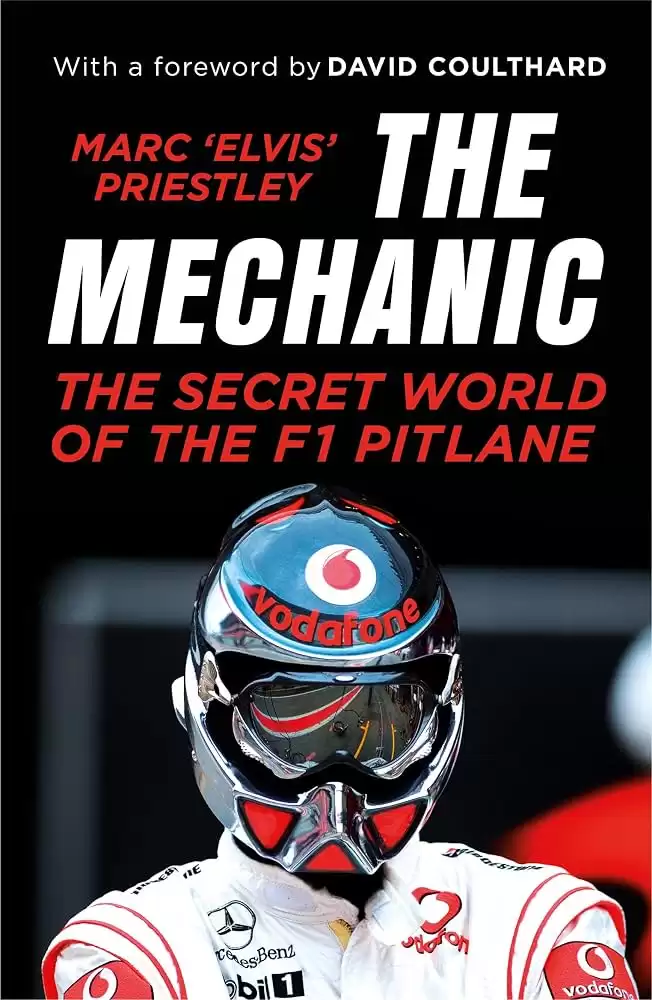
The Mechanic: The Secret World of the F1 Pitlane
By Marc PriestleyReleased 2017Curated by SPMA Hub because sport culture lives beyond the field.
Marc Priestley's The Mechanic explores Formula 1 from the working edge of the garage, where team culture and small mistakes can decide an expensive race.
The Shelf
The Gist
Why it caught our attention
The Details
Quick facts
- Format
- Book
- Author
- Marc Priestley
- Published
- 2017
- Genre
- Biography
- Relevant Sport
- Motorsport

At A Glance
Marc Priestley's The Mechanic explores Formula 1 from the working edge of the garage, where team culture and small mistakes can decide an expensive race.

About This Shelf Item
About The Mechanic: The Secret World of the F1 Pitlane
Priestley's account moves between racing weekends, team relationships and the distinctive social world of Formula 1. Working around prominent drivers and technical leaders does not erase the status differences within a large organization. Mechanics need accurate instructions, reliable supplies and the confidence to speak when something appears wrong. Their jobs demand physical stamina as well as technical knowledge, with travel and tight deadlines complicating everyday life. The book makes visible a set of professions whose contribution is rarely explained in a driver-focused biography. It also shows that a team's informal culture can be supportive and occasionally chaotic, a combination that managers should not romanticize simply because successful teams have endured it.

Why It Belongs
The Sport Connection
For sport managers, The Mechanic is a study of operational leadership under time pressure. A race weekend can expose poorly designed communication channels almost immediately. If an instruction is ambiguous, it must be clarified before the car leaves the garage, not debated after a failure. Safety procedures should not depend on whether a famous driver is impatient. The story also raises workforce questions: how much exhaustion can a high-performance environment absorb before errors become more likely? How should a team recognize specialist knowledge when the public credits the result to the people at the front? Organizations that treat support staff as replaceable risk losing the tacit coordination that makes routine tasks look effortless.
Pit crews operate under intense timing pressure, but their work depends on preparation that spectators almost never see. The car must be assembled correctly, tools placed consistently and duties assigned so that people do not have to improvise basic procedures during a race. Priestley's account offers a way to understand the relationship between specialist skill and collective reliability. A successful stop is the result of coordination across multiple functions; an error can occur even when every individual is highly capable. The same is true of maintenance decisions made under a narrow window between sessions. Managers must decide when to accept the time cost of inspection and when a planned change creates more uncertainty than the problem it is meant to solve. There is also a human question about accountability after mistakes. An environment that punishes the first person to report a problem may protect appearances while making subsequent failures more likely. Operational excellence requires a culture where precision and candour can coexist.

Our Recommendation
Why Read The Mechanic: The Secret World of the F1 Pitlane
The book is particularly useful for readers considering careers in team logistics, equipment, performance operations or technical support. It demonstrates why professionals are valued for judgement as well as for speed. A mechanic must know when an apparently small concern is worth stopping the process and how to communicate that concern without creating confusion. Priestley's candid personal voice may not resemble a formal management textbook, and his memories are one person's perspective on McLaren culture. That limitation is part of the reading experience. Treating his account as evidence of everyday pressures, rather than as a complete institutional history, reveals its practical strengths.
Final Thoughts
Arash's Final Thoughts
The Mechanic belongs on the Shelf because it makes supporting work central to the sporting achievement. Precision is not merely a driver's quality; it is a collective habit built into tools, routines and trust. Priestley's stories give a human face to the people whose best performances are often invisible.
Related organizations

Keep Exploring
Similar Books on The Shelf





Same sport
More Motorsport on The Shelf





Stay in the loop
Follow SPMA
New jobs, interviews and sport-industry news in your feed.






Hiring now on Sports Hired
74221295 new jobs in sport this week
Teams, leagues, agencies and brands in Canadain the USAin Canada & the USA are hiring. Find your next role, or let new ones come to you.
4001,6432,043 open jobs3,1826,7229,904 organizations
Just posted
 Digital Content & Social Media InternSport Management Hub · Toronto, ON★ Featured
 Event Operations & Fan Experience Crew (Game Day Staff Pool)Saskatoon Mamba · Saskatoon, SK1 day ago
 Chapter Director, First Tee – AlbertaGolf Canada · Edmonton, AB9 hours ago
 Assistant Athletic Trainer - BaseballUniversity of Iowa · Iowa City, IA9 hours ago
 General ManagerBrodie Rec League · Austin, TX19 hours ago
 Customer Marketing Coordinator, CommsFanDuel · New York, NY23 hours ago
- Digital Content & Social Media InternSport Management Hub · Toronto, ON★ Featured
- Assistant Athletic Trainer - BaseballUniversity of Iowa · Iowa City, IA9 hours ago
- General ManagerBrodie Rec League · Austin, TX19 hours ago
Copied
