




Plimpton's method is participatory reporting. Instead of observing football entirely from the sideline, he places his own body and limited ability inside its routines. The resulting experience gives familiar actions a new scale. Remembering an assignment, handling the ball and responding to movement are no longer things a viewer can discuss at leisure. They become tasks that must be performed quickly while other people expect the play to continue.
The Shelf · Books
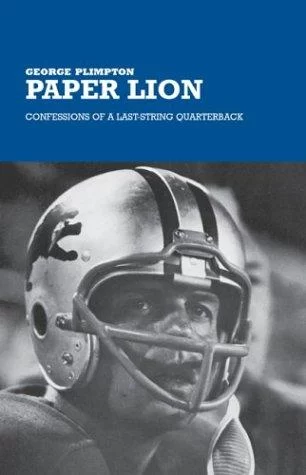
Paper Lion
By George PlimptonReleased 1966Curated by SPMA Hub because sport culture lives beyond the field.
Paper Lion begins with a sporting fantasy that becomes increasingly uncomfortable when placed inside an actual professional team. George Plimpton joins the Detroit Lions' training environment and attempts to function as a quarterback. His 1966 account uses the distance between the interested spectator and the trained athlete as its central source of humour, while making that distance more revealing than a simple series of comic failures.

The Shelf
The Gist
Why it caught our attention
The Details
Quick facts
- Format
- Book
- Author
- George Plimpton
- Published
- 1966
- Genre
- Non-Fiction
- Relevant Sport
- American Football

At A Glance
Paper Lion begins with a sporting fantasy that becomes increasingly uncomfortable when placed inside an actual professional team. George Plimpton joins the Detroit Lions' training environment and attempts to function as a quarterback. His 1966 account uses the distance between the interested spectator and the trained athlete as its central source of humour, while making that distance more revealing than a simple series of comic failures.

About This Shelf Item
About Paper Lion
That change in position is the book's most useful device. Television can make professional sport look legible because it gives the audience a clear view after the action has unfolded. The participant works with less certainty and much less time. Plimpton's limitations expose the difference. What seems obvious from a distance can become difficult to identify, let alone execute, when the observer is suddenly required to act as part of the system.
The Lions' training camp also gives him access to the social world around the work. Players share space, routines, jokes and the pressure of evaluation. Those details prevent the book from becoming only an account of physical inadequacy. The team is a community with its own language and expectations, and an outsider's presence can reveal habits that established members might have little reason to explain to someone who is merely passing through.

Why It Belongs
The Sport Connection
For SPMA readers, Paper Lion is valuable as an example of using experience to improve communication. Plimpton cannot become a professional quarterback through brief immersion, but he can discover which aspects of the job he previously misunderstood. That is an important distinction. A short encounter with a demanding role should produce better questions and greater respect for expertise, rather than the belief that participation has supplied the full authority of long practice.
The book also offers a corrective to casual judgement of athletes. A missed assignment may look like a simple error when viewed without the competing information and physical pressure of the moment. Understanding those demands does not mean suspending evaluation. It means making the evaluation more accurate. The observer can still ask why a play failed while recognising that the task was harder and the available time shorter than the broadcast perspective suggests.

Our Recommendation
Why Read Paper Lion
Readers who enjoy self-deprecating nonfiction will find the premise accessible even without deep knowledge of football. Plimpton makes himself part of the joke, which helps create an entry into a world that might otherwise feel closed to the general reader. The humour works best when it leads outward toward the players' skill and daily lives, allowing the failed experiment to become a means of seeing the professionals with fresh attention.
The method has limits that are worth keeping visible. Plimpton's access is unusual, and his temporary participation does not carry the same career risk as that of a player trying to earn a job. His perspective is therefore that of a privileged visitor, however physically exposed the experience may become. Acknowledging that difference strengthens the reading by separating what the experiment can reveal from what it cannot reproduce about professional insecurity and long-term commitment.
Final Thoughts
Alex's Final Thoughts
Paper Lion makes an outsider's inadequacy useful. Plimpton turns the gap between imagining a role and performing it into a lively account of football's complexity and social life. The book belongs on the SPMA shelf for its enduring reporting question: what might we understand better if we moved closer to the work, and what must we still avoid claiming simply because we have briefly been allowed inside?
Related organizations

Keep Exploring
Similar Books on The Shelf





Same sport
More American Football on The Shelf








Stay in the loop
Follow SPMA
New jobs, interviews and sport-industry news in your feed.






Hiring now on Sports Hired
43251294 new jobs in sport this week
Teams, leagues, agencies and brands in Canadain the USAin Canada & the USA are hiring. Find your next role, or let new ones come to you.
3571,0141,371 open jobs3,8128,01711,829 organizations
Just posted
 Digital Content & Social Media InternSport Management Hub · Toronto, ONFeatured
 Assistant/Associate Golf ProfessionalGlen Abbey Golf Club · Oakville, ON14 hours ago
 Physical Literacy Program LeaderPISE (Pacific Institute for Sport Excellence) · Victoria, BC19 hours ago
- Digital Content & Social Media InternSport Management Hub · Toronto, ONFeatured
 Summer InternFirst Tee · Charleston, SC8 hours ago
Copied
