




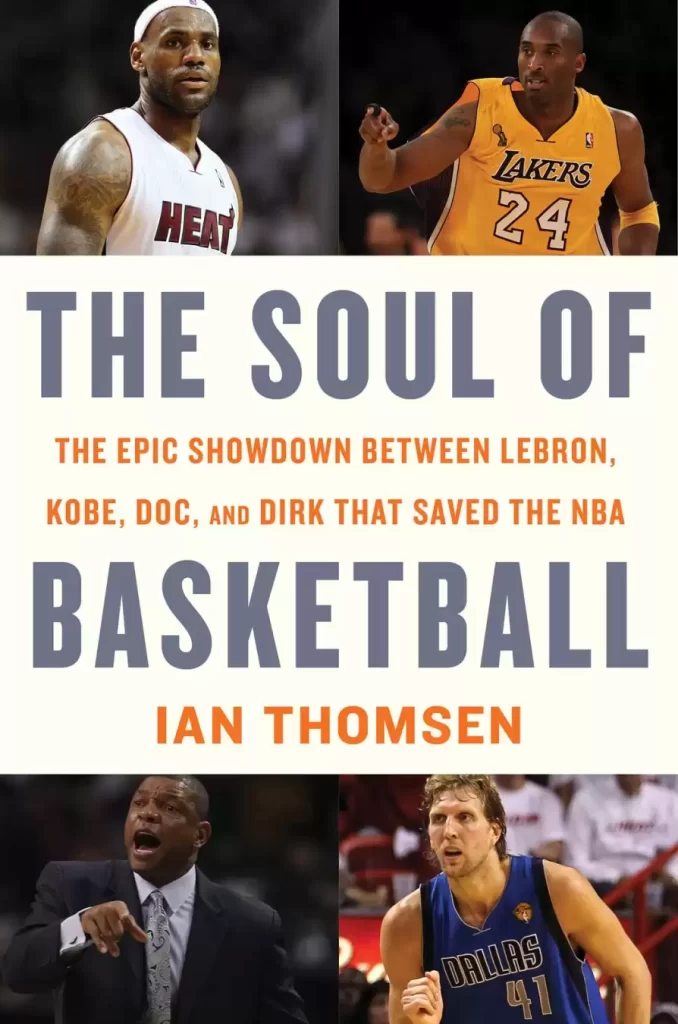
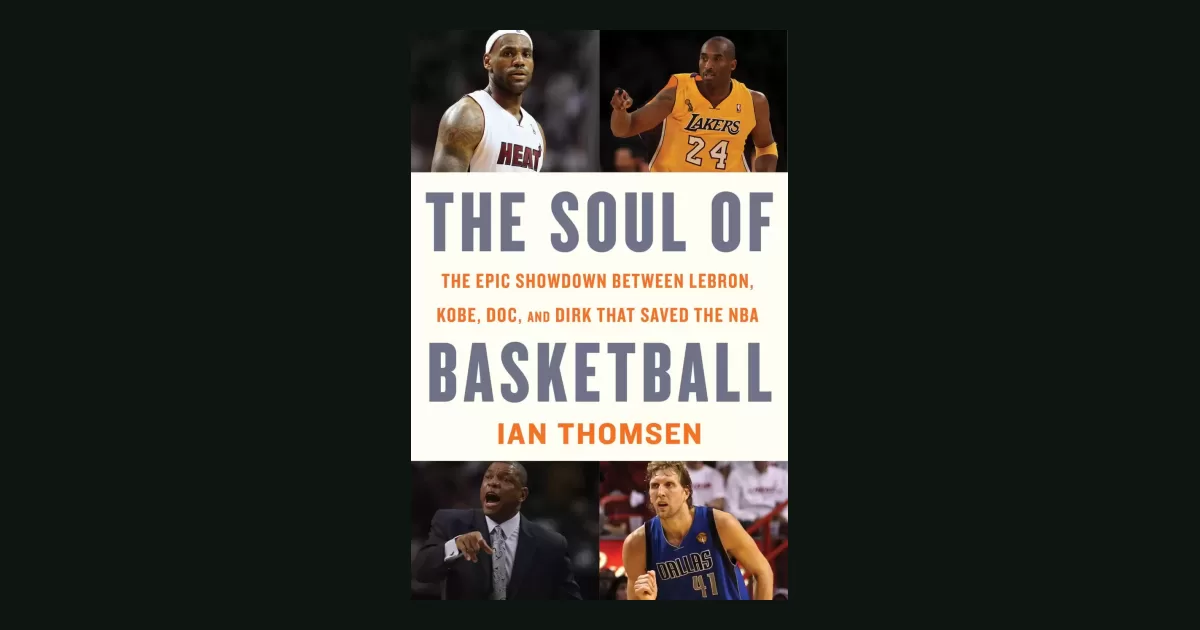
The decision that opens this story is already famous. LeBron James announced his departure from Cleveland for Miami on television in 2010, turning a player's career choice into a national referendum on loyalty, marketing and ambition. Ian Thomsen resists writing only about that spectacle. His 2018 book follows the subsequent season through James, Kobe Bryant, Doc Rivers and Dirk Nowitzki, showing different approaches to winning in a league becoming ever more visible and commercial. The Dallas Mavericks' championship provides an important counterpoint to the expectation that star power alone could arrange the ending. For someone interested in managing athletes and organizations, the fascination lies in what the participants expected from themselves and how those expectations changed inside a competitive environment.
The Shelf · Books
The Soul of Basketball
Ian Thomsen's The Soul of Basketball turns the NBA's turbulent 2010–11 season into a study of leadership, identity and the cost of converting individual stardom into a team.
The Gist
Why it caught our attention
The Details
Quick facts
- Format
- Book
- Author
- Ian Thomsen
- Published
- 2018
- Genre
- Non-Fiction
- Relevant Sport
- Basketball

At A Glance
Ian Thomsen's The Soul of Basketball turns the NBA's turbulent 2010–11 season into a study of leadership, identity and the cost of converting individual stardom into a team.

About This Shelf Item
About The Soul of Basketball
Thomsen's reporting moves among locker rooms, front offices and personalities who represent competing ideas of basketball success. Rivers is concerned with sustaining a collective identity in Boston; Bryant's career has already made him a demanding reference point for excellence; James carries the pressure of a newly assembled Miami roster; and Nowitzki challenges assumptions about the type of player who can lead a champion. These are not interchangeable personalities. Their different circumstances make the season a useful portrait of a league struggling with an old question in a new commercial setting: how much should basketball revolve around one recognizable person? The book gives the reader a way to consider the question without treating any single player's reputation as a complete answer.

Why It Belongs
The Sport Connection
Sports managers regularly inherit public narratives that can work against operational needs. A superstar's brand may be central to ticketing and media exposure, but coaching requires the player to accept responsibilities that are not designed for highlight reels. A front office must build a roster with enough variety to support its stars, while communications staff need to understand how one sentence can become part of a season's identity. The Soul of Basketball offers material for examining whether public certainty leaves room for private adaptation. James's Miami experiment illustrates the pressure to deliver immediately, while Dallas reminds readers that coherence, experience and decision-making can defeat a more loudly promoted structure. Neither lesson is a universal blueprint; the point is to interrogate the assumptions made before the games begin.
The Finals ending supplies an outcome, but the more interesting management work occurs before anyone knows the result. Miami's assembled stars had to learn what cooperation meant when each arrived with an established identity. Dallas, by contrast, could draw on roles, experience and an organization that had lived through earlier disappointment. Neither arrangement proves that one style of roster construction always wins. It shows why star acquisition is not the same as building a sustainable team. Thomsen's focus on perception also matters to executives. LeBron's televised departure became a story that shaped how every subsequent decision was interpreted, including the ordinary trial and error of a new playing relationship. The organization could not entirely control that story. In a modern club, communications, coaching and player support staff need to agree on what they will communicate without asking athletes to become flawless representatives of an invented public narrative. The distance between image and work is a recurring issue in professional sport.

Our Recommendation
Why Read The Soul of Basketball
The book is particularly interesting for people working in athlete relations, reputation management or team culture. It raises questions about leadership in an environment where every disappointment is interpreted as a verdict on character. How can coaches correct established stars without creating a public struggle for authority? When does a communications strategy help a team, and when does it impose expectations that the roster cannot yet satisfy? Thomsen's account should also be read with attention to its period. The digital sports conversation and the league's commercial structures have evolved since 2011. What remains useful is the close view of how organizations dealt with personalities whose fame extended beyond the institution employing them.
Final Thoughts
Arash's Final Thoughts
The Soul of Basketball is not simply a nostalgia piece about a memorable title run. It is a book about what professional basketball asks of people when their individual ambitions, collective obligations and public identities collide. That makes it a worthwhile Shelf entry for readers concerned with leadership rather than celebrity mythology.
Related organizations


Keep Exploring
Similar Books on The Shelf










Same sport
More Basketball on The Shelf







Stay in the loop
Follow SPMA
New jobs, interviews and sport-industry news in your feed.






43251294 new jobs in sport this week
Teams, leagues, agencies and brands in Canadain the USAin Canada & the USA are hiring. Find your next role, or let new ones come to you.
Just posted
 Digital Content & Social Media InternSport Management Hub · Toronto, ONFeatured
 Assistant/Associate Golf ProfessionalGlen Abbey Golf Club · Oakville, ON14 hours ago
 Physical Literacy Program LeaderPISE (Pacific Institute for Sport Excellence) · Victoria, BC19 hours ago
- Digital Content & Social Media InternSport Management Hub · Toronto, ONFeatured
 Summer InternFirst Tee · Charleston, SC8 hours ago
