




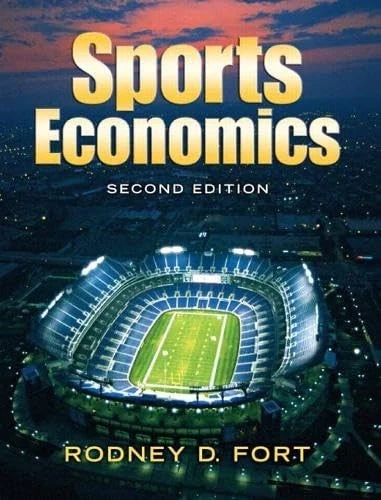
Sports Economics first appeared in 2003; the identified second edition was published in 2006. It is an economics textbook focused principally on professional team sport, with a section on college athletics. Fort uses demand, costs, market power and incentives to explain how the business operates. The progression begins with the industry's basic economic relationships before moving into broadcasting, team decisions, talent markets and government involvement. This is a useful structure because familiar debates about ticket prices, salaries or stadiums often begin at the point of disagreement. The book supplies concepts that help readers identify what is being exchanged, who has alternatives and which constraints influence each participant's choices.
The Shelf · Books
Sports Economics
Why do rival teams cooperate through a league, and why does a city pay to keep one? Rodney D. Fort's Sports Economics gives readers a framework for examining questions that sporting passion alone cannot answer. The book connects what happens in competition with the markets, bargaining arrangements and public choices that shape its conditions.
The Gist
Why it caught our attention
The Details
Quick facts
- Format
- Book
- Author
- Rodney D. Fort
- Published
- 2003
- ISBN
- 9780131704213
- Genre
- Non-Fiction

At A Glance
Why do rival teams cooperate through a league, and why does a city pay to keep one? Rodney D. Fort's Sports Economics gives readers a framework for examining questions that sporting passion alone cannot answer. The book connects what happens in competition with the markets, bargaining arrangements and public choices that shape its conditions.

About This Shelf Item
About Sports Economics
The league is a particularly interesting economic organisation. Its members compete against one another, yet they also require opponents and shared arrangements to produce a saleable competition. Fort's treatment of league structure and competitive balance gives readers tools for thinking about that interdependence. A rule that benefits an individual club may have different consequences for the competition as a whole.
The market for players introduces another set of relationships. Talent has value within an organisation that can turn sporting performance into revenue, while bargaining rules influence how that value is distributed. The book places player pay and labour relations alongside broadcasting and team profitability, allowing those subjects to be considered together. Its later treatment of subsidies, stadiums, taxation and competition policy brings public institutions into the analysis. A team's business decision can create demands on governments and communities that are not themselves participants in a league.

Why It Belongs
The Sport Connection
The text is especially relevant to the habit of making economic claims on behalf of sport. A proposed venue, expansion franchise or labour agreement will usually be accompanied by arguments about benefits and costs. Fort's framework encourages readers to ask who receives each benefit and who bears each cost, and to identify the comparison being used. The chapter sequence also demonstrates why one headline figure rarely settles a complex issue. Revenue, profit, public expenditure and competitive outcomes describe different things. Understanding their relationships helps a student evaluate an argument more carefully, even before reaching a judgement about whether a particular policy or investment is desirable.

Our Recommendation
Why Read Sports Economics
Sports Economics suits economics students using sport as an applied field and sport management students ready to work with economic reasoning. Fans interested in the institutions behind competition may also find it rewarding, provided they expect a textbook rather than a narrative history. The second edition's examples belong to its publication period, so the enduring attraction is the analytical method. Readers can ask how a newer case changes the assumptions or outcomes without confusing a historical rule or market condition with a current one. That makes the book useful for developing questions that remain productive even as leagues and their commercial arrangements evolve.
Final Thoughts
Arash's Final Thoughts
Fort's book makes the business of sport intelligible through relationships rather than isolated sums of money. Owners, players, broadcasters, spectators and governments respond to one another, and their decisions shape the competition visible on the field. The value of Sports Economics is the discipline it brings to examining those interactions. It invites readers to move from a strongly held sporting preference to an argument whose assumptions can be stated and tested, a necessary step whenever the decisions affect more people than the supporters of one team.
Keep Exploring
Similar Books on The Shelf











Stay in the loop
Follow SPMA
New jobs, interviews and sport-industry news in your feed.






43251294 new jobs in sport this week
Teams, leagues, agencies and brands in Canadain the USAin Canada & the USA are hiring. Find your next role, or let new ones come to you.
Just posted
 Digital Content & Social Media InternSport Management Hub · Toronto, ONFeatured
 Assistant/Associate Golf ProfessionalGlen Abbey Golf Club · Oakville, ON14 hours ago
 Physical Literacy Program LeaderPISE (Pacific Institute for Sport Excellence) · Victoria, BC19 hours ago
- Digital Content & Social Media InternSport Management Hub · Toronto, ONFeatured
 Summer InternFirst Tee · Charleston, SC8 hours ago
