




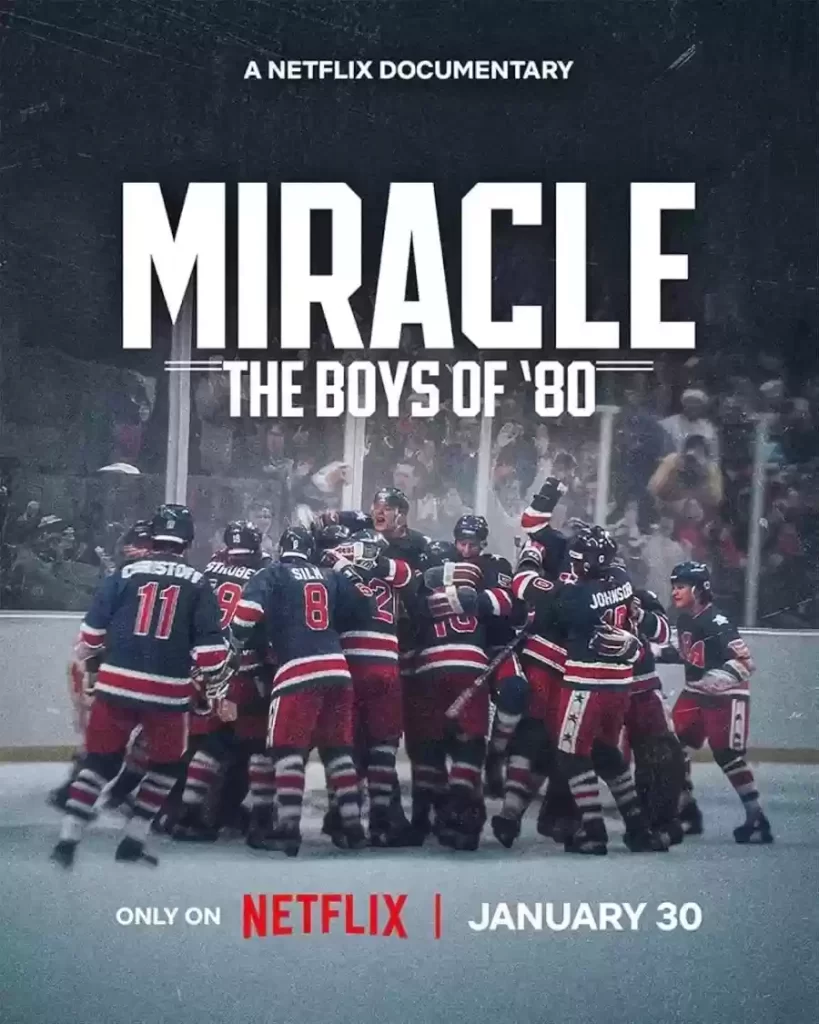
The part almost everyone remembers is February 22, 1980: the young United States hockey team beating the Soviet Union 4–3 at Lake Placid. The part that tends to vanish from retellings is February 24. The Americans still had to defeat Finland to win Olympic gold, and they trailed entering the third period before scoring three times to win 4–2. That second game is a good way into Miracle: The Boys of ’80, a Netflix documentary that promises new footage and reflections from people connected with the team. Once a sporting moment becomes a national myth, the ending is treated as inevitable and the people involved can disappear behind a slogan. The record of what happened on the ice is more difficult—and more compelling—than the slogan.
The Shelf · Movies
Miracle: The Boys of '80
Released 2026Curated by SPMA Hub because sport culture lives beyond the field.
A Netflix documentary revisits the 1980 U.S. Olympic hockey team through fresh footage and firsthand recollections, beyond the familiar Miracle on Ice headline.
The Shelf
The Gist
Why it caught our attention
The Details
Quick facts
- Format
- Movie
- Released
- 2026
- Genre
- Documentary
- Relevant Sport
- Hockey

At A Glance
A Netflix documentary revisits the 1980 U.S. Olympic hockey team through fresh footage and firsthand recollections, beyond the familiar Miracle on Ice headline.

About This Shelf Item
About Miracle: The Boys of '80
Herb Brooks assembled a roster built largely from college hockey, facing a Soviet side that had won the previous four Olympic titles. The mismatch was painfully clear in an exhibition just before the Games: the Soviets beat the U.S. 10–3. At Lake Placid, however, the Americans survived an opening tie with Sweden, beat Czechoslovakia and came through their remaining preliminary games to reach the medal round. Against the Soviets, Mark Johnson scored twice, Mike Eruzione put the Americans ahead in the third period and goaltender Jim Craig defended the lead. The win became the image of the tournament; the gold medal came only after the Finland comeback. Netflix calls its film a retelling with previously unseen material and firsthand accounts. That offers an opportunity to recover voices from beneath the mythology, although it does not guarantee that every familiar legend will be challenged by the finished film.

Why It Belongs
The Sport Connection
One management lesson is brutally practical: building a team is not the same as collecting the most celebrated individuals. Brooks needed players who could execute a system against opponents with formidable experience. That is not proof that chemistry always beats talent, a comfortable but false lesson often attached to underdog stories. Team selection, coaching, fitness, tactical discipline and an opponent’s errors all belong in an honest account. There is also the question of what happens after the medal ceremony. The athletes’ achievement became a piece of American cultural property, adapted for screens, commemorative events and sports-marketing campaigns. Every new retelling benefits from a recognizable ending, but the rights to photographs, interviews and archival footage belong to real people and institutions. Sports organizations handling their histories must balance the value of preservation with a participant’s right not to have his entire life compressed into one victorious night. The 1980 team presents both sides of that challenge unusually clearly.

Our Recommendation
Why Watch Miracle: The Boys of '80
Use the film to test the difference between an event and the story that later grows around it. It is easy, with hindsight, to describe Brooks’ preparation as a master plan destined to succeed. The athletes were not playing with hindsight. They had lost badly to the Soviets in the exhibition, and the USSR still had the talent to win when the teams met again. It is equally easy to make the Soviet game the end of the tale, even though the Finland result determined the medal. The documentary’s promised interviews may illuminate what the players remember about that uncertainty. A close viewing should pay attention to the balance between contemporary footage and later memory; both matter, but they answer different questions.
Final Thoughts
Arash's Final Thoughts
The Miracle on Ice survives because the achievement really was extraordinary. It does not need embellishment. Miracle: The Boys of ’80 is worthwhile as an opportunity to return to the players and the actual tournament rather than an inspirational catchphrase. Any judgment about what its editing adds must be made after seeing the complete documentary. The historical starting point is firm: the United States beat the Soviets, then beat Finland, and earned every part of its gold medal.
Keep Exploring
Similar Movies on The Shelf











Same sport
More Hockey on The Shelf












Stay in the loop
Follow SPMA
New jobs, interviews and sport-industry news in your feed.






Hiring now on Sports Hired
74273347 new jobs in sport this week
Teams, leagues, agencies and brands in Canadain the USAin Canada & the USA are hiring. Find your next role, or let new ones come to you.
4262,0232,449 open jobs3,7187,72711,445 organizations
Just posted
 Digital Content & Social Media InternSport Management Hub · Toronto, ON★ Featured
 Team Leader Swim LessonsYMCA of Greater Toronto · Scarborough, ON2 hours ago
 Sport Medicine PhysicianBrock University · St. Catharines, ON5 hours ago
 Athlete Highlight SpecialistBrodie Rec League · Seattle, WA14 minutes ago
 Lead Quantitative Analyst, On-Field StrategyPhiladelphia Phillies · Philadelphia, PA34 minutes ago
 Application DeveloperNational Football League (NFL) · New York, NY2 hours ago
- Digital Content & Social Media InternSport Management Hub · Toronto, ON★ Featured
- Athlete Highlight SpecialistBrodie Rec League · Seattle, WA14 minutes ago
- Lead Quantitative Analyst, On-Field StrategyPhiladelphia Phillies · Philadelphia, PA34 minutes ago
Copied
